
A dictionary value can be another dictionary
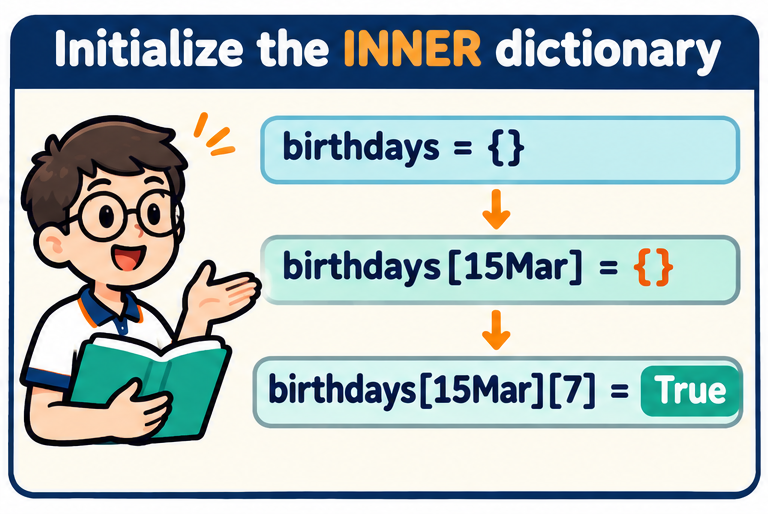
birthdays = {}
duplicates = {}
foreach X in scores {
    dob = normalizedDayMonth(X.DateOfBirth)
    id = X.CardNo
    if (isKey(birthdays,dob)) {
        duplicates[dob] = True
    }
    else {
        birthdays[dob] = {}
    }
    birthdays[dob][id] = True
}
birthdays[15 Mar] is now {7:True,21:True}. To find IDs, use keys(birthdays[15 Mar]). To ask whether ID 21 is in that date group, test isKey(birthdays[15 Mar],21). First check the outer date key before reading its inner dictionary.
The inner {} must be created only for a new date. Reinitializing it on every occurrence erases earlier IDs. With unique student records, the list and inner-dictionary versions identify the same students. If an ID is accidentally processed twice, a list retains the duplicate occurrence but an ID-keyed dictionary overwrites that ID’s True flag.
Try it yourself
What is the type of birthdays[15 Mar]?
Show explained answer
A dictionary whose keys are student IDs and values are True flags.
Try it yourself
What goes wrong if birthdays[dob]={} is executed for every record?
Show explained answer
It clears the existing group and loses earlier students at that date.
Try it yourself
Does an inner dictionary preserve repeated copies of the same ID?
Show explained answer
No. Each ID key has one current value. This differs from appending repeatedly to a list.