
Separate simple groups before comparing detailed profiles
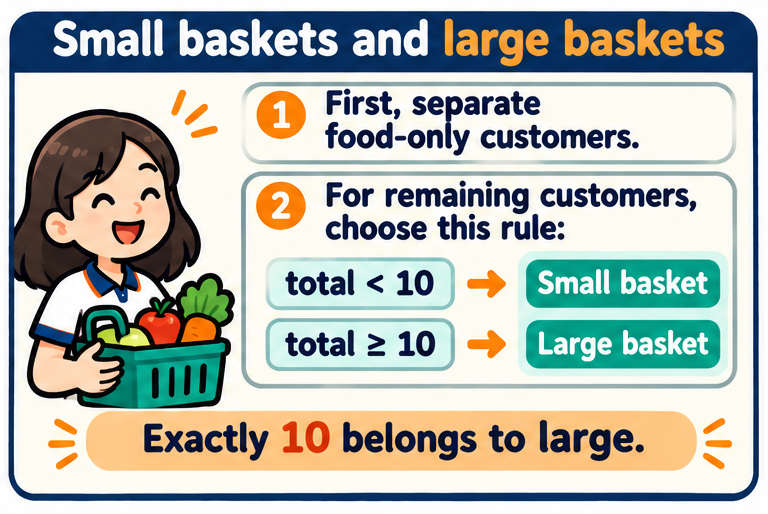
The lecture explores coarse bins before examining all profile differences. First set aside customers whose only observed category is Food: Akhil, George, Julia and Radha. Then divide the remaining customers by total rows. Spoken boundaries vary between “more than 10” and “10 and above”; we state one complete rule: below 10 is small, 10 or above is large. No original customer has exactly 10, so this boundary choice does not change this dataset’s groups.
The six large, multi-category profiles are Abhinav, Akshaya, Ahmed, Srivatsan, Advaith and Vignesh. They have totals 14,21,24,21,12,12. Grouping by total alone does not show that their category patterns match. These bins are an exploratory simplification, not an automatic clustering result.
Try it yourself
Does “food-only” mean one row?
Show explained answer
No. It means only one observed category, Food; Julia has six Food rows.
Try it yourself
Under our explicit rule, where does a multi-category total of 10 go?
Show explained answer
The large group, since 10 ≥ 10.
Try it yourself
Can two customers with the same total have different categories?
Show explained answer
Yes. Their rows may be distributed very differently across the five columns.