
Ready to begin
No records have been processed. Start with Next step.
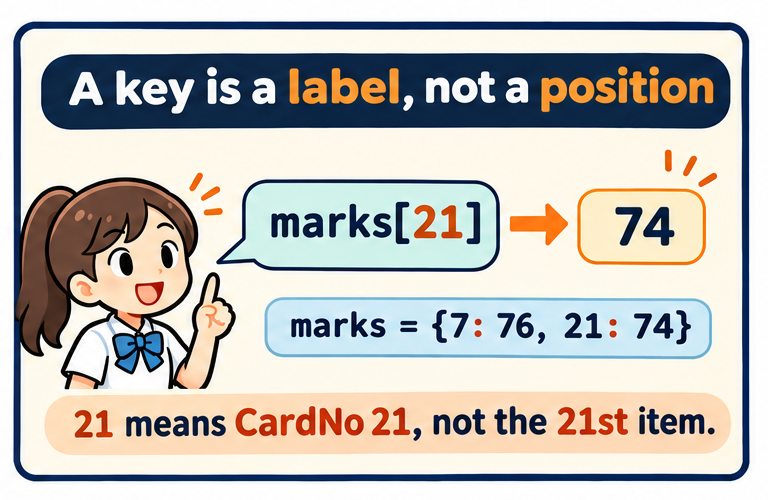
The dictionary {7:76,21:74} has two entries. Yet marks[21] is a valid lookup because 21 is a key. It does not request the 21st element. Similarly, CardNo 0 is a real student ID in the dataset; it does not mean “missing”.
Choose a unique key when you want one entry per student. Names can repeat. Two distinct students called Asha would collide in a name → mark dictionary. The later assignment would overwrite the earlier mark. IDs 101 and 202 avoid that problem in the constructed example below.
Follow the dictionary as its keys and values change. Predict each lookup or update before revealing the next step.
Ready
No records have been processed. Start with Next step.
Predict the next key, whether it already exists, and the value that will be stored.
Different keys are allowed to store the same value. Rida and Bhuvanesh both have Chemistry 78, but their CardNo keys 3 and 0 are different. Unique KEYS do not imply unique VALUES.
Does marks[21] require at least 21 dictionary entries?
No. It requires the key 21 to exist.
Can {101:70,202:70} be valid?
Yes. The keys differ; equal values are allowed.
Why can names lose information?
If two records share a name, assigning by that name replaces the first value. Use unique IDs or deliberately group multiple IDs under a name.