
SECTION 13 / 31
Store the IDs who share each birthday
birthdays = {}
duplicates = {}
foreach X in scores {
    dob = normalizedDayMonth(X.DateOfBirth)
    id = X.CardNo
    if (isKey(birthdays,dob)) {
        duplicates[dob] = True
        birthdays[dob] = birthdays[dob] ++ [id]
    }
    else {
        birthdays[dob] = [id]
    }
}
foreach dob in keys(duplicates) {
    sharedIDs = birthdays[dob]
}
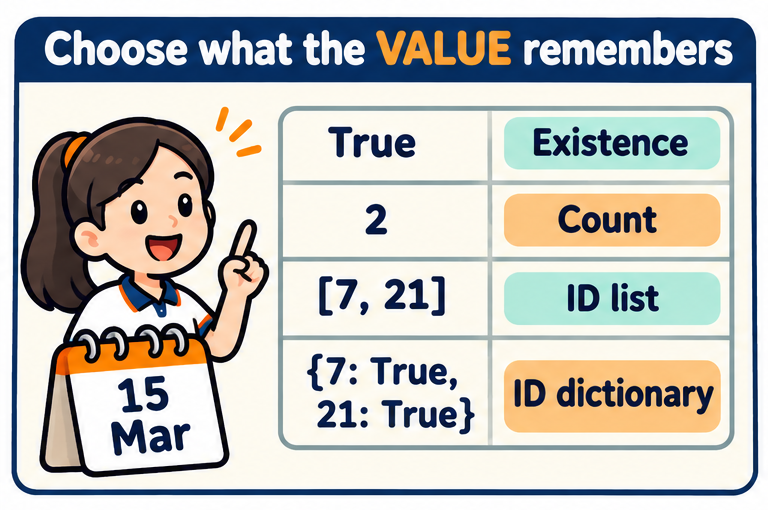
On Aditya’s card, birthdays[15 Mar] becomes [7]. On Monika’s card it becomes [7,21]. Here length(birthdays[15 Mar]) is 2, while length(keys(birthdays)) is 29 after the full scan. One counts students at a chosen date; the other counts observed dates.
Try it yourself
Why append [id] rather than id?
Show explained answer
++ concatenates lists, so wrap the new ID in a one-element list.
Try it yourself
Does birthdays[dob]=[id] on every card retain all students?
Show explained answer
No. It replaces earlier lists. Append on existing keys.
Try it yourself
What does birthdays[15 Mar] return here?
Show explained answer
The whole ID list [7,21], not one ID and not just a Boolean flag.