
Close pairs do not automatically form one close group
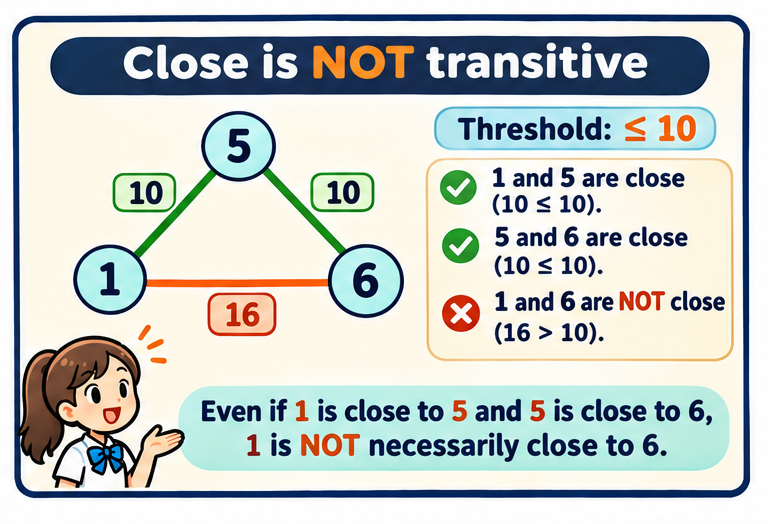
With close defined as distance ≤10, the qualifying pairs are 1–2 (7), 1–5 (10) and 5–6 (10). But the candidate group {1,5,6} contains a distant pair 1–6 (16). A chain of close links and a group in which every pair is close are different group rules.
Specify whether the threshold is < or ≤. The lecture notes one distance below 10: 1–2. Our lab makes the alternative inclusive threshold explicit so the two distances equal to 10 can be explored. A distance table alone does not decide a unique clustering.
These profiles summarize a small set of observed purchases. One urgent purchase or a single bill may not describe a lasting habit. The lecture’s examples of possible customer types are hypotheses, not facts about families or personal characteristics derived from these bills.
Try it yourself
If A is close to B and B to C, must A be close to C?
Show explained answer
No. The example 1–5–6 disproves that for the distance≤10 rule.
Try it yourself
How many of the six-customer pairs have distance strictly below 10?
Show explained answer
One: Abhinav–Akshaya, distance 7.
Try it yourself
Does a table of distances specify how to cluster every customer?
Show explained answer
No. A grouping rule and its parameters must still be chosen.