
First choose the unit: item rows, quantities or money
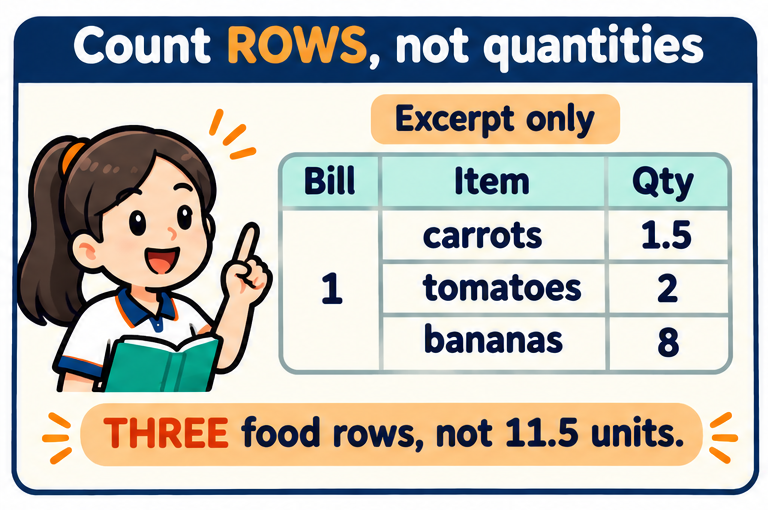
A bill item row represents one listed product entry. The quantity column says how much of that product was purchased. Price × quantity gives the row cost. These are different measurements. The lecturers initially explore quantities, then explicitly switch to counting ROWS because mixing kilos, packets and individual pieces is unclear.
| Bill 1 excerpt | Quantity | Contribution to Food row count |
|---|---|---|
| Carrots | 1.5 | 1 |
| Tomatoes | 2 | 1 |
| Bananas | 8 | 1 |
| Excerpt total | Do not mix these units | 3 rows |
The full Bill 1 has seven rows: five Food, one Toiletries and one Apparel. The illustration is only a three-row excerpt. Across all 30 original bills there are 155 item rows, of which 97 are Food under the stated broad-category map. We keep row names and original category labels so these counts can be checked.
Try it yourself
A single bananas row has quantity 12. How much does it add?
Show explained answer
One Food row under this task’s unit.
Try it yourself
Does a bill with five food rows represent five separate bills?
Show explained answer
No. It is one bill with five qualifying item rows.
Try it yourself
Can the Food row maximum identify the highest spender in rupees?
Show explained answer
No. The count does not use prices or costs. A money-based question needs a separate sum.