
Create on the first visit; accumulate on later visits
runs = {}
foreach scoreRow in matchRows {
    player = scoreRow.Player
    if (isKey(runs,player)) {
        runs[player] = runs[player] + scoreRow.Runs
    }
    else {
        runs[player] = scoreRow.Runs
    }
}
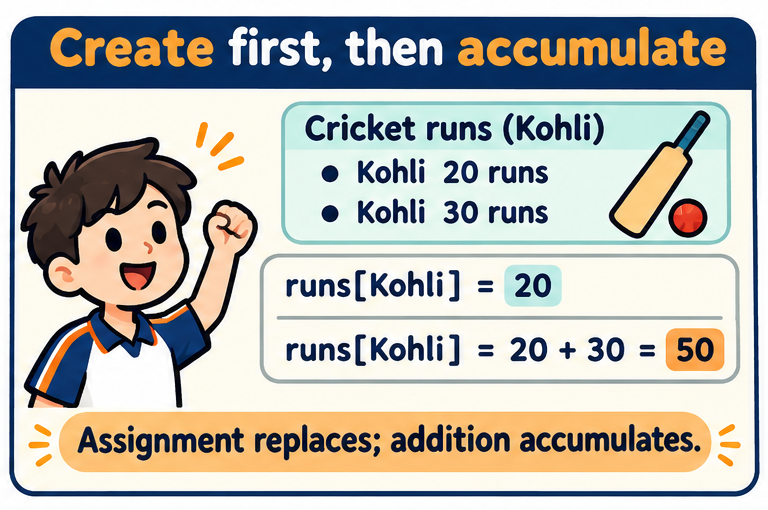
For Kohli’s first illustrative 20, create runs[Kohli]=20. For a later 30, read 20 and replace it with 20+30=50. Writing runs[Kohli]=30 would erase the earlier total. Writing runs[Kohli]=runs[Kohli]+20 before the key exists would read an absent value.
The course assumes direct dictionary lookup, update and built-in isKey take constant time. “Random access” means direct access by a key; it does not mean choosing a random key. The lecture’s manual isKey scans keys(D), sets found=True on a match and uses exitloop. That manual version can inspect every key, so it is linear in the number of keys. Keep the assumed built-in and the demonstration scan separate.
Procedure manualIsKey(D,k)
    found = False
    foreach candidate in keys(D) {
        if (candidate == k) {
            found = True
            exitloop
        }
    }
    return(found)
End manualIsKey
These are the course’s abstract data-structure assumptions. Real languages can implement lists and dictionaries differently. Iterating over every key still costs work for every entry; a constant-time lookup does not make a whole scan constant time.
Try it yourself
A dictionary already stores runs[A]=20. What does runs[A]=30 leave?
Show explained answer
30. To accumulate a new 30, assign runs[A]=runs[A]+30, giving 50.
Try it yourself
Does manualIsKey prove dictionary lookup is constant time?
Show explained answer
No. It is a correct linear search demonstration. The efficient built-in isKey is an assumed primitive.
Try it yourself
If there are m keys and a key is missing, how many candidates can the manual search inspect?
Show explained answer
All m keys. Only then can it report absence.