
Ready to begin
No records have been processed. Start with Next step.
Follow the dictionary as its keys and values change. Predict each lookup or update before revealing the next step.
Ready
No records have been processed. Start with Next step.
Predict the next key, whether it already exists, and the value that will be stored.
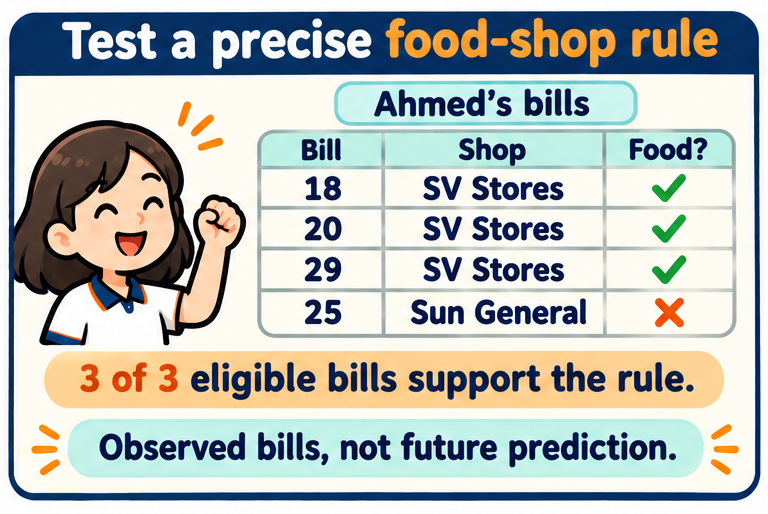
A vague statement such as “top food buyers shop at the top food shop” needs a rule. We test one explicit all-bills version: for the selected customer, EVERY observed bill containing at least one Food row must be from a shop tied for highest total Food rows. First compute top shops from the full dataset. Then inspect the selected customer’s saved bill IDs.
Ahmed’s Food bills 18,20,29 all come from SV Stores, so his three eligible bills support that rule. Bill 25 is from Sun General but contains no Food rows, so it is excluded. Akshaya has Food bills 3,5,21: Bill 5 comes from Big Bazaar, so the ALL-bills rule fails for her. Abhinav has one eligible Food bill, Bill 11 at SV Stores.
“Usually” could instead mean a majority of Food bills, a majority of Food rows, or a majority of Food spending. Those are different denominators and different hypotheses. Choose before checking. For a selected customer with no eligible Food bill, report “no eligible evidence”; do not call it observed support just because there is no counterexample.
Why is Ahmed’s Bill25 excluded?
It contains no Food rows, so it is irrelevant to this explicitly food-bill-based rule.
Does one counterexample reject an every-eligible-bill rule?
Yes. Akshaya’s Food-containing Big Bazaar bill is a counterexample.
Does Ahmed’s result prove future shopping behavior?
No. It describes the supplied observed bills under the chosen rule.