
Ready to begin
No records have been processed. Start with Next step.
Follow the dictionary as its keys and values change. Predict each lookup or update before revealing the next step.
Ready
No records have been processed. Start with Next step.
Predict the next key, whether it already exists, and the value that will be stored.
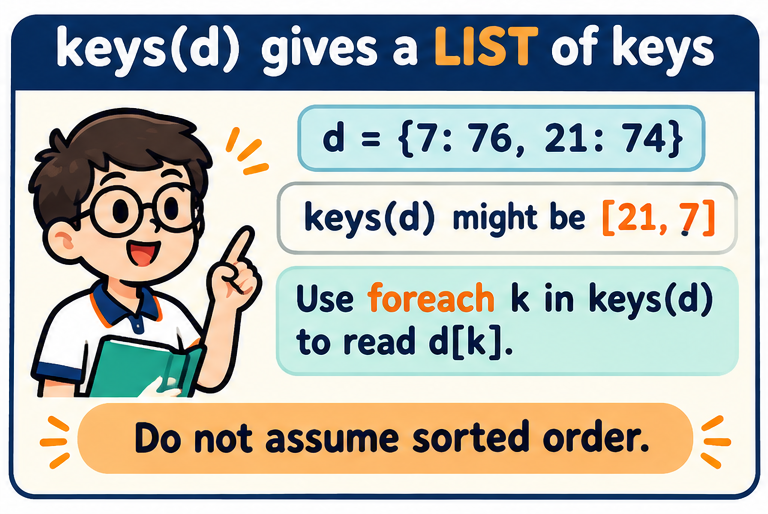
foreach k in keys(d) {
    value = d[k]
    # use k and value
}
Do not assume dictionary keys come out in the order they were inserted, in number order, or in alphabetical order. Our visual table chooses a readable display order; that is not a pseudocode guarantee. If a task needs sorted keys, extract keys(d) and sort that LIST using an explicit comparator.
The resulting list of keys lets you use familiar list operations. length(keys(d)) counts distinct entries. It does not count all original records if several records were accumulated under the same key.
If d={Chennai:8,Madurai:5}, what does length(keys(d)) count?
Two city keys. It does not report the 13 student records represented by those values.
Can summing all dictionary values depend on key order?
For these exact integer counts, no. Each value contributes once regardless of order.
Does a displayed row order prove keys(d) is sorted?
No. It is only a display choice unless the algorithm explicitly sorts the key list.