
Ready to begin
No records have been processed. Start with Next step.
Follow the selected procedure. Change a field, tie rule or weekday and explain why the result changes.
Ready
No records have been processed. Start with Next step.
Predict the next change. Keep track of which list level, field and position convention the procedure uses.
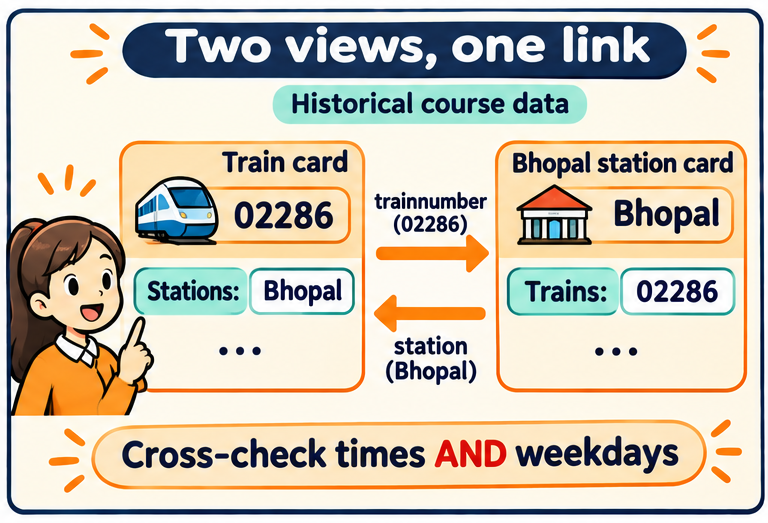
A station card lists services calling at that station. It is an index into the train cards: begin with relevant train numbers rather than scanning every unrelated route. The train card then supplies that service’s ordered station list, distance and journey timing.
The lab derives station views from the ten verified train-wise cards. The original Bhopal card also includes 12213 and 12214, which are outside this interactive subset. Absence from our derived view does not mean absence from the original station card or the railway network.
A station table may order rows by clock arrival, not train number. Different rows can operate on different weekdays, so neighbouring rows in a weekly summary are not necessarily trains seen one after another on the same day. Filter for the chosen weekday and interpret midnight crossings carefully.
Why start a route query with the source station’s train list?
It narrows the candidate services to those that actually call at the source.
Does a station list sorted by clock time guarantee all rows run today?
No. Each row’s operating weekdays still need checking.
Does missing from the ten-train lab prove a service does not exist?
No. The lab is explicitly a subset of historical course cards.