
Meet the historical train-card dataset
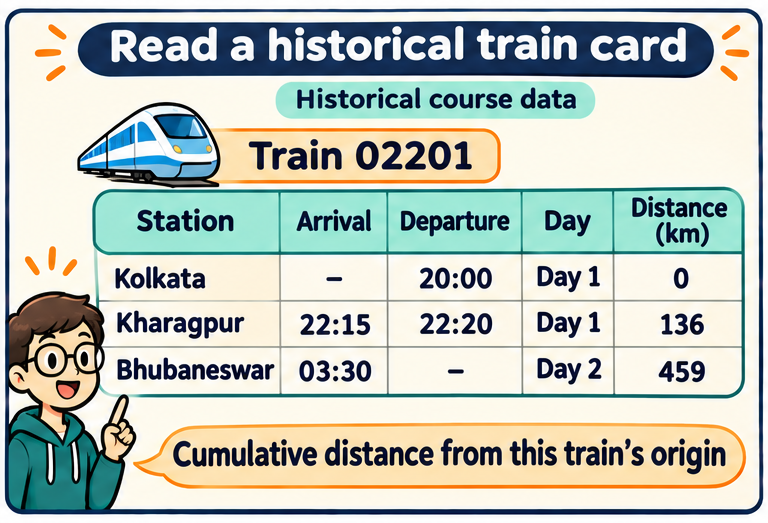
The new dataset has train-wise cards and station-wise cards. A train card names one service number, its origin operating weekdays and an ordered sequence of station calls. Each call contains cumulative distance, arrival, departure and a journey-day indication. Leading zeros in train numbers are retained as part of the string identifier.
| 02201 station | Distance km from origin | Arrival | Departure | Journey day |
|---|---|---|---|---|
| Kolkata | 0 | — | 20:00 | 1 |
| Kharagpur | 136 | 22:15 | 22:20 | 1 |
| Bhubaneswar | 459 | 03:30 | — | 2 |
Distance 459 is from Kolkata, not from Kharagpur. The Kharagpur-to-Bhubaneswar leg is 459−136 = 323 km. A missing origin arrival or final departure is not a clock time of zero. The return card 02202 has a different total distance, 522 km, so do not force symmetry between paired cards.
The interactive train material uses ten visually verified original cards with 57 stop rows. It is a teaching subset, not every train in the complete supplied collection. These are historical course records, not a current travel timetable or availability service. The paired numbers describe opposite-direction services; they do not prove which physical rolling stock is used.
Try it yourself
What does cumulative distance mean?
Show explained answer
Distance since that particular train’s origin. Subtract cumulative values to obtain an intermediate leg length.
Try it yourself
Is — at an endpoint the same as 00:00?
Show explained answer
No. It means that arrival or departure is not applicable on that service card.
Try it yourself
Why preserve 02201 rather than storing only 2201?
Show explained answer
The card’s identifier includes the leading zero. Treat service IDs consistently when joining records.