
Ready to begin
No records have been processed. Start with Next step.
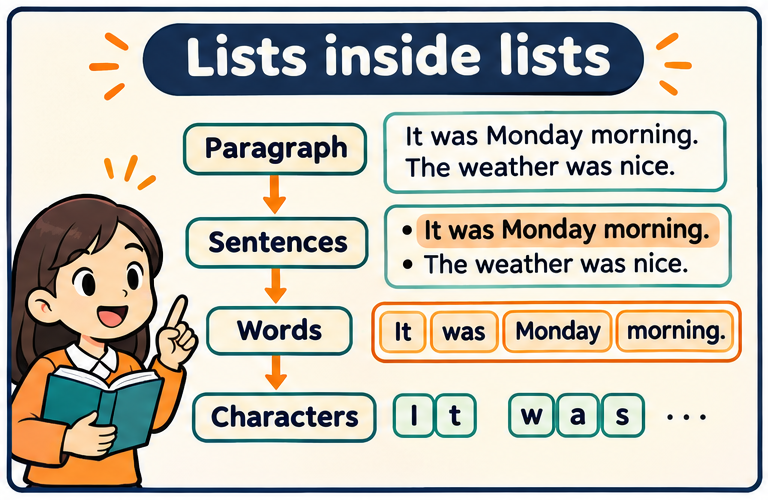
Last week, a pair was a list with two elements and a triple had three. Nested lists can also contain inner lists of different lengths. A paragraph can contain sentence lists; a sentence can contain word lists; a word can contain character lists. Each level answers a different question.
Follow the selected procedure. Change a field, tie rule or weekday and explain why the result changes.
Ready
No records have been processed. Start with Next step.
Predict the next change. Keep track of which list level, field and position convention the procedure uses.
Paragraph = [Sentence1, Sentence2, ...]
Sentence1 = [explode("It"), explode("was"),
             explode("Monday"), explode("morning.")]
# first(Paragraph) is a sentence list
# first(first(Paragraph)) is a character list for its first word
# first(first(first(Paragraph))) is its first character
These expressions depend on the representation. Our original dataset stores word RECORDS with a Word field, not already-exploded character lists. For that version, get the first sentence’s first word record, read its Word field, then explode it. A number such as a student ID cannot be unpacked with first as though it were a list.
The original paragraph has five sentence groups of 4, 7, 8, 21 and 25 word cards. We use terminal full stops in these supplied cards to build the groups once, then reuse the sentence lists. This is a dataset convention, not a complete sentence splitter for abbreviations, quotes or general English.
If the outer paragraph contains five sentence lists, is its length 65?
No. Its outer length is 5. The total word-card count across those sentence lists is 65.
Can you always call first three times on an object?
No. Each intermediate result must be a non-empty list with the expected meaning. A scalar or an empty list has no first element.
Why group sentences once?
Later sentence-level tasks can reuse that structure instead of repeatedly searching for punctuation boundaries.