
Ready to begin
No records have been processed. Start with Next step.
Follow the selected procedure. Change a field, tie rule or weekday and explain why the result changes.
Ready
No records have been processed. Start with Next step.
Predict the next change. Keep track of which list level, field and position convention the procedure uses.
ElapsedMinute(day, time) = (day-1)*1440 + 60*hour(time) + minute(time)
JourneyMinutes = ElapsedMinute(arrivalDay, arrivalTime)
                 - ElapsedMinute(departureDay, departureTime)
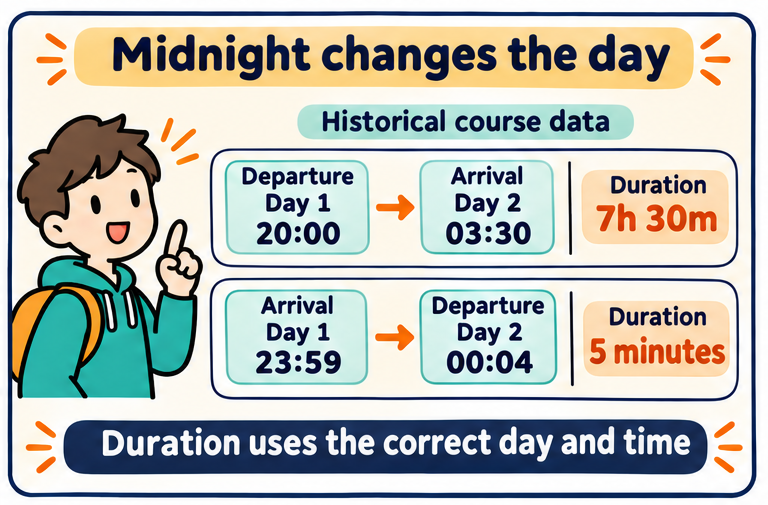
Clock text alone cannot distinguish the next morning from the previous morning. On 02201, Kolkata Day 1 20:00 to Bhubaneswar Day 2 03:30 is 450 minutes, or 7 h 30 min. Return 02202 runs 20:15 to next-day 04:15: 480 minutes.
The 12270 Bhopal row arrives 23:59 and leaves 00:04. Its printed Day 2 aligns with departure after midnight; the arrival belongs to Day 1 in the route chronology. The lab stores separate arrivalDay and departureDay values to make the five-minute dwell explicit instead of producing a negative duration.
This resolves a representational ambiguity in the supplied format; it is not a rule that every printed row day always means arrival day. Check the full sequence and cross-view weekdays. Do not subtract missing endpoint fields as if they were times.
Why is 03:30 − 20:00 a bad duration calculation here?
It ignores the day change. Convert both date-relative times to a common minute index first.
What is the 12270 Bhopal dwell across midnight?
5 minutes: 23:59 on one day to 00:04 the next.
Can a row’s one printed day safely be copied to both times in every case?
No. A midnight-crossing stop may need different arrival and departure day indices.