
Ready to begin
No records have been processed. Start with Next step.
Follow the selected procedure. Change a field, tie rule or weekday and explain why the result changes.
Ready
No records have been processed. Start with Next step.
Predict the next change. Keep track of which list level, field and position convention the procedure uses.
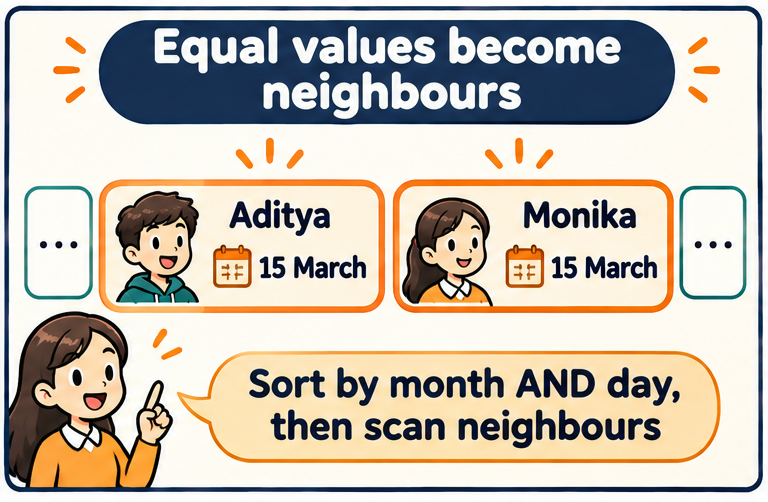
Normalize month spellings, then sort by calendar month and day number. Do not sort raw date strings alphabetically: “12 Jan” and “4 Jan” need numeric day order, and July and Jul mean the same month. Equality for this task ignores the year.
After sorting, compare neighbours using first(L) and first(rest(L)), then advance one position. A non-empty 30-card list has 29 neighbour checks. The sorting work is additional preparation, not part of those 29 checks. This dataset gives the matching neighbour pair [7,21], Aditya and Monika.
A matching-neighbour count is not always the number of ALL matching unordered pairs. A run of r equal birthdays has r−1 equal neighbour links but r(r−1)/2 distinct student pairs. Three matching students produce two neighbour links and three pairs. Count a run’s size if the question asks for all pairs.
Why is sorting by month alone insufficient for immediate-neighbour equality checks?
Different days in one month can interleave equal day values. Sort by both month and day.
If four students share a date, how many unordered matching pairs exist?
4×3/2 = 6, even though their sorted run has only three equal-neighbour links.
Is the entire method only 29 operations?
No. It includes key construction, sorting and then the 29 neighbour comparisons.