
Ready to begin
No records have been processed. Start with Next step.
Follow the selected procedure. Change a field, tie rule or weekday and explain why the result changes.
Ready
No records have been processed. Start with Next step.
Predict the next change. Keep track of which list level, field and position convention the procedure uses.
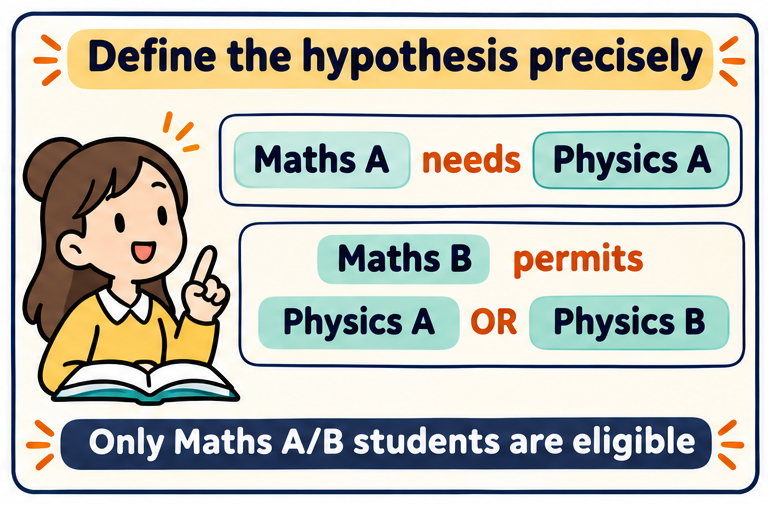
The statement “students who do well in Maths do at least as well in Physics” needs a measurable rule. Here doing well means Maths grade A or B. At least as well means the Physics grade is no worse than that student’s Maths grade, under A better than B better than C better than D.
For a Maths A student, only Physics A confirms. For a Maths B student, Physics A or B confirms. Keep each eligible ID in exactly one of Confirm and Reject. C/D Maths students are outside this question’s population; automatically adding them as confirmations would inflate the fraction.
Under the exact positional code and supplied data, Maths A/B gives 14 eligible students: 7 confirm and 7 reject. The fraction is 7/(7+7) = 0.5. A DIFFERENT rule, “both subjects in the top half”, permits Physics B even for Maths A and gives 8/14. The explorer lets you compare the two rules and reverse the direction.
Does a Maths A, Physics B student confirm the at-least-as-good rule?
No. B is worse than A. They would confirm the different “both A/B” rule.
What belongs in the denominator?
Confirm + Reject among the eligible origin-subject A/B students, not all 30 students.
Why does reversing the hypothesis matter?
It changes which subject selects the eligible population and which grade must be matched or exceeded. The statements are not automatically equivalent.