
Ready to begin
No records have been processed. Start with Next step.
Follow the selected procedure. Change a field, tie rule or weekday and explain why the result changes.
Ready
No records have been processed. Start with Next step.
Predict the next change. Keep track of which list level, field and position convention the procedure uses.
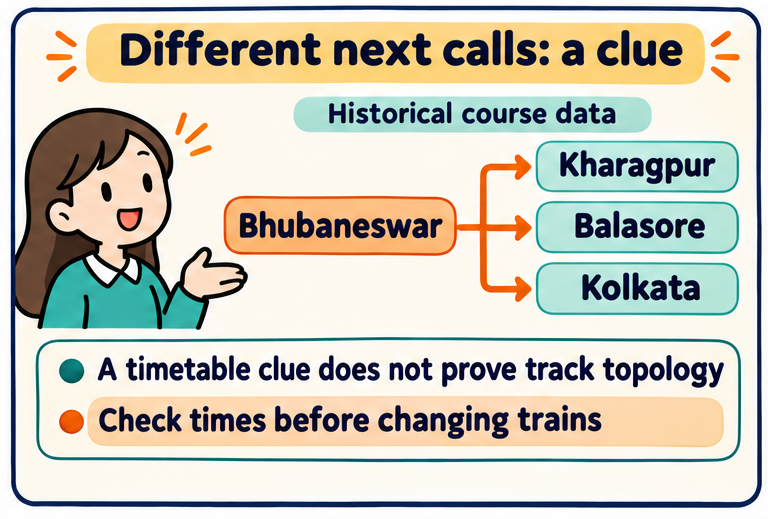
The lecture compares different services calling at a station, excluding a service and its paired return as the sole evidence. If their next scheduled calls differ, the timetable offers a branching or transfer clue. At Bhubaneswar, examples include Kharagpur, Balasore, Kolkata and Vijayawada on different verified cards.
Use nested comparison over relevant train pairs, then locate the next call after the current station. A destination with no next call is not an outgoing branch. Do not assume that adjacent train numbers always identify a return pair; use the known pairing information.
Different scheduled next stops can reflect express stopping patterns on the SAME physical line. Therefore the clue does not prove a track junction. Conversely, a limited timetable can omit physical branches. To assess a possible transfer, separately check arrival before departure, calendar weekdays, sufficient transfer time and any additional journey constraints. This introduction does not claim to solve the full connection-search problem.
Why is comparing only a train and its opposite-direction partner weak junction evidence?
Their different next calls may simply reflect travelling back along the same route.
Do different next scheduled calls necessarily mean different physical tracks?
No. One train can skip a station where another stops.
Does sharing a station guarantee a usable transfer?
No. The services must operate on compatible dates and times, with a feasible transfer interval.