
Handle empty, first and final insertion positions
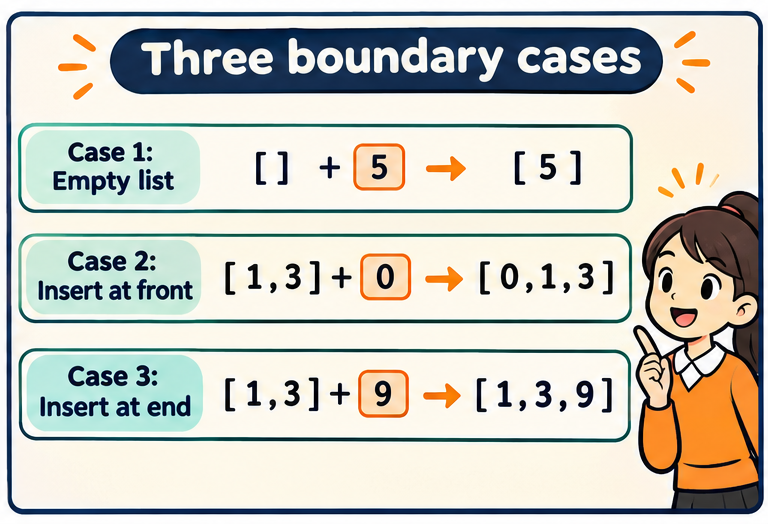
Three boundary cases test the algorithm. On [], the foreach body runs zero times, so a final fallback must produce [x]. If x is smaller than everything, insert before the first old element. If x is larger than or equal to every existing key under strict <, insert after the loop.
if NOT inserted:
    newList = newList ++ [x]
return newList
This final IF belongs outside the foreach loop. Putting it inside could insert too soon, or append x repeatedly. For a non-empty input, the output length must be old length + 1; for empty input it must be 1.
Try it yourself
What happens when you insert 5 into []?
Show explained answer
[5]. The final fallback appends it because the loop never ran.
Try it yourself
Where does 0 go in [1,3]?
Show explained answer
At the front: [0,1,3].
Try it yourself
Why is the final fallback still needed when most examples insert in the middle?
Show explained answer
It handles both empty input and values that belong after every old element.