
Why Efficiency Matters
Start here Does it really matter if a program is a little slow? This page answers with a real Indian problem: linking every SIM card to an Aadhaar card. A simple program would take about 3200 years. A smarter one takes about 50 minutes. Same computer, same data — only the method changes. That is why this course exists.
The problem
Every SIM card must be linked to an Aadhaar card. For each SIM card, we must check its Aadhaar details against the Aadhaar database.
- M = number of SIM cards
- N = number of Aadhaar cards
How big are these? Almost everyone in India has an Aadhaar card, and the number of SIM cards is similar:
- N > 10⁹ (more than 100 crore)
- M > 10⁹
The simple method — a nested loop
for each SIM card S:
    for each Aadhaar number A:
        check if Aadhaar details of S match A
For each SIM card, the inner loop goes through all Aadhaar cards. So the total number of checks is M × N.
Let us calculate (take M = N = 10⁹)
| Step | Calculation | Result |
|---|---|---|
| Total checks | 10⁹ × 10⁹ | 10¹⁸ checks |
| Seconds (Python ≈ 10⁷ per second) | 10¹⁸ ÷ 10⁷ | 10¹¹ seconds |
| Minutes | 10¹¹ ÷ 60 | ≈ 1.67 × 10⁹ minutes |
| Hours | 1.67 × 10⁹ ÷ 60 | ≈ 2.8 × 10⁷ hours |
| Days | 2.8 × 10⁷ ÷ 24 | ≈ 1.17 × 10⁶ days |
| Years | 1.17 × 10⁶ ÷ 365 | ≈ 3200 years! |
(Exact value: about 3170 years. Either way — useless.) How can we fix this?
A game: guess my birthday
I think of a date. You guess. I only answer Yes, Earlier or Later.
Say my birthday is 12 April.
Random guessing: September 12? Earlier. February 23? Later. July 2? Earlier. ... This could go on for a long time.
Smart guessing: keep an interval of possible dates, and always guess the middle. Each answer throws away half the interval.
| Guess (the middle) | Answer | Dates still possible |
|---|---|---|
| (start) | — | 365 |
| June 30 | Earlier | 182 |
| March 31 | Later | 91 |
| May 15 | Earlier | 45 |
| April 22 | Earlier | 22 |
| April 11 | Later | 11 |
| April 16 | Earlier | 5 |
| April 13 | Earlier | 2 |
| April 12 | Yes! | 1 |
Found in 8 guesses — always under 10 questions for any date in the year!
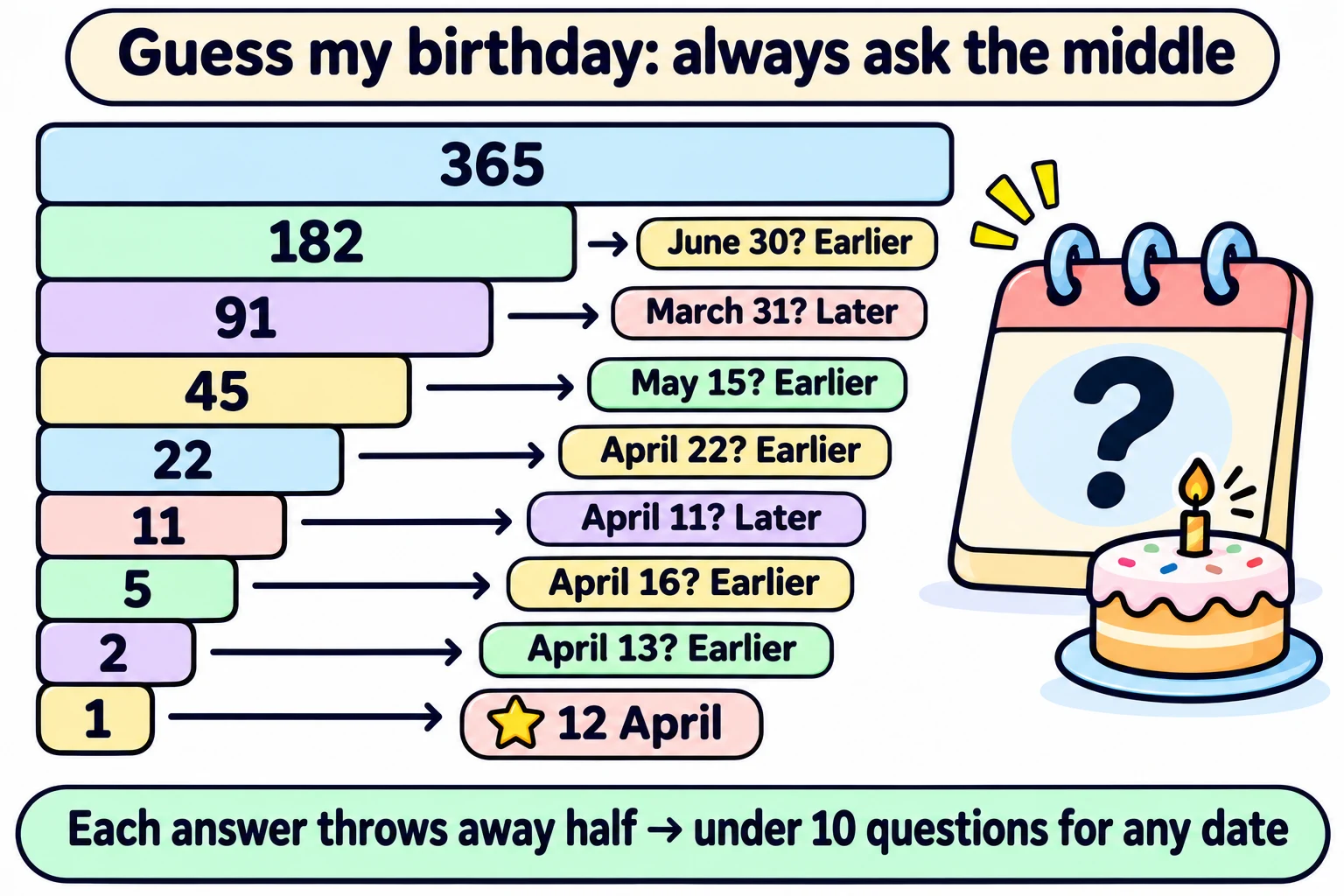
This "guess the middle" trick is called binary search. We will study it properly in Week 2. It needs one thing: the data must be in order (dates in a year are already in order).
The smart method — sort first, then halve
Step 1: Arrange (sort) the Aadhaar details in order of Aadhaar number. Step 2: For each SIM card, use the halving trick on the sorted list.
for each SIM card S:
    probe the sorted Aadhaar list (halving) to check Aadhaar details of S
How many halvings for 10⁹ cards?
Key fact: 2¹⁰ = 1024 ≈ 1000 = 10³. So 10 halvings cut the list down about 1000 times.
| Number of halvings | Cards still possible |
|---|---|
| 0 | 10⁹ |
| 10 | 10⁹ ÷ 10³ = 10⁶ |
| 20 | 10⁶ ÷ 10³ = 10³ |
| 30 | 10³ ÷ 10³ = 1 |
So about 30 checks find any one card among 10⁹.
Total time
| Step | Calculation | Result |
|---|---|---|
| Total checks | 10⁹ SIM cards × 30 | 3 × 10¹⁰ |
| Seconds | 3 × 10¹⁰ ÷ 10⁷ | 3000 seconds |
| Minutes | 3000 ÷ 60 | 50 minutes |
From 3200 years to 50 minutes!
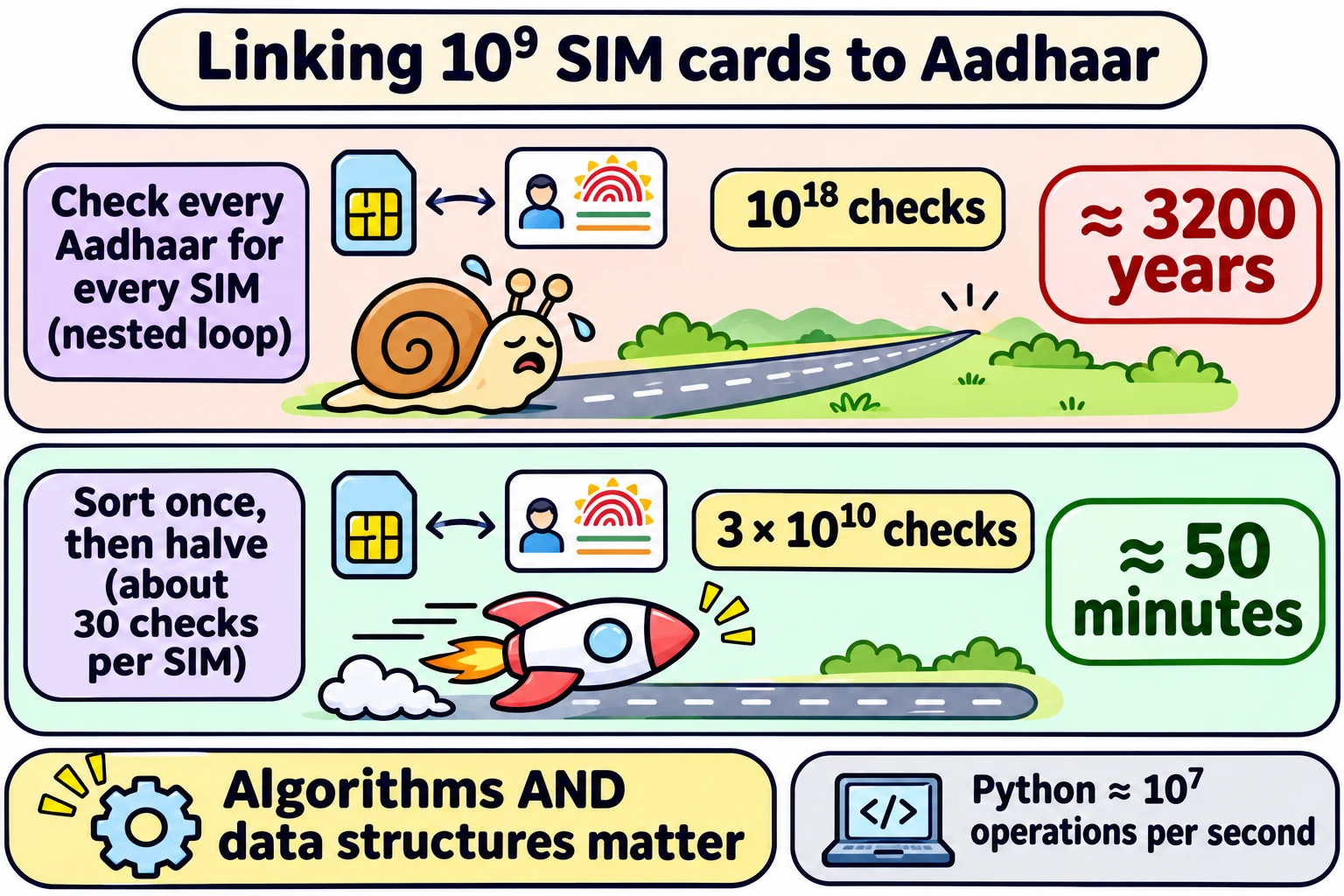
| Simple nested loop | Sort + halving | |
|---|---|---|
| Checks per SIM card | 10⁹ (every Aadhaar) | about 30 |
| Total checks | 10¹⁸ | 3 × 10¹⁰ |
| Time in Python | ≈ 3200 years | ≈ 50 minutes |
The catch: we first have to sort the Aadhaar list. Sorting also takes time — but it is done once, and good sorting methods (coming in Week 2) are fast enough.
The big lesson:
- Algorithms matter — a clever method (halving) beats a brute-force method (checking everything).
- Data structures matter — arranging the data (keeping it sorted) is what makes the clever method possible.
Both together are what this course is about: Programming, Data Structures and Algorithms.
In one line: Nested loops over 10⁹ × 10⁹ items take ~3200 years; sorting once and then halving takes ~50 minutes — good algorithms plus good data arrangement make the difference.
Exam words: efficiency, nested loop (M × N), interval halving, binary search, sorted data, 2¹⁰ ≈ 10³, 10⁷ operations per second.