
Week 1 Quick Revision
Start here Everything from Week 1 on one page. Read it the night before a quiz. If any line feels unclear, go back to that topic's page.
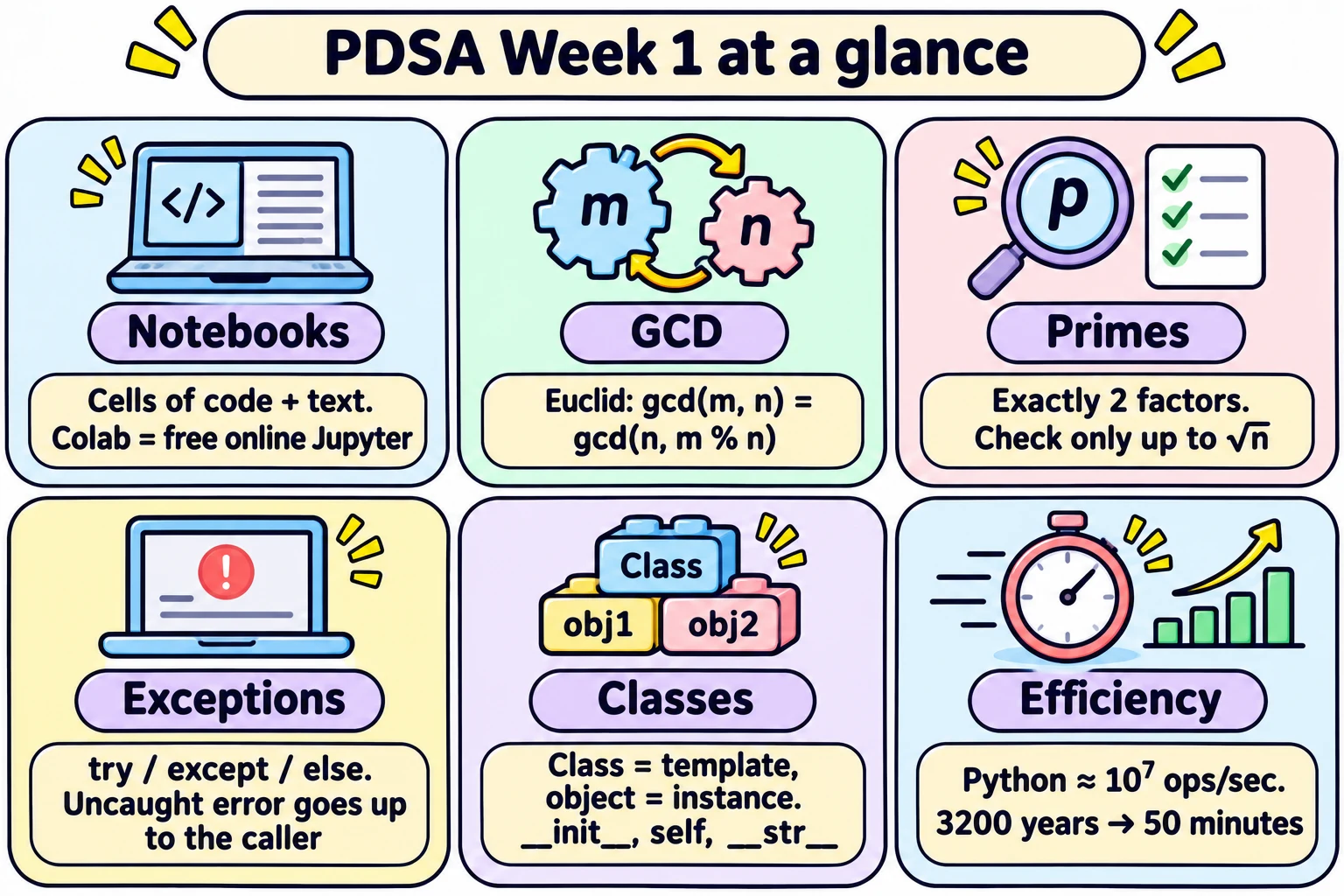
1. Notebooks
- Notebook = cells. Code cell (Python + output) and text cell (Markdown).
- Python remembers what you ran last, not what is lowest on the page.
In [3]= run order. - Kernel = the engine that runs the code (we use Python). Jupyter = Julia + Python + R.
- Google Colab = free online Jupyter: no install, ML packages ready, GPU access.
2. GCD
| Method | Rule | Time grows with |
|---|---|---|
| Check every number | Largest i ≤ min(m, n) dividing both | min(m, n) |
| Subtraction (recursive) | gcd(m, n) = gcd(n, m − n) | max(m, n) in worst case — e.g. gcd(2, 9999) ≈ 5000 steps |
| Euclid | gcd(m, n) = gcd(n, m % n) | number of digits of max(m, n) |
- Base case: if n divides m, answer is n.
- Example: gcd(48, 18) → gcd(18, 12) → gcd(12, 6) → 6.
3. Primes
- Prime = exactly two factors, 1 and itself. 1 is not prime. 2 is the only even prime.
- Factors come in pairs → only check up to √n.
break= leave the loop at once.forwhen the number of rounds is known;whilewhen it isn't — and make sure thewhileloop makes progress (else it never ends).(a, b) = (b, a)→ multiple assignment (swap).- Twin primes: (p, p + 2). Infinitely many? Unproved conjecture.
4. Exceptions
- Syntax error → can't run at all. Run-time error → an exception; can be handled.
- Common ones:
ZeroDivisionError,NameError,IndexError,KeyError,ValueError. try→except Type(first match wins) →except(anything else) →else(only if no error).- Uncaught error travels back up to the caller: h → g → f → main → abort.
- "Positive" use:
try: scores[b].append(s)except KeyError: scores[b] = [s].
5. Classes and objects
- ADT = data + allowed functions. Keep public interface separate from private implementation.
- Class = template; object = instance.
__init__= constructor;self= this object, always the first parameter.- (x, y) and (r, θ) Point classes have the same interface — users don't need to know which one is inside.
__str__→print()/str();__add__→+;__mul__→*;__lt__→<;__ge__→>=.
6. Timing and efficiency
time.perf_counter(): take two readings, subtract → seconds.- Python ≈ 10⁷ operations per second (rough estimate).
- 2¹⁰ = 1024 ≈ 10³ → 10 halvings ÷ 1000. About 30 halvings for 10⁹ items.
- SIM–Aadhaar: nested loop 10¹⁸ checks ≈ 3200 years; sort + halving 3 × 10¹⁰ checks ≈ 50 minutes.
- Both algorithms and data structures matter.
Watch out — mistakes in the slides
| Slide | What's wrong | Correct |
|---|---|---|
| Recap III gcd code | else without : | else: |
| Recap II √n code | while line is missing ): at the end | while (result and (i <= math.sqrt(n))): |
| Recap II, Methods 2 and 3 | prime(1) returns True | add if n < 2: return False |
| Recap III subtraction gcd | gcd(2, 9999) needs 5000 nested calls | real Python stops with RecursionError (limit ≈ 1000) |
| Classes — polar Point | math.atan(y/x) gives wrong angle when x < 0 (and for straight-down points) | use math.atan2(y, x) |
| Classes — special functions | mult | __mul__ |
| Timing slides | "perf time()" | perf_counter() |
| Jupyter slides | Kaggle at kaggle.org | kaggle.com |
Practice questions
1. What does this print? l = [4, 8, 15, 16, 23, 42]; print(l[-2], l[1:3])
23 [8, 15]. l[-2] is the second-last item; l[1:3] takes positions 1 and 2.2. Using Euclid's algorithm, find gcd(252, 105). Show the steps.
252 % 105 = 42 → gcd(105, 42). 105 % 42 = 21 → gcd(42, 21). 42 % 21 = 0 → 21.3. To check whether 221 is prime with the √n method, which numbers do you test? Is it prime?
√221 ≈ 14.9, so test 2 to 14. 221 = 13 × 17, so 13 divides it. Not prime.4. What does this print?
<pre>try: x = [1, 2, 3] print(x[5]) except KeyError: print("A") except IndexError: print("B") else: print("C")</pre></summary><b>B</b>. x[5] is an invalid list index → IndexError. KeyError doesn't match, so the IndexError block runs. else is skipped because an error happened.</details>
5. What does this print?
<pre>class Box: def __init__(self, v=1): self.v = v def __add__(self, other): return Box(self.v * other.v) def __str__(self): return "Box" + str(self.v)
print(Box(3) + Box())</pre></summary><b>Box3</b>. Box() has v = 1 (default). <code>+</code> calls __add__, which (surprise!) multiplies: 3 × 1 = 3. print calls __str__ → "Box3". The operator name tells Python <i>when</i> to call the method, not <i>what</i> it does.</details>
6. A program has 3 nested loops, each running 1000 times. Roughly how long in Python?
1000 × 1000 × 1000 = 10⁹ operations. 10⁹ ÷ 10⁷ = 100 seconds.7. How many halvings to find one name among 10¹² sorted names?
10¹² = (10³)⁴ ≈ (2¹⁰)⁴ = 2⁴⁰, so about 40.8. Will this loop end? i = 1 / while i != 10: i = i + 2
No. i takes values 1, 3, 5, 7, 9, 11, ... — it is always odd, so it never equals 10. Use i < 10 instead.