
Python Recap I — Computing the GCD
Start here You learnt Python before. This page refreshes the basics — lists, loops,
if,range()— using one small problem: finding the greatest common divisor of two numbers. The same problem will later show us why some programs are fast and others are slow.
What is the GCD?
The GCD (greatest common divisor) of two numbers m and n is the largest number that divides both of them exactly (no remainder). It is also called the HCF (highest common factor).
| Numbers | Factors of first | Factors of second | Common factors | GCD |
|---|---|---|---|---|
| 8, 12 | 1, 2, 4, 8 | 1, 2, 3, 4, 6, 12 | 1, 2, 4 | 4 |
| 18, 25 | 1, 2, 3, 6, 9, 18 | 1, 5, 25 | 1 | 1 |
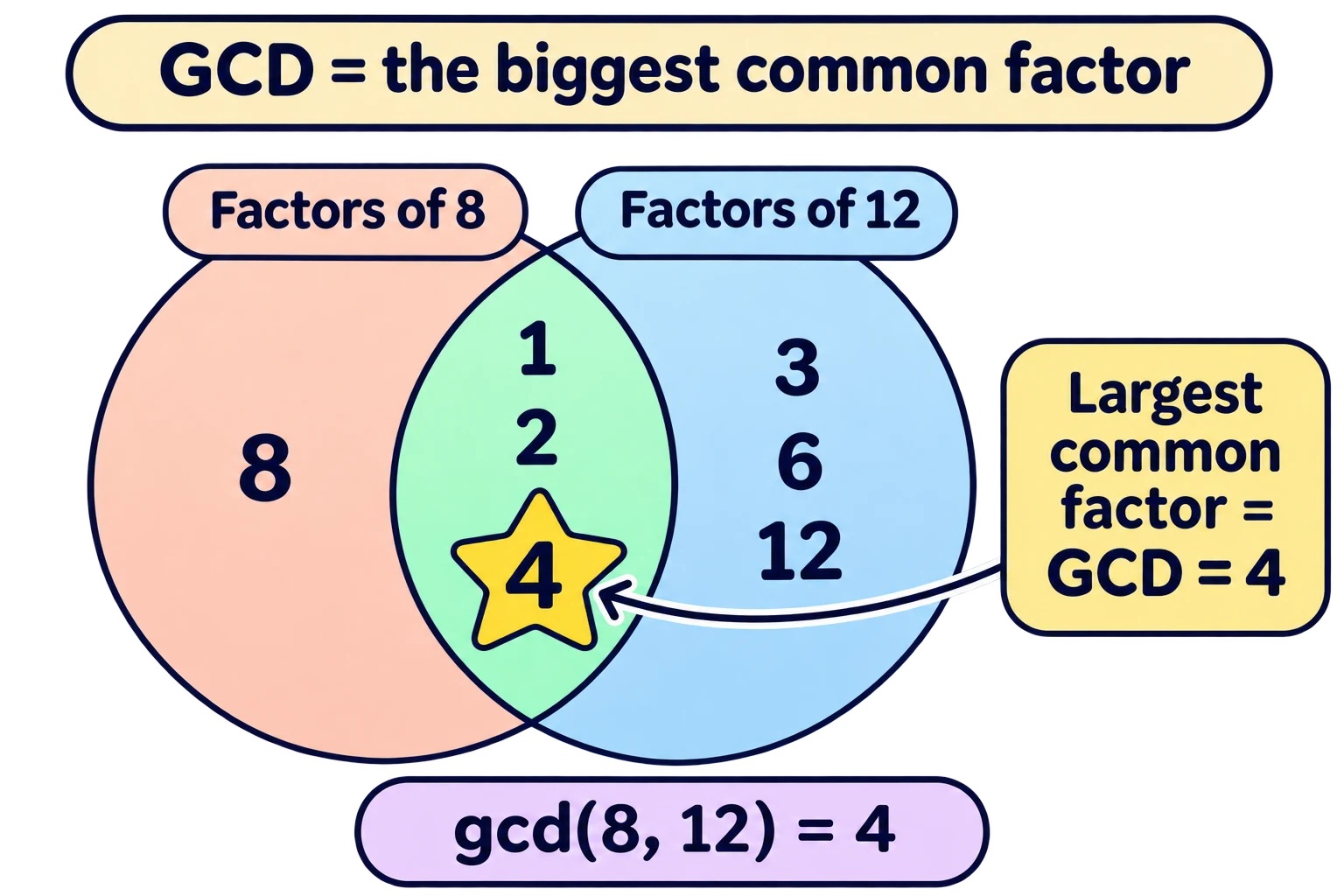
Two facts help us write the program:
- The GCD always exists.
1divides every number, so there is always at least one common factor. - The GCD can never be bigger than the smaller number. A factor of 8 cannot be bigger than 8. So we only need to check
1, 2, ..., min(m, n).
Version 1 — keep a list of common factors
Idea: check every number from 1 to min(m, n). If it divides both, add it to a list. The last item in the list is the largest, so that is the GCD.
def gcd(m, n):
    cf = []                              # list of common factors
    for i in range(1, min(m, n) + 1):
        if (m % i) == 0 and (n % i) == 0:
            cf.append(i)
    return cf[-1]                        # last (largest) common factor
Let us trace gcd(8, 12). Here min(8, 12) = 8, so i goes from 1 to 8.
| i | 8 % i | 12 % i | Both 0? | cf after this step |
|---|---|---|---|---|
| 1 | 0 | 0 | Yes | [1] |
| 2 | 0 | 0 | Yes | [1, 2] |
| 3 | 2 | 0 | No | [1, 2] |
| 4 | 0 | 0 | Yes | [1, 2, 4] |
| 5 | 3 | 2 | No | [1, 2, 4] |
| 6 | 2 | 0 | No | [1, 2, 4] |
| 7 | 1 | 5 | No | [1, 2, 4] |
| 8 | 0 | 4 | No | [1, 2, 4] |
cf[-1] = last item = 4. ✔
Python points to remember from this code
| Point | What it means |
|---|---|
cf = [] must come first | You cannot .append() to a list that does not exist yet. |
| Names get their type from their value | cf is a list because we put [] in it. No need to declare types like in C. |
% is the remainder | 12 % 5 = 2, because 12 = 2 × 5 + 2. "Divides exactly" means % == 0. |
range(i, j) stops at j - 1 | range(1, 9) gives 1, 2, ..., 8. That is why we write min(m, n) + 1. |
| List indexes | Forward: 0 to len(l) - 1. Backward: -1 (last) to -len(l) (first). So cf[-1] is the last item. |
| Control flow | if = decide, for = repeat. |
Version 2 — no list needed
We only ever use the last common factor. So why store all of them? Just remember the most recent common factor (mrcf).
def gcd(m, n):
    for i in range(1, min(m, n) + 1):
        if (m % i) == 0 and (n % i) == 0:
            mrcf = i                     # overwrite with the newest common factor
    return mrcf
Why don't we need mrcf = 0 at the start? Because when i = 1, the if is always true (1 divides everything). So mrcf always gets a value in the very first round.
How fast are these versions?
Both versions run the loop min(m, n) times. So the time taken grows in proportion to min(m, n).
gcd(8, 12)→ 8 rounds. Tiny.gcd(1000000, 2000000)→ 10,00,000 rounds. Slow!
Can we do better? Yes — see Python Recap III (Euclid's algorithm).
In one line: GCD = largest common factor; the simple method checks every number up to min(m, n), so it takes time proportional to min(m, n).
Exam words: GCD, HCF, % (remainder), range(i, j), l[-1], append(), mrcf.
Quick check
1. What does range(3, 7) give?
3, 4, 5, 6 — it stops one before 7.2. For l = [5, 9, 2, 7], what is l[-1] and l[-4]?
l[-1] = 7 (last item). l[-4] = 5 (first item, because len(l) = 4).3. Find gcd(18, 24) the slow way.
Factors of 18: 1, 2, 3, 6, 9, 18. Factors of 24: 1, 2, 3, 4, 6, 8, 12, 24. Common: 1, 2, 3, 6. GCD = 6.4. How many times does the loop run for gcd(15, 100)?
min(15, 100) = 15, so 15 times.5. Why can Version 2 skip mrcf = 0?
Because i = 1 always divides both numbers, so mrcf is set in the first round itself.