
Python Recap III — Euclid's Algorithm
Start here In Recap I, our GCD program checked every number up to
min(m, n). For big numbers that is slow. Here we find a clever trick that is more than 2000 years old — Euclid's algorithm — and also revise recursion (a function calling itself).
Idea 1 — a common factor also divides the difference
Suppose d divides both m and n. Then:
m = a × dandn = b × d(for some whole numbersa,b)- So
m − n = a×d − b×d = (a − b) × d - So
dalso dividesm − n.
Number example: 4 divides 20 and 12. And 20 − 12 = 8 — yes, 4 divides 8 too.
This means: gcd(m, n) = gcd(n, m − n) (with m the bigger one). The numbers get smaller, but the answer stays the same!
Recursive version (subtraction)
A recursive function calls itself on a smaller problem. It needs:
- a base case — when to stop: if
ndividesm, the answer isn. - a reduction step — otherwise solve the smaller problem
gcd(n, m − n).
def gcd(m, n):
    (a, b) = (max(m, n), min(m, n))   # a = bigger, b = smaller
    if a % b == 0:
        return b                      # base case
    else:
        return gcd(b, a - b)          # smaller problem
Trace gcd(48, 18):
| Call | a (bigger) | b (smaller) | a % b | Next |
|---|---|---|---|---|
| gcd(48, 18) | 48 | 18 | 12 | gcd(18, 48 − 18) = gcd(18, 30) |
| gcd(18, 30) | 30 | 18 | 12 | gcd(18, 30 − 18) = gcd(18, 12) |
| gcd(18, 12) | 18 | 12 | 6 | gcd(12, 18 − 12) = gcd(12, 6) |
| gcd(12, 6) | 12 | 6 | 0 | return 6 |
The problem: it can be very slow
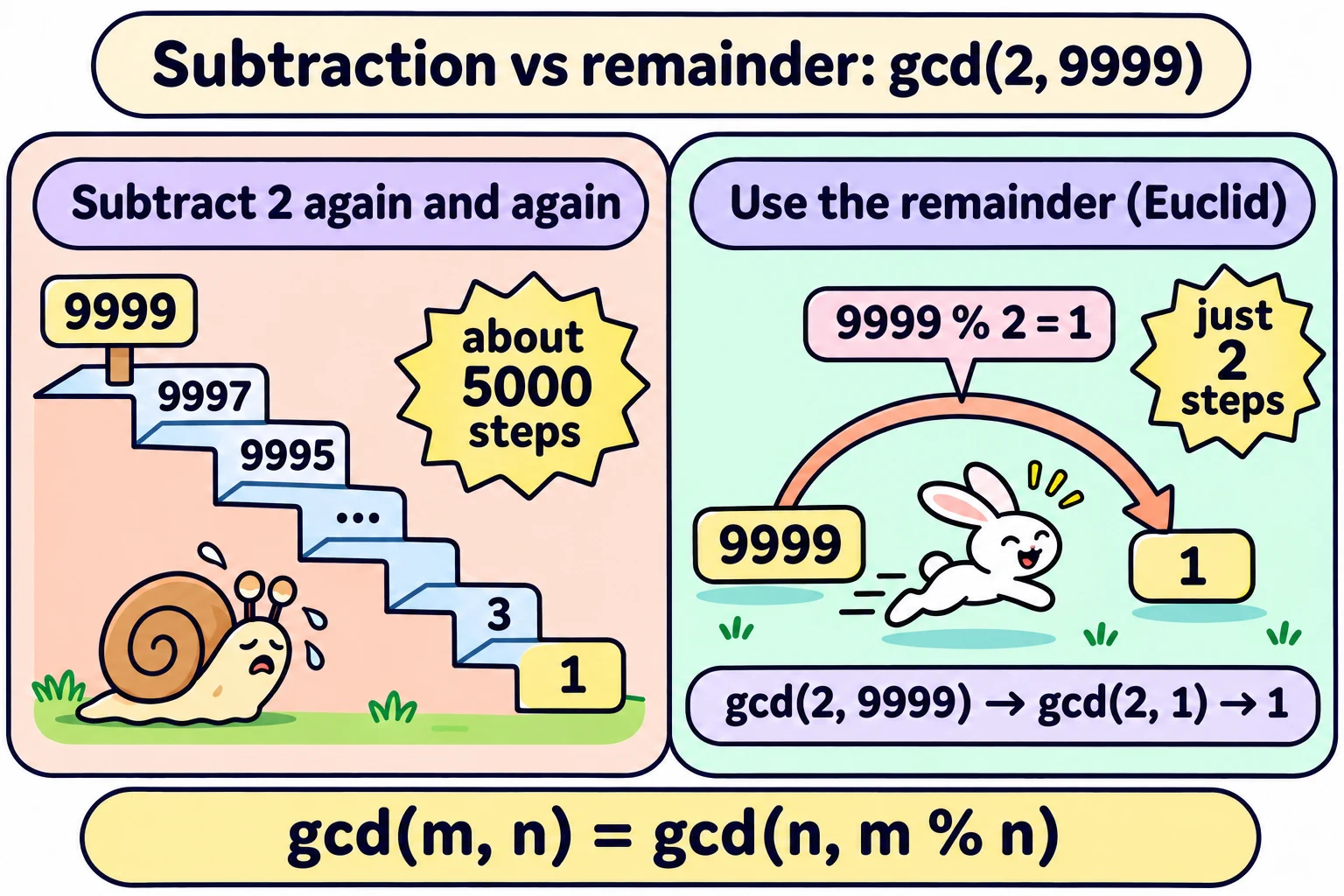
Lecture example — gcd(2, 9999) gcd(2, 9999) → gcd(2, 9997) → gcd(2, 9995) → ... → gcd(2, 3) → gcd(2, 1) → 1. Each step takes away only 2. That is about 5000 steps!
So this version takes time proportional to max(m, n) — even worse than Recap I in this case.
Tried it ourselves: running this exact code for gcd(2, 9999) in normal Python crashes with
RecursionError: maximum recursion depth exceeded. Python allows only about 1000 nested calls by default, and this needs 5000. One more reason we need a better method.
Idea 2 — use the remainder instead (Euclid's algorithm)
Why subtract 2 again and again, 5000 times? Subtracting n from m as many times as possible is exactly what division does. What is left over is the remainder, m % n.
When n does not divide m, write m = q × n + r (q = quotient, r = remainder).
If d divides both m and n:
m = a×dandn = b×da×d = q × (b×d) + r- so
r = a×d − q×b×d = (a − q×b) × d - so
dalso dividesr.
So gcd(m, n) = gcd(n, m % n). This is Euclid's algorithm:
- If
ndividesm, then gcd(m, n) =n. - Otherwise, find gcd(n, m % n).
def gcd(m, n):
    (a, b) = (max(m, n), min(m, n))
    if a % b == 0:
        return b
    else:
        return gcd(b, a % b)          # only change: a - b  →  a % b
(The lecture slides miss the : after else — in real Python you must write else:.)
Trace gcd(48, 18) again:
| Call | a | b | a % b | Next |
|---|---|---|---|---|
| gcd(48, 18) | 48 | 18 | 48 = 2×18 + 12 | gcd(18, 12) |
| gcd(18, 12) | 18 | 12 | 18 = 1×12 + 6 | gcd(12, 6) |
| gcd(12, 6) | 12 | 6 | 12 = 2×6 + 0 | return 6 |
3 calls instead of 4. And for gcd(2, 9999): 9999 % 2 = 1, so gcd(2, 9999) → gcd(2, 1) → 1. Just 2 calls instead of 5000!
How fast is Euclid's algorithm?
It takes time proportional to the number of digits in max(m, n) — not to the number itself.
| max(m, n) | Number of digits | Simple method (≈ min(m, n) rounds) can be up to | Euclid (grows with digits) |
|---|---|---|---|
| 9,999 | 4 | about 10,000 rounds | a handful of steps |
| 1,000,000,000 | 10 | about 1,000,000,000 rounds | a few dozen steps at most |
That is a huge difference. Euclid's algorithm is one of the first non-trivial algorithms ever written down.
In one line: gcd(m, n) = gcd(n, m % n); replacing subtraction with remainder makes the GCD take time proportional to the number of digits.
Exam words: recursion, base case, gcd(m, n) = gcd(n, m − n), Euclid's algorithm, gcd(m, n) = gcd(n, m % n), proportional to number of digits.