
Exception Handling
Start here Programs go wrong: someone divides by zero, a file is missing, a list index is too big. Without a plan, Python stops the whole program with a red error. Exception handling lets us expect such problems and recover calmly.
Things that can go wrong while code runs
| Code | What goes wrong | Error Python shows |
|---|---|---|
y = x / z | z is 0 | ZeroDivisionError |
y = int(s) | s is "abc", not a number | ValueError |
y = 5 * x | x was never given a value | NameError |
y = l[i] | i is not a valid index of list l | IndexError |
d[k] | key k is not in dictionary d | KeyError |
| Open a file to read | The file does not exist | FileNotFoundError |
| Write to a file | The disk is full | OSError |
Two kinds of errors
- Syntax error — the code is written wrongly (like a missing
:). Python refuses to even start. You can't "handle" this — just fix the code.
SyntaxError: invalid syntax
- Run-time errors (exceptions) — the code is written correctly but something goes wrong while it runs. These are the ones we handle.
NameError: name 'x' is not defined ZeroDivisionError: division by zero IndexError: list assignment index out of range
Two key words
- Raise an exception — when a run-time error happens, Python raises (signals) it, with its type and a message. Example:
NameError: name 'x' is not defined. - Handle an exception — your code catches it and takes corrective action based on its type.
If nobody handles it, the program aborts (stops).
Everyday example: A cricket ball is hit high (exception raised). If a fielder catches it (handled), the game goes on calmly. If nobody catches it, it falls to the ground (program aborts).
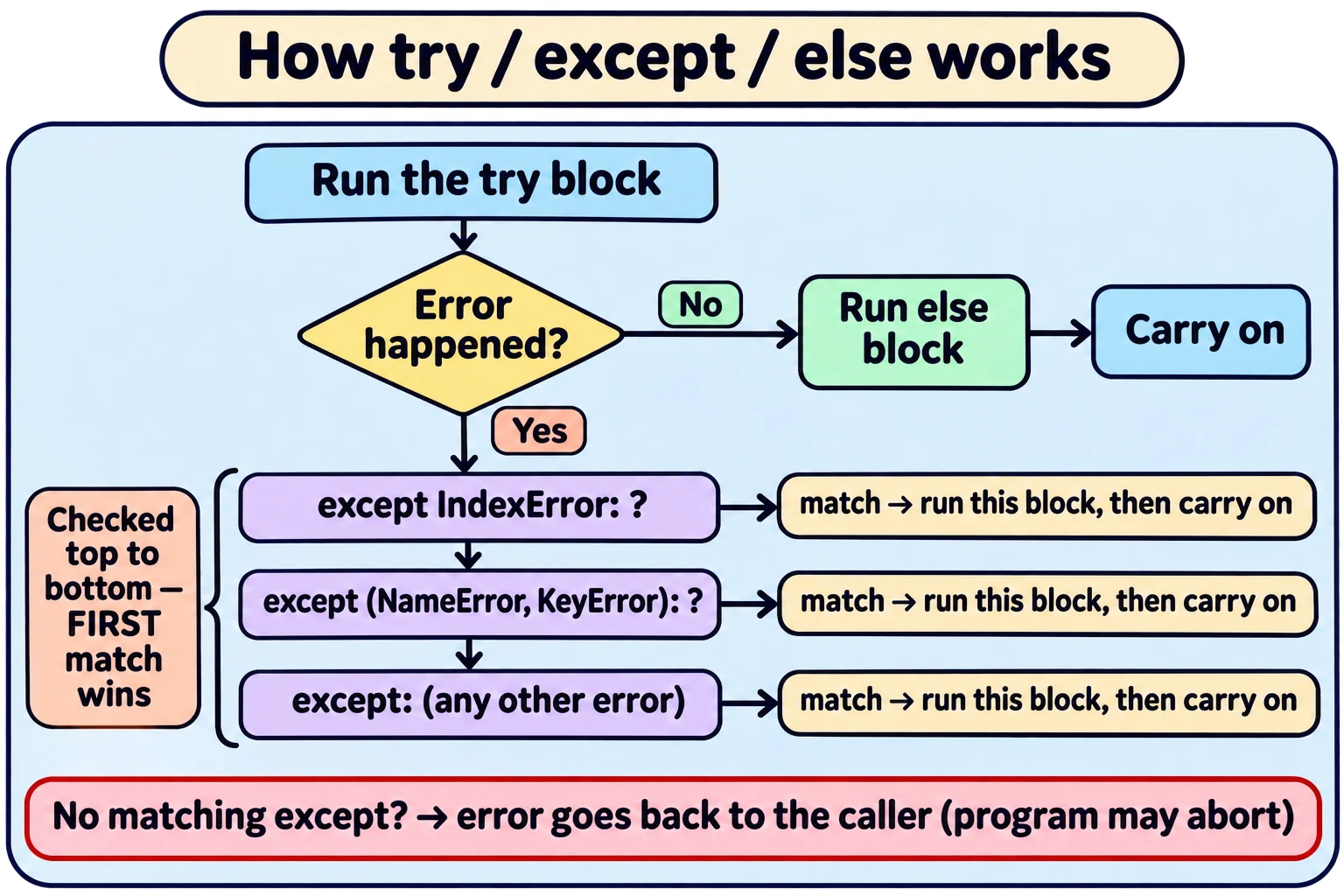
The try–except structure
try:
    ...                         # code where an error may happen
except IndexError:
    ...                         # runs only for IndexError
except (NameError, KeyError):
    ...                         # one block for two types
except:
    ...                         # any other error
else:
    ...                         # runs only if try had NO error
How Python reads this:
- Run the
tryblock. - If an error happens, jump out of
tryat once and look down theexceptlines in order. Run the first one that matches the error type. - If no error happened, skip all the
exceptblocks and runelse.
A small working example:
try:
    x = int(input("Enter a number: "))
    print(100 / x)
except ValueError:
    print("That was not a number.")
except ZeroDivisionError:
    print("Cannot divide by zero.")
else:
print("All good!")| User types | What prints |
|---|---|
4 | 25.0 then All good! |
0 | Cannot divide by zero. |
hello | That was not a number. |
Using exceptions "positively"
Exceptions are not only for disasters. Sometimes they make normal code simpler.
Lecture example — cricket scores We keep each batter's scores in a dictionary:
scores = {"Shefali": [3, 22], "Harmanpreet": [200, 3]}A new scoresarrives for batterb. - Ifbis already in the dictionary → add to the list:scores[b].append(s)- Ifbis new → make a fresh list:scores[b] = [s]
Traditional way — check first:
if b in scores.keys():
    scores[b].append(s)
else:
    scores[b] = [s]
Exception way — just try it:
try:
    scores[b].append(s)
except KeyError:              # b was not there
    scores[b] = [s]
Both give the same result. The second one says: "Assume the batter exists; if not, Python tells us with a KeyError, and we create the entry."
Where does an unhandled error go?
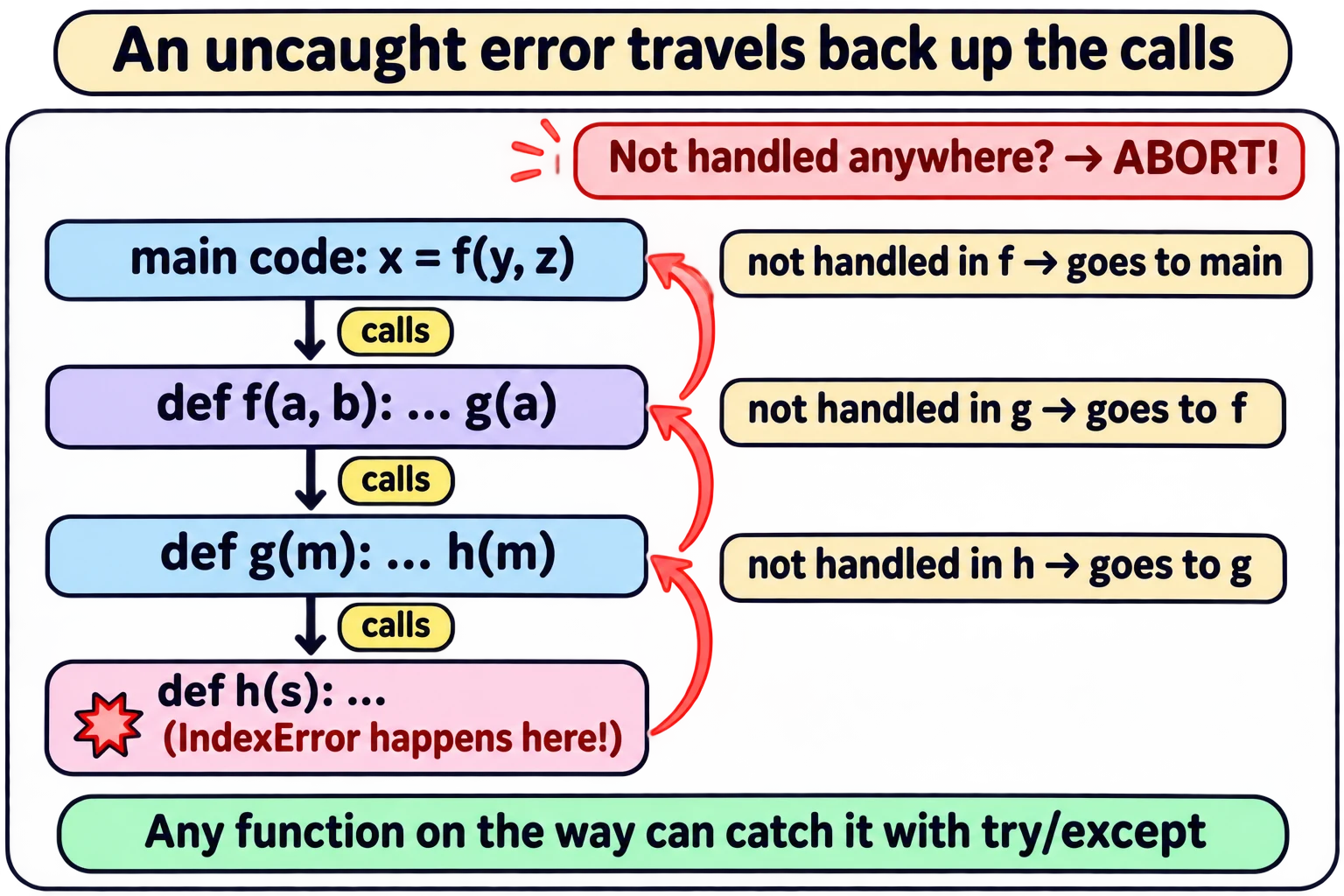
Functions call other functions. Suppose the main code calls f(), f() calls g(), and g() calls h().
If an IndexError happens inside h() and h() does not handle it:
- The error goes back to
g()(the one that calledh()). - If
g()doesn't handle it, it goes back tof(). - If
f()doesn't handle it, it goes back to the main code. - If the main code doesn't handle it — the program aborts.
So an error travels back up the chain of calls until someone catches it.
In one line: Put risky code in try, handle each error type in its own except, and remember an uncaught error travels back up to the caller.
Exam words: exception, raise, handle, try, except, else, ZeroDivisionError, NameError, IndexError, KeyError, ValueError, syntax error vs run-time error, abort.
Quick check
1. Can try–except handle a SyntaxError in your own code?
No. Python cannot even start a program with a syntax error. Fix the code instead.2. When does the else block of a try statement run?
Only when the try block ran with no error at all.3. Which error does d = {}; d["a"] += 1 raise?
KeyError, because the key "a" is not in the dictionary.4. h() raises an IndexError and does not handle it. g() called h() inside a try with except IndexError. What happens?
g() catches it and continues. The error never reaches f() or the main code.