
Relative frequency: compare fairly
On this page 4 headings
Raw counts can be hard to compare when groups have different sizes. Relative frequency tells us what fraction of a group belongs to a category.
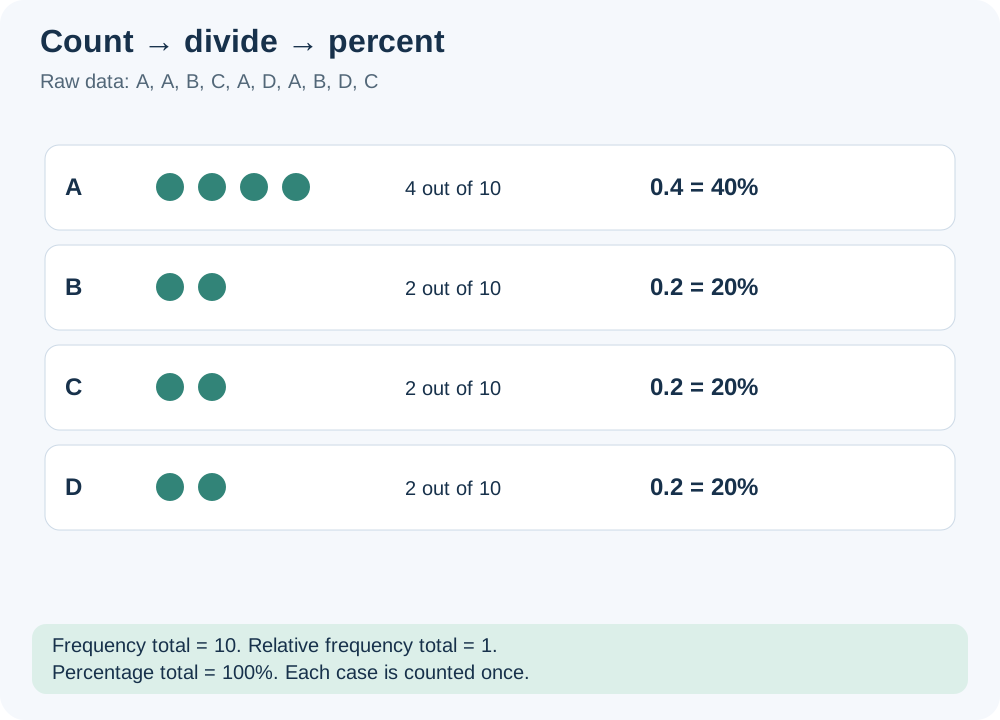
One idea, three ways to write it
For A in the first lecture example, f = 4 and n = 10. Its relative frequency is 4/10 = 0.4, its proportion is 0.4, and its percentage is 40%. The remaining three categories each have 2/10 = 0.2 = 20%.
| Category | List 1: n = 10 | List 2: n = 15 | List 3: n = 15 | List 4: n = 18 |
|---|---|---|---|---|
| A | 4/10 = 0.4 | 6/15 = 0.4 | 3/15 = 0.2 | 6/18 ≈ 0.3333 |
| B | 2/10 = 0.2 | 3/15 = 0.2 | 6/15 = 0.4 | 3/18 ≈ 0.1667 |
| C | 2/10 = 0.2 | 3/15 = 0.2 | 3/15 = 0.2 | 4/18 ≈ 0.2222 |
| D | 2/10 = 0.2 | 3/15 = 0.2 | 3/15 = 0.2 | 5/18 ≈ 0.2778 |
Why the denominator matters
Lists 1 and 2 have different counts but identical proportions: A is 40% in both. As another example, 20 bus users among 50 students is 40%, whereas 30 among 100 is 30%. The second group has more bus users but a smaller share.
Checks that catch mistakes
Each relative frequency lies between 0 and 1. For a complete set of non-overlapping categories, exact relative frequencies sum to 1 and exact percentages sum to 100%. Use the total for the group you are actually describing: after filtering, the denominator may change.
Keep fractions or full precision while calculating and round only for display. Three equal categories each have share 1/3. Displaying each as 33.3% gives 99.9%; this small discrepancy is rounding, not a missing observation.
Try it yourself
A category has 12 of 40 responses. Find its relative frequency and percentage.
Show explained answer
12/40 = 0.3 = 30%.
Try it yourself
Group X has 8 out of 20 choosing A. Group Y has 15 out of 50 choosing A. Which has a larger share?
Show explained answer
X: 8/20 = 40%. Y: 15/50 = 30%. X has the larger share even though Y has the larger count.
More practice: apply what you learned
Try it yourself
In a class of 25 students, 10 choose football. Find the relative frequency and percentage.
Show explained answer
Relative frequency = 10/25 = 0.4. Percentage = 0.4×100% = 40%. Use the class total 25 as the denominator.
Try it yourself
A survey has 100 responses, but after filtering one class only 20 remain; 5 choose A. Find A’s share within that class.
Show explained answer
5/20 = 0.25 = 25%. The question asks within the filtered class, so divide by 20, not by the original 100.
Source: Lecture 2.1.pdf. Explanations, diagrams and extra practice are prepared for these notes.