
What is statistics? Population and sample
On this page 4 headings
Statistics is the process of collecting, describing and analyzing data so we can learn something. Data are the recorded facts and figures: numbers, labels, answers, or measurements.
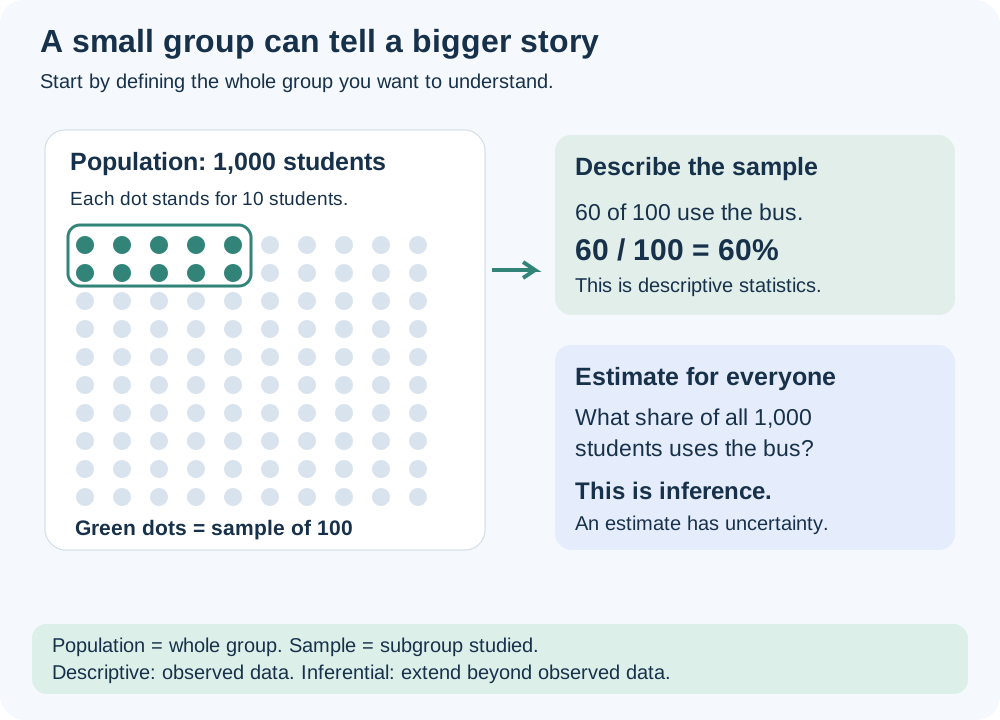
Population means the whole group you care about
The population depends on your question. For house prices in Tamil Nadu, the population is all houses included in that question. For visitors to a city mall in a particular month, it is the people who visited that mall during that month. Define the place and time carefully.
A sample is a subgroup of the population studied in detail. If asking all 1,000 students is difficult, we might ask 100. Studying the whole population is a census.
Descriptive statistics: describe what you observed
Suppose 60 of the 100 students surveyed use the bus. Saying “60% of the students in our survey use the bus” describes the observed sample. Tables, charts and numerical summaries are descriptive tools. You can describe either a sample or an entire population.
Inferential statistics: go beyond what you observed
Using those 100 students to estimate the bus-use share among all 1,000 is inference. The sample may not match the population perfectly. Chance creates uncertainty; probability helps us reason about it. A convenient sample can also be biased: asking only students standing at the bus stop is unlikely to represent everyone.
| Statement | Type | Why |
|---|---|---|
| The 100 surveyed students include 60 bus users. | Descriptive | It reports the observed data. |
| About 60% of all college students may use the bus. | Inferential | It extends from the sample to the population. |
| Every house in the city was counted and summarized. | Descriptive | Summarizing a population is still description. |
The purpose of a statement decides whether it is descriptive or inferential. Merely using a sample does not automatically make a study inferential.
Try it yourself
We record car sales at 20 dealerships and report only their total. Is that inference?
Show explained answer
No. Reporting those observed dealerships is descriptive. Estimating sales across all dealerships would be inferential.
Try it yourself
We want the ages of all mall visitors in July, but ask 80 visitors on one afternoon. Identify the population and sample.
Show explained answer
Population: all visitors covered by the July question. Sample: the 80 people asked. One afternoon may miss other kinds of visitors.
More practice: apply what you learned
Try it yourself
A school has 600 students. A teacher asks 60 of them about their favorite sport. Identify the population and sample.
Show explained answer
Population: all 600 students in the school. Sample: the 60 students who answered. The sample is part of the population.
Try it yourself
A café asks only customers buying coffee whether they prefer coffee or tea. Can it safely describe every customer’s preference?
Show explained answer
No. Tea buyers and other customers are left out. The sample is likely biased toward coffee lovers, so a claim about all customers is not well supported.
Source: Lecture 1.1.pdf. Explanations, diagrams and extra practice are prepared for these notes.