
Scales of measurement: nominal to ratio
On this page 6 headings
A measurement scale tells us which comparisons make sense. A label, an ordered label and a measured amount give us different kinds of information.
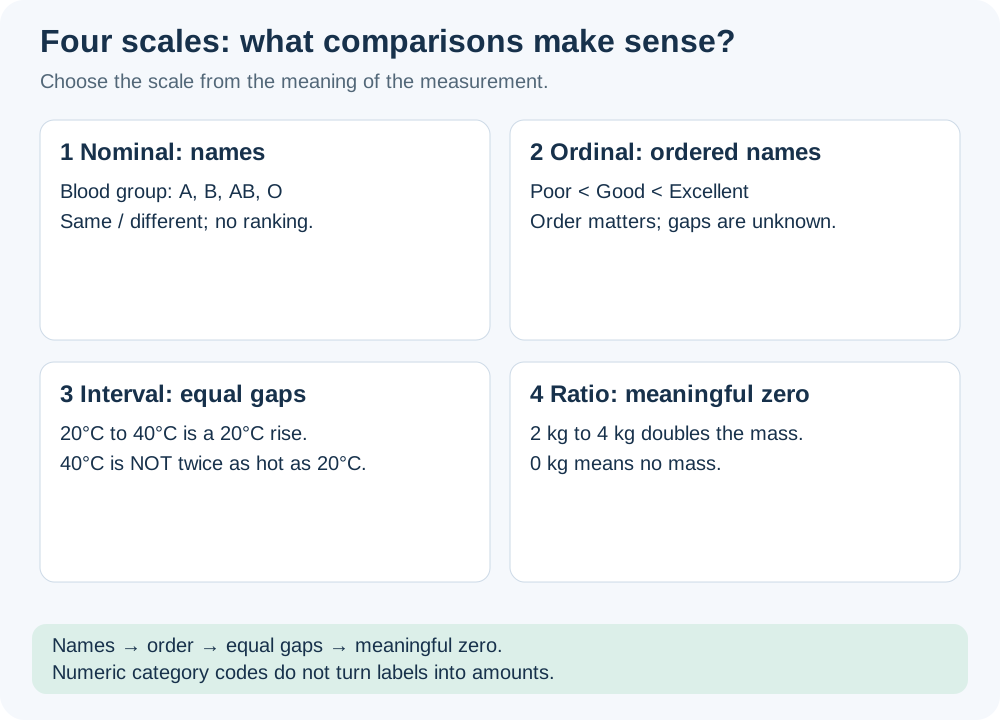
Nominal: names with no built-in order
Nominal values identify categories without ranking them. Names, boards and blood groups are examples. Coding blood group A as 1 and B as 2 is allowed, but code 2 does not mean twice as much blood group. Changing the codes does not change the category information.
Ordinal: labels with an order
Ordinal categories have a meaningful ranking. Poor, Good and Excellent can be arranged from lower to higher service quality. T-shirt sizes Small, Medium and Large also have order. The distance from Poor to Good need not equal the distance from Good to Excellent. Do not assume equal gaps from codes 1, 2 and 3.
Interval: equal gaps, but an arbitrary zero
Interval data are numerical, and differences have a fixed meaning. In Celsius, the difference between 20°C and 40°C is 20°C. But 0°C does not mean no thermal energy. So 40°C is not twice as hot as 20°C in a meaningful ratio sense.
| Reference point | Celsius | Fahrenheit |
|---|---|---|
| Water freezes (standard pressure) | 0°C | 32°F |
| Water boils (standard pressure) | 100°C | 212°F |
The same room at 20°C is 68°F; outdoors at 40°C is 104°F. The ratio changes from 40/20 = 2 to 104/68 ≈ 1.53 when the temperature scale changes. That is why Celsius ratios do not measure “twice as hot”.
Ratio: equal gaps and a meaningful zero
Ratio data have a zero that represents absence of the measured quantity, so ratios make sense. A 4 kg mass is twice a 2 kg mass. Height, elapsed time, age measured as elapsed time, and counts are standard examples. Kelvin temperature has a meaningful absolute zero.
The lecture lists marks as ratio data: 80 marks is twice 40 marks as a score. This does not mean twice the knowledge or ability. A comparison is meaningful only for the quantity actually measured.
The way you ask changes the data
The broad topic “temperature” does not have one scale for every question. “Comfortable or uncomfortable?” records nominal comfort labels. “Cold, warm or hot?” records ordered categories. A Celsius reading is interval. A Kelvin reading is ratio.
| Scale | Names/groups | Order | Equal gaps | Meaningful ratios |
|---|---|---|---|---|
| Nominal | Yes | No | No | No |
| Ordinal | Yes | Yes | No | No |
| Interval | Yes | Yes | Yes | No |
| Ratio | Yes | Yes | Yes | Yes |
Try it yourself
A runner finishes first, second or third. Does third take three times as long as first?
Show explained answer
No. Rank is ordinal. Actual finishing time is a different variable and is ratio-scaled.
Try it yourself
Classify PIN code, satisfaction level, Celsius temperature and weight.
Show explained answer
PIN code: nominal. Satisfaction level: ordinal. Celsius: interval. Weight: ratio.
More practice: apply what you learned
Try it yourself
Bus routes are labeled 10,20,30. Is route 20 twice as much as route 10?
Show explained answer
No. Route numbers are nominal labels. Their digits identify routes, not amounts, so ratios and averages have no useful route meaning.
Try it yourself
A bag weighs 0 kg when empty of the material being measured. Compare 2 kg and 6 kg of that material. Which scale applies?
Show explained answer
Mass is ratio-scaled: zero means none of the measured mass. 6/2 = 3, so 6 kg is three times the mass of 2 kg.
Source: Lecture 1.4.pdf. Explanations, diagrams and extra practice are prepared for these notes.