
Topological Sorting
Start here A topological sort lists the vertices of a DAG so that every arrow points forward — each task comes after everything it depends on. The method is simple and natural: first do a task with no pending dependencies, cross it off, and repeat.
What we want
Topological sort: list the vertices of a DAG so that for every edge (i, j), i appears before j.
This list is a feasible schedule.
A graph with a directed cycle can't be topologically sorted. If there are paths i ⇝ j and j ⇝ i (a cycle), then i must come before j and j before i — impossible.
Claim: every DAG can be topologically sorted.
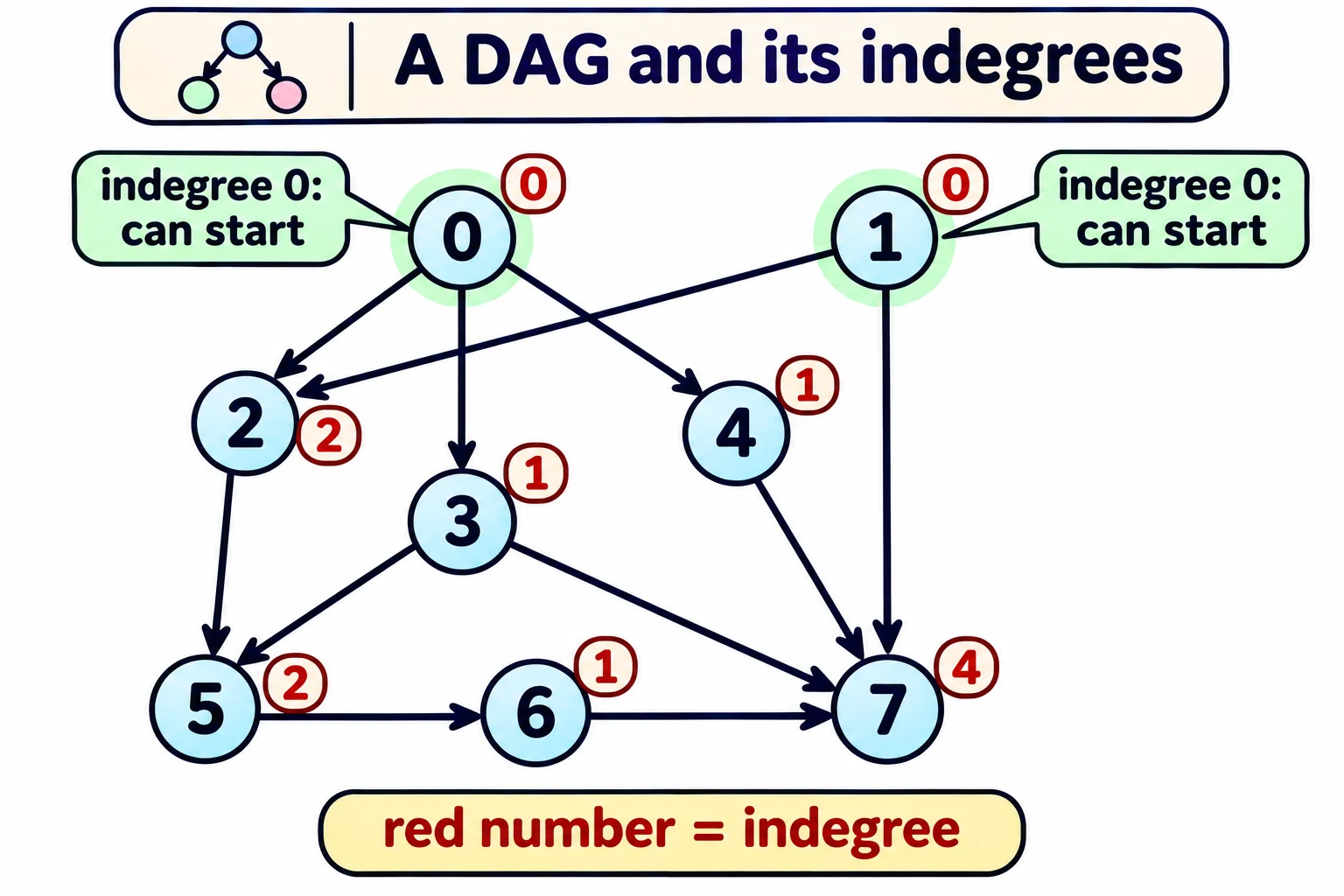
The example DAG (from the lecture)
8 vertices, 11 edges: 0 → 2, 0 → 3, 0 → 4, 1 → 2, 1 → 7, 2 → 5, 3 → 5, 3 → 7, 4 → 7, 5 → 6, 6 → 7.
The strategy
- First list the vertices with no dependencies.
- Then keep listing vertices whose dependencies have all been listed already.
"No dependencies" = no incoming edges = indegree 0.
Two questions:
- Why must there be a starting vertex with indegree 0?
- How do we know we can always keep going?
Why every DAG has a vertex with indegree 0
Suppose every vertex had indegree > 0. Start anywhere and keep walking backwards along an incoming edge to a predecessor. You can always take another step back (every vertex has an incoming edge). After n steps you've visited n + 1 vertices — but there are only n, so some vertex repeats. That means there's a cycle — impossible in a DAG. So some vertex must have indegree 0. ✔
Why we can keep going
List a vertex j with indegree 0, then delete j and all its outgoing edges. Deleting things can't create a cycle, so what remains is still a DAG — and so it again has a vertex with indegree 0. Repeat until every vertex is listed. ✔
The algorithm
- Compute the indegree of every vertex.
- Pick a vertex with indegree 0, list it, and "remove" it: subtract 1 from the indegree of each of its out-neighbours.
- Repeat until all vertices are listed.
Full trace on the example DAG
Starting indegrees:
| Vertex | 0 | 1 | 2 | 3 | 4 | 5 | 6 | 7 |
|---|---|---|---|---|---|---|---|---|
| Indegree | 0 | 0 | 2 | 1 | 1 | 2 | 1 | 4 |
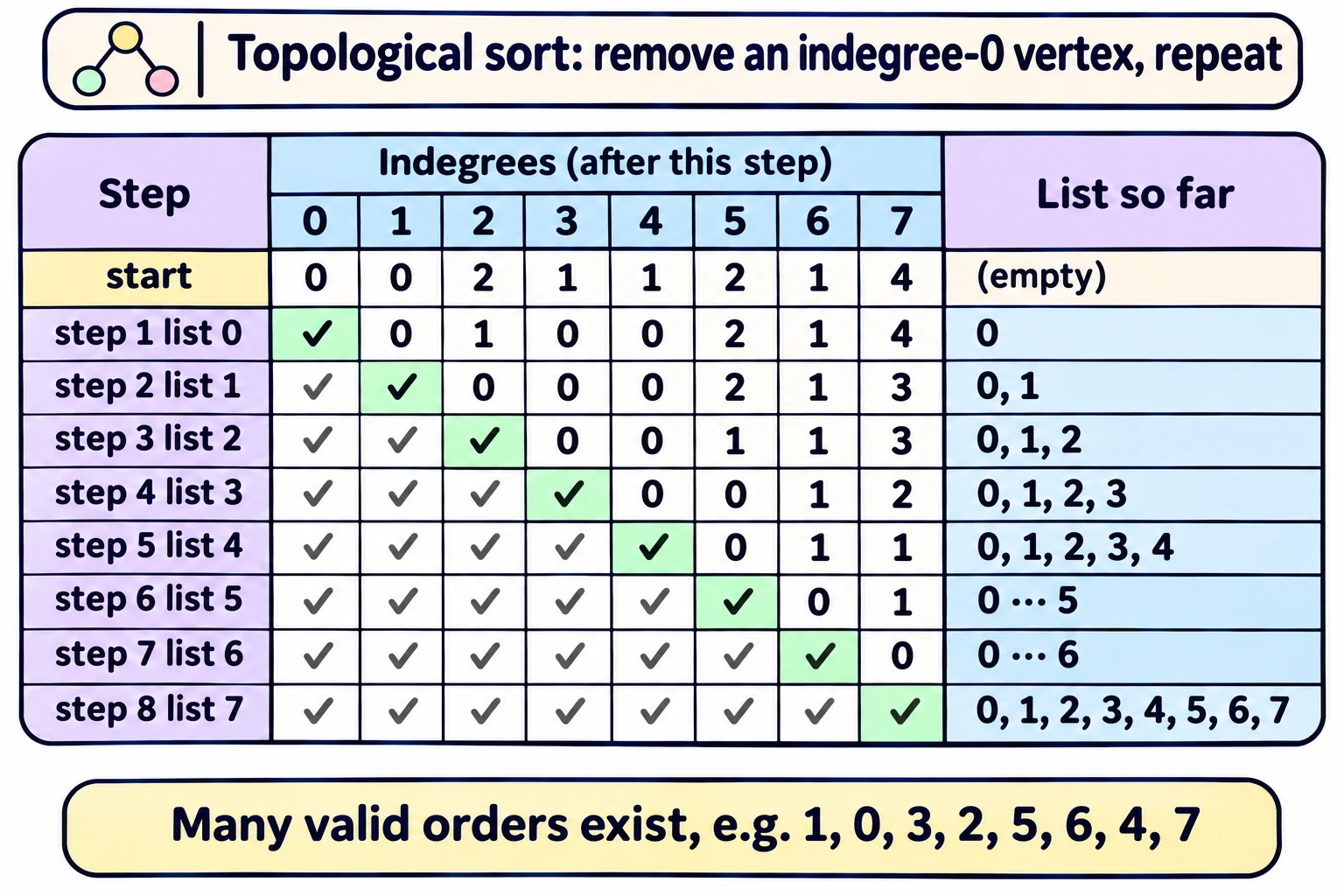
Here we always pick the smallest vertex with indegree 0 (that's what the lecture's code does):
| Step | Indegree-0 choices | List | Update indegrees of its out-neighbours |
|---|---|---|---|
| 1 | 0, 1 | 0 | 2: 2→1, 3: 1→0, 4: 1→0 |
| 2 | 1, 3, 4 | 1 | 2: 1→0, 7: 4→3 |
| 3 | 2, 3, 4 | 2 | 5: 2→1 |
| 4 | 3, 4 | 3 | 5: 1→0, 7: 3→2 |
| 5 | 4, 5 | 4 | 7: 2→1 |
| 6 | 5 | 5 | 6: 1→0 |
| 7 | 6 | 6 | 7: 1→0 |
| 8 | 7 | 7 | — |
Topological order: 0, 1, 2, 3, 4, 5, 6, 7.
The lecture's animation picks differently at each step and gets 1, 0, 3, 2, 5, 6, 4, 7. That is also correct — we checked every edge goes forward in it. More than one topological sort is possible, depending on which indegree-0 vertex you choose next.
Code — with an adjacency matrix
def toposort(AMat):
    (rows, cols) = AMat.shape
    indegree = {}
    toposortlist = []

    for c in range(cols):                  # indegree = number of 1s in column c
        indegree[c] = 0
        for r in range(rows):
            if AMat[r, c] == 1:
                indegree[c] = indegree[c] + 1

    for i in range(rows):
        j = min([k for k in range(cols) if indegree[k] == 0])
        toposortlist.append(j)
        indegree[j] = indegree[j] - 1      # becomes -1, so j is never picked again
        for k in range(cols):
            if AMat[j, k] == 1:
                indegree[k] = indegree[k] - 1

    return toposortlist
Note the trick: setting indegree[j] to −1 marks j as "already listed", so indegree[k] == 0 never picks it again.
Analysis:
- Computing indegrees (scan the whole matrix): O(n²).
- The main loop runs n times. Each time: finding the next vertex O(n) + updating indegrees (scan row j) O(n).
- Total: O(n²).
Code — with an adjacency list (faster)
Keep a queue of vertices whose indegree is 0, so we never have to search for the next one.
def toposortlist(AList):
    (indegree, toposortlist) = ({}, [])
    for u in AList.keys():
        indegree[u] = 0
    for u in AList.keys():
        for v in AList[u]:
            indegree[v] = indegree[v] + 1

    zerodegreeq = Queue()
    for u in AList.keys():
        if indegree[u] == 0:
            zerodegreeq.addq(u)

    while (not zerodegreeq.isempty()):
        j = zerodegreeq.delq()
        toposortlist.append(j)
        indegree[j] = indegree[j] - 1
        for k in AList[j]:
            indegree[k] = indegree[k] - 1
            if indegree[k] == 0:
                zerodegreeq.addq(k)

    return toposortlist
On the example DAG this gives 0, 1, 3, 4, 2, 5, 6, 7 (another valid order — the queue decides).
Analysis:
- Computing indegrees: O(m + n).
- Each vertex enters and leaves the queue once: O(n).
- Each edge's indegree update happens once overall: amortised O(m).
- Total: O(m + n).
| Representation | Time |
|---|---|
| Adjacency matrix | O(n²) |
| Adjacency list (with queue) | O(m + n) |
Everyday example: Planning your semester. First take courses with no prerequisites. Once you've done them, new courses become available (their prerequisites are now complete). Keep going until you've planned every course.
In one line: Repeatedly list a vertex with indegree 0 and reduce its neighbours' indegrees; it works for every DAG, gives O(n²) with a matrix and O(m + n) with lists, and there can be many valid orders.
Exam words: topological sort, feasible schedule, indegree 0, every DAG has a source, remove vertex and update indegrees, queue of indegree-0 vertices, O(n²), O(m + n), more than one topological order.
Quick check
1. In the example DAG, after listing 0 and 1, which vertices have indegree 0?
2, 3 and 4.2. Is 1, 0, 4, 3, 2, 5, 6, 7 a valid topological order for the example DAG?
Check every edge goes forward: 0→2, 0→3, 0→4 ✔ (0 before them); 1→2, 1→7 ✔; 2→5 ✔; 3→5, 3→7 ✔; 4→7 ✔; 5→6 ✔; 6→7 ✔. Yes.3. Topologically sort: edges A → B, A → C, B → D, C → D.
Indegrees: A 0, B 1, C 1, D 2. List A → B, C both drop to 0 → list B, C → D drops to 0 → list D. A, B, C, D (A, C, B, D is also valid).4. What happens if you run topological sort on a graph with a cycle?
At some point no vertex has indegree 0 (the cycle's vertices keep each other above 0), so the cycle's vertices can never be listed. (The matrix code would crash:min([]) of an empty list.)5. Why is the adjacency-list version O(m + n)?
Each vertex enters/leaves the queue once (O(n)) and each edge reduces one indegree exactly once (O(m)).Topological Sort playground
Move one step at a time. The visual state and explanation update together.
Choose A, an indegree-zero task.
Why? An indegree of zero means no unfinished prerequisite points into it.