
REVISION AND PRACTICE
Week 4 Quick Revision
Start here Week 4 in one page: what graphs are, how to store them, BFS and DFS, what they reveal (components, cycles, edge types), and DAGs with topological sort and longest paths.
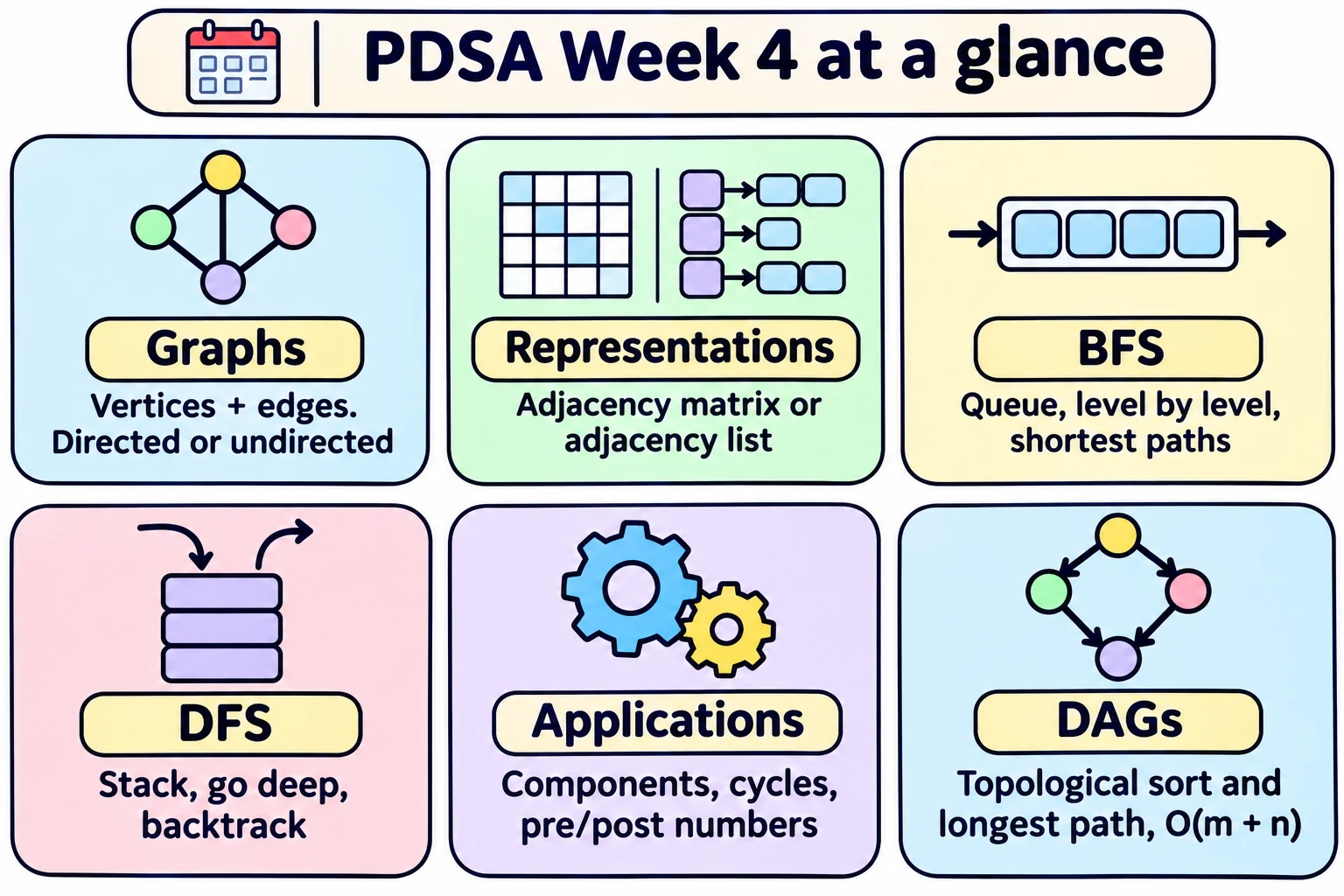
1. Graph basics
- G = (V, E): vertices (nodes) and edges.
- Directed (arrows, one way) vs undirected (lines, both ways).
- Path = no repeated vertex; walk may repeat.
- v is reachable from u if there's a path u ⇝ v.
- Other graph problems: colouring (4 colours suffice for maps), vertex cover, independent set, matching.
2. Representations (n vertices, m edges)
| Adjacency matrix | Adjacency list | |
|---|---|---|
| Storage | n × n, A[i, j] = 1 if edge | Dictionary: vertex → list of neighbours |
| Space | n² | about n + m |
| Is (i, j) an edge? | O(1) | O(degree(i)) |
| All neighbours of i | O(n) | O(degree(i)) |
- Undirected matrix is symmetric. Directed: row = outgoing, column = incoming.
- degree / indegree / outdegree. Sum of degrees = 2m.
3. BFS and DFS
| BFS | DFS | |
|---|---|---|
| Explores | Level by level | Deep first, then backtrack |
| Uses | Queue (FIFO) | Stack (LIFO) / recursion |
| Shortest paths? | Yes (fewest edges, via level) | No |
| Time (matrix / list) | O(n²) / O(n + m) | O(n²) / O(n + m) |
- BFS from 7 (airline graph): levels 1 = {4, 5, 8}, 2 = {0, 3, 6, 9}, 3 = {1, 2}. Path 7–4–0–2 via parents.
- DFS from 4: visits 4, 0, 1, 2, 3, 5, 6, 7, 8, 9.
parent[k] = jlets you trace the path back.
4. Applications
- Connected components: BFS from the smallest unassigned vertex, give a new component number each time.
- Cycles (undirected): a non-tree edge in the BFS/DFS tree means a cycle.
- DFS numbering: pre[v] on entry, post[v] on exit (one counter).
- Directed edge types using intervals [pre, post]:
- Tree / forward: [pre(u), post(u)] contains [pre(v), post(v)]. - Back: [pre(v), post(v)] contains [pre(u), post(u)] → cycle. - Cross: intervals disjoint.
- Strongly connected: paths both ways. Graph splits into SCCs.
5. DAGs, topological sort, longest path
- DAG = directed graph with no directed cycles → models dependencies.
- Topological sort: for every edge (i, j), i before j. Every DAG has one; usually many.
- Every DAG has an indegree-0 vertex; remove it, the rest is still a DAG.
- Algorithm: compute indegrees → repeatedly list an indegree-0 vertex, decrement its neighbours. Matrix O(n²), list + queue O(m + n).
- Longest path: longest-path-to(i) = 0 if indegree 0, else 1 + max over incoming neighbours. Compute in topological order; one extra line
lpath[k] = max(lpath[k], lpath[j]+1). O(m + n). - Lecture DAG: longest-path-to = 0, 0, 1, 1, 1, 2, 3, 4 for vertices 0–7 → 5 semesters.
- Longest path in general graphs: no efficient method known.
Watch out — slide points to know
| Slide | Point |
|---|---|
| 4.2 directed adjacency matrix | Side note "Neighbours of 6 are [3, 5]" is from the undirected graph; in the directed graph 6's only out-neighbour is 5 |
| 4.5 DFSInitPrePost | pre[i],post[i]) = (-1,-1) is missing a bracket → (pre[i], post[i]) = (-1, -1) |
| 4.7 topological sort | The animation lists 1, 0, 3, 2, 5, 6, 4, 7; the matrix code (always the smallest indegree-0 vertex) outputs 0, 1, 2, 3, 4, 5, 6, 7 — both valid |
| 4.3 Queue class | delq copies the list (queue[1:]), so it's O(n); collections.deque gives O(1) |
Practice questions
1. An undirected graph has 6 vertices with degrees 3, 2, 2, 1, 1, 1. How many edges?
Sum of degrees = 10 = 2m → m = 5.2. Write the adjacency list for the undirected graph with edges 0–1, 0–2, 1–3.
{0: [1, 2], 1: [0, 3], 2: [0], 3: [1]}