
Introduction to Graphs
Start here Many real problems are about relationships: who is friends with whom, which cities have direct flights, which task must finish before another. A graph is the simple picture that captures all of these: dots for things, lines for relationships. Once a problem becomes a graph, we can use the same algorithms to solve very different problems.
Relations as pictures
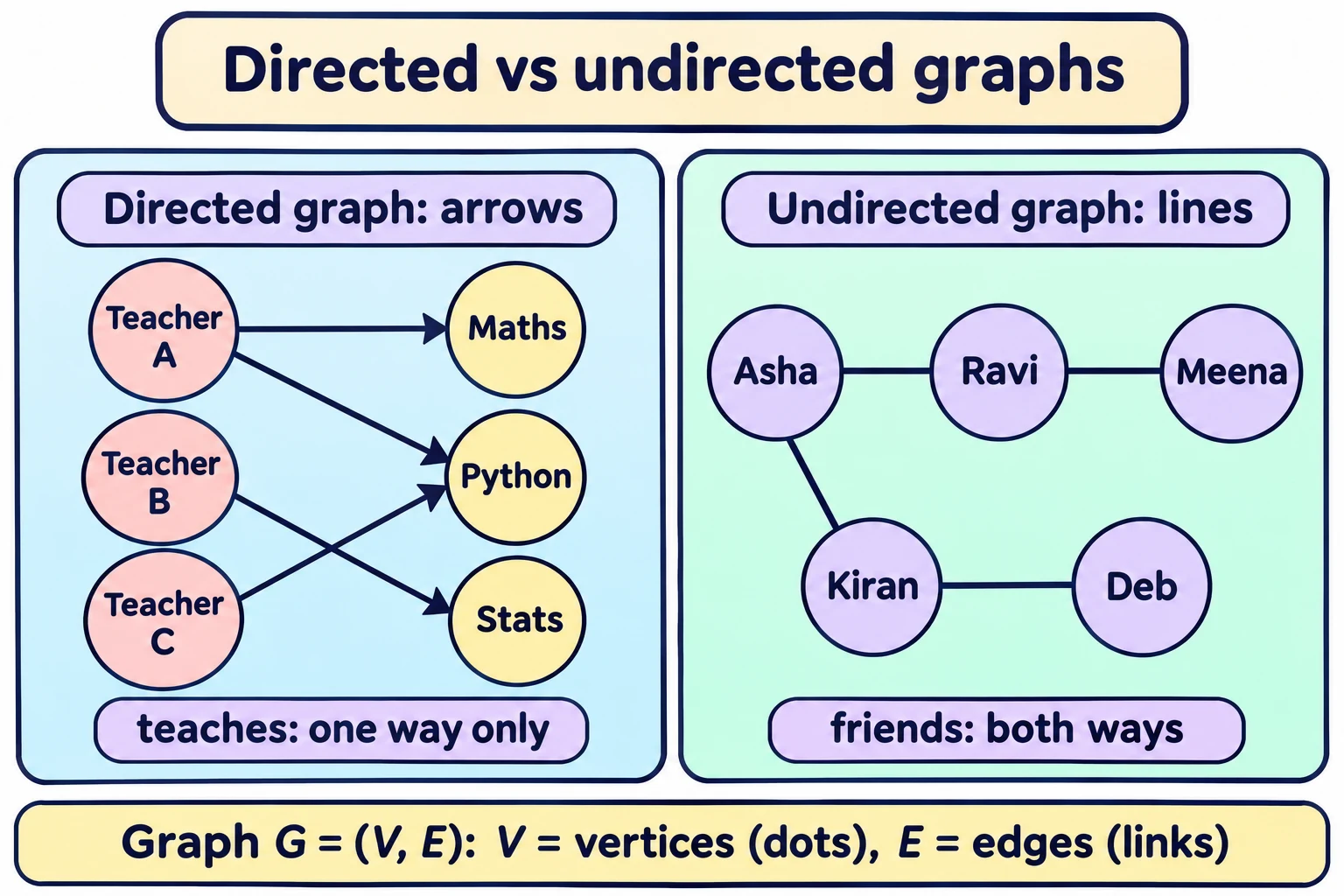
Example 1 — teachers and courses.
- T = the set of teachers in a college, C = the set of courses.
- A = {(t, c) | teacher t teaches course c}. This is a set of pairs.
- Draw each teacher and course as a dot; draw an arrow from t to c if t teaches c.
Example 2 — friendships.
- P = a set of students.
- F = {(p, q) | p and q are friends, p ≠ q}.
- Friendship works both ways: (p, q) is in F if and only if (q, p) is in F. So we draw a line (no arrow).
What is a graph?
Graph G = (V, E) - V = a set of vertices (also called nodes). One vertex, many vertices. - E = a set of edges. Each edge is a pair of vertices: E ⊆ V × V.
| Type | Rule | Example |
|---|---|---|
| Directed graph | (v, v′) in E does not mean (v′, v) is in E. Edges are arrows. | Teacher → course; one-way flight routes; "A is a parent of B" |
| Undirected graph | (v, v′) in E if and only if (v′, v) is in E. Edges are plain lines. | Friendship; two-way roads; "A is a friend of B" |
In an undirected graph, (v, v′) and (v′, v) are really the same edge.
Paths
A path is a sequence of vertices v₁, v₂, ..., vₖ where each next pair is joined by an edge: (vᵢ, vᵢ₊₁) is in E for every 1 ≤ i < k.
- Normally a path does not visit any vertex twice.
- A sequence that re-visits a vertex is usually called a walk.
Example (friendship graph): Kumar — Feroze — Colin — Aziz — Priya is a path (no repeats). If it continued "— Feroze — Sheila", Feroze would appear twice, so the whole sequence is a walk.
Reachability
In a directed graph, paths must follow the arrows.
Example — airline routes. Cities are vertices; a direct flight from city u to city v is an edge u → v. "How can I fly from Madurai to Delhi?" means: find a path from the Madurai vertex to the Delhi vertex.
Vertex v is reachable from vertex u if there is a path from u to v.
Typical questions:
- Is v reachable from u?
- What is the shortest path from u to v?
- Which vertices are reachable from u?
- Is the graph connected — is every vertex reachable from every other?
We answer these with BFS and DFS later this week.
Graphs solve many other problems
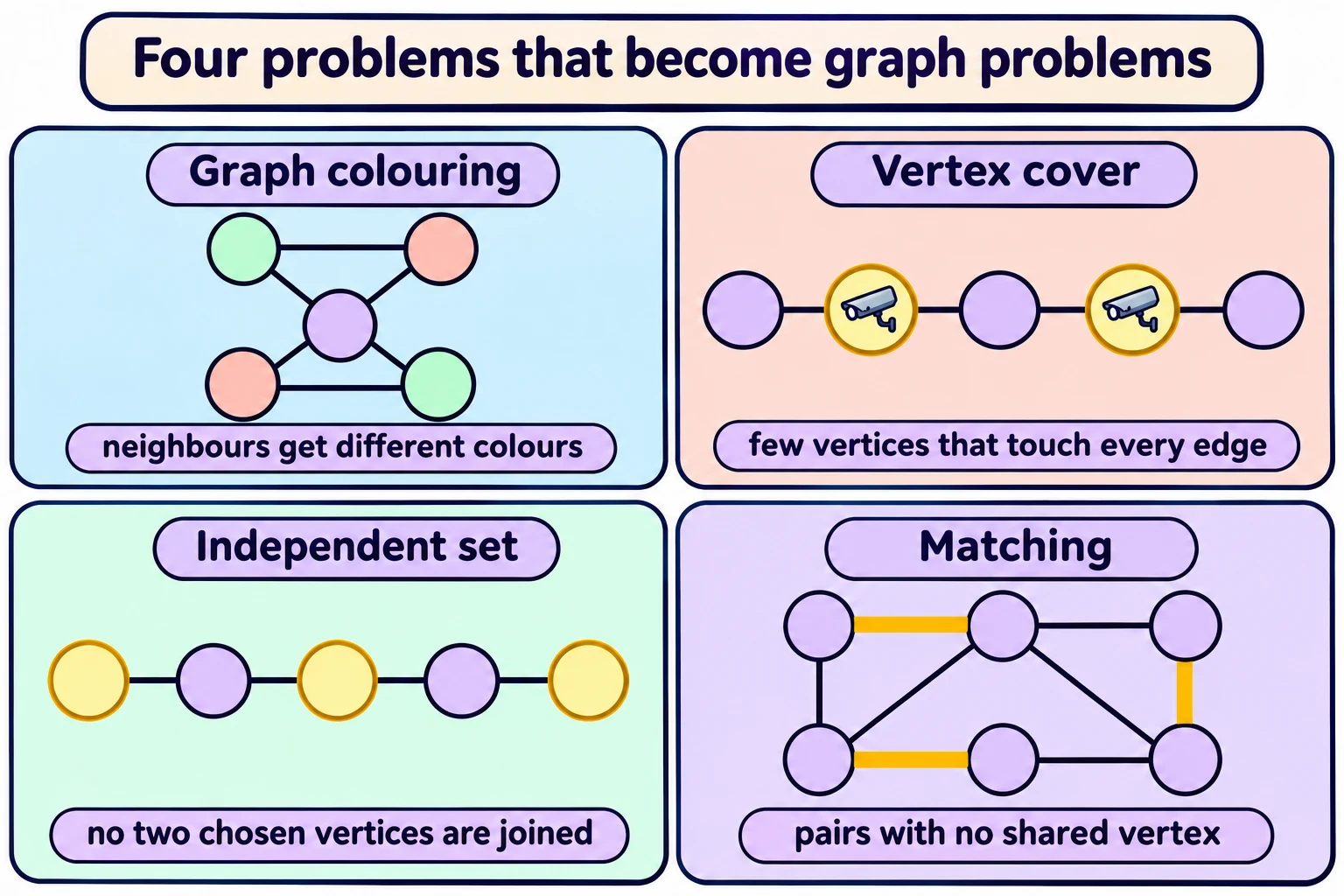
The magic of graphs: very different real-life problems become the same graph problem. Here are four from the lecture.
1. Graph colouring
Problem: colour a map so that states sharing a border get different colours. How few colours do we need?
As a graph: each state is a vertex; join two states if they share a border. Give each vertex a colour so that the two ends of every edge have different colours.
A colouring is a function c : V → C such that if (u, v) is in E, then c(u) ≠ c(v).
- Only the graph matters — you can stretch or bend the map; the problem is the same. That's the power of abstraction.
- Four Colour Theorem: for maps (planar graphs), 4 colours are always enough.
- Not every graph is planar. For general graphs, finding the minimum number of colours is hard.
Why care? — classrooms. Courses are vertices; join two courses if their timetable slots overlap. Colours = classrooms. The minimum number of colours = the minimum number of classrooms needed.
2. Vertex cover
Problem: a hotel wants security cameras. Corridors are straight lines. A camera at an intersection watches all corridors meeting there. What is the minimum number of cameras?
As a graph: intersections are vertices, corridor segments are edges. Choose the smallest set of vertices that touches every edge.
3. Independent set
Problem: a dance school has several group dances; dancers may be in more than one dance. In a programme, each dancer performs at most once. What is the maximum number of dances we can include?
As a graph: each dance is a vertex; join two dances if they share a dancer. Choose the largest set of vertices with no edge between any two of them.
4. Matching
Problem: a class project is done alone or in pairs, and pairs must be friends. Make good groups.
As a graph: the friendship graph. A matching is a set of edges where no two edges share a vertex (each person is in at most one pair). Find a maximal matching. Is there a perfect matching — one that covers every vertex?
| Problem | Real question | Graph question |
|---|---|---|
| Colouring | Fewest colours / classrooms | Colour vertices so every edge has different-coloured ends |
| Vertex cover | Fewest cameras | Smallest set of vertices touching every edge |
| Independent set | Most dances | Largest set of vertices with no edges between them |
| Matching | Project pairs | Set of edges with no shared vertex |
In one line: A graph G = (V, E) has vertices (things) and edges (relationships), directed or undirected; paths and reachability are the basic questions, and colouring, vertex cover, independent set and matching are more examples.
Exam words: graph, vertex/node, edge, directed, undirected, path, walk, reachable, connected, graph colouring, Four Colour Theorem, vertex cover, independent set, matching, perfect matching.