
Longest Path in a DAG
Start here Suppose the DAG shows prerequisites between courses, and each course takes one semester. You can take many courses in the same semester, as long as their prerequisites are done. What is the minimum number of semesters to finish? The answer is the longest chain of prerequisites — the longest path in the DAG. And we can compute it at the same time as topological sorting.
The question
- The DAG represents prerequisites between courses.
- Each course takes one semester.
- Courses with no pending prerequisites can be taken together.
- Minimum number of semesters to complete the programme?
The bottleneck is the longest chain A → B → C → ... — you must take them one after another. So we need the longest path.
The rule
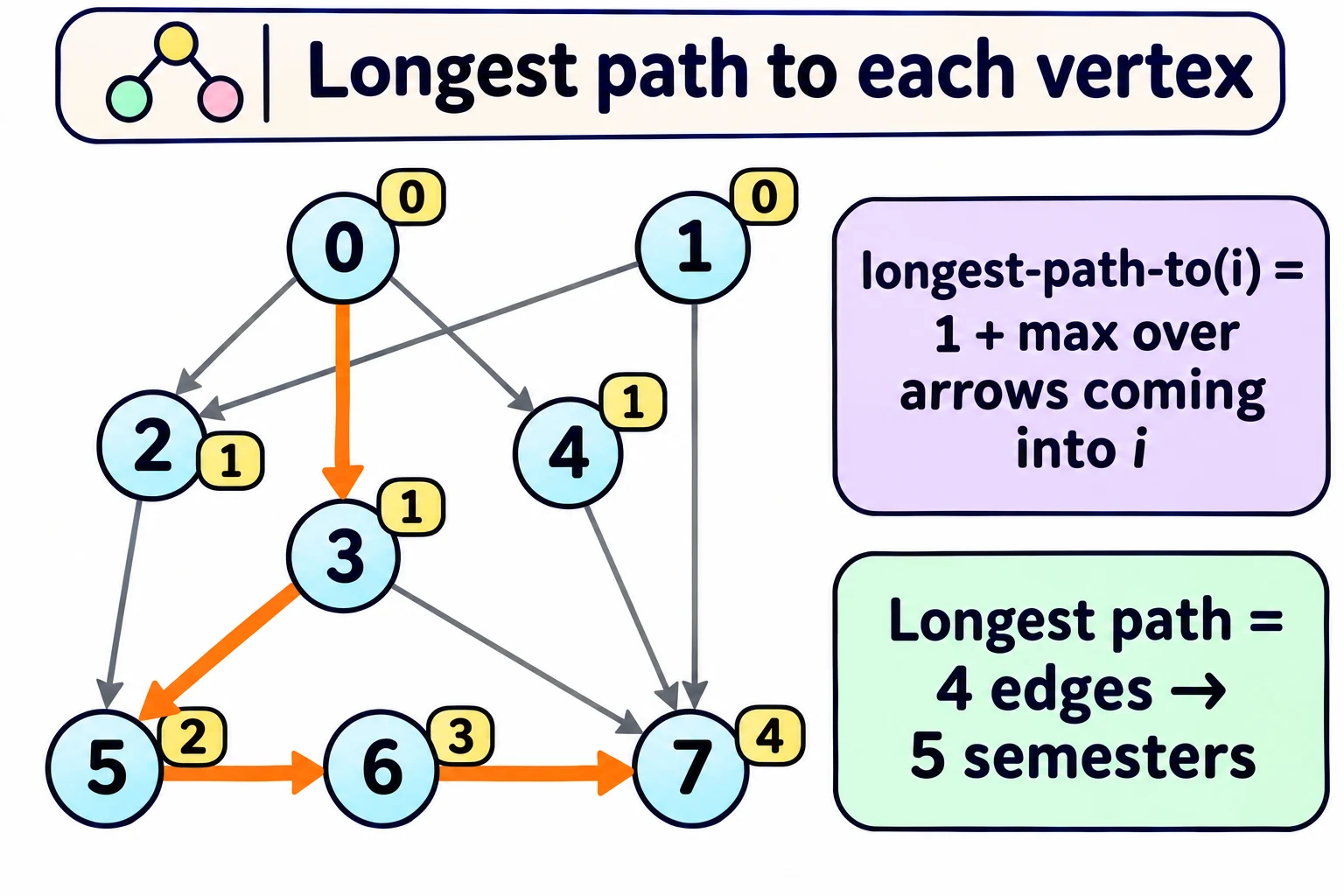
Let longest-path-to(i) = the number of edges in the longest path ending at vertex i.
- If indegree(i) = 0 (no prerequisites): longest-path-to(i) = 0.
- Otherwise, the longest path to i is one more than the longest path to any vertex that points to i:
longest-path-to(i) = 1 + max { longest-path-to(j) | (j, i) is an edge }
Everyday example: You can't start Course C until you've finished every prerequisite. So C's earliest semester is one more than the latest of its prerequisites' semesters.
Compute in topological order
To compute longest-path-to(i), we need the values for all its incoming neighbours first. In a topological order, every incoming neighbour of i appears before i. So:
Go through the vertices in topological order, left to right, computing each longest-path-to(i) from the values already known.
Even better, do it during the topological sort itself.
Full trace — the lecture's DAG
Edges: 0 → 2, 0 → 3, 0 → 4, 1 → 2, 1 → 7, 2 → 5, 3 → 5, 3 → 7, 4 → 7, 5 → 6, 6 → 7.
Using the lecture's order 1, 0, 3, 2, 5, 6, 4, 7:
| Vertex (in topological order) | Incoming from | Calculation | longest-path-to |
|---|---|---|---|
| 1 | — | indegree 0 | 0 |
| 0 | — | indegree 0 | 0 |
| 3 | 0 | 1 + 0 | 1 |
| 2 | 0, 1 | 1 + max(0, 0) | 1 |
| 5 | 2, 3 | 1 + max(1, 1) | 2 |
| 6 | 5 | 1 + 2 | 3 |
| 4 | 0 | 1 + 0 | 1 |
| 7 | 1, 3, 4, 6 | 1 + max(0, 1, 1, 3) | 4 |
The longest path has 4 edges, ending at 7. One such path: 0 → 3 → 5 → 6 → 7 (or 0 → 2 → 5 → 6 → 7, or 1 → 2 → 5 → 6 → 7).
So if each vertex is a one-semester course, the programme takes 4 + 1 = 5 semesters (a path with 4 edges has 5 courses).
| Semester | Courses that can be taken (longest-path-to = semester − 1) |
|---|---|
| 1 | 0, 1 |
| 2 | 2, 3, 4 |
| 3 | 5 |
| 4 | 6 |
| 5 | 7 |
The code — topological sort + longest path together
def longestpathlist(AList):
    (indegree, lpath) = ({}, {})
    for u in AList.keys():
        (indegree[u], lpath[u]) = (0, 0)
    for u in AList.keys():
        for v in AList[u]:
            indegree[v] = indegree[v] + 1

    zerodegreeq = Queue()
    for u in AList.keys():
        if indegree[u] == 0:
            zerodegreeq.addq(u)

    while (not zerodegreeq.isempty()):
        j = zerodegreeq.delq()
        indegree[j] = indegree[j] - 1
        for k in AList[j]:
            indegree[k] = indegree[k] - 1
            lpath[k] = max(lpath[k], lpath[j] + 1)    # the only new line
            if indegree[k] == 0:
                zerodegreeq.addq(k)

    return lpath
It's the topological-sort code with one extra line: when we remove edge j → k, update lpath[k] = max(lpath[k], lpath[j] + 1). By the time k's indegree reaches 0, every incoming neighbour has been processed, so lpath[k] is final.
Running it on the example gives: {0: 0, 1: 0, 2: 1, 3: 1, 4: 1, 5: 2, 6: 3, 7: 4} ✔ (same as the table).
Analysis: same as topological sort with lists:
- Indegrees: O(m + n). Each vertex processed once: O(n). Each edge updated once: amortised O(m).
- Total: O(m + n). (With an adjacency matrix: O(n²).)
Longest paths in general graphs — much harder!
- The idea of a longest path also makes sense in graphs with cycles. Since a path doesn't repeat vertices, it has at most n − 1 edges.
- But for general graphs, no efficient method is known. The best known strategy is basically to try all paths — exponentially many.
- In a DAG, it's easy (O(m + n)) because topological order lets us build answers step by step.
Back to the office example
Each task takes a day: Conduits = 0, Tiling/Plastering = 1, Painting = 2, Wiring (E)/Cabling (T) = 3, Fittings (E) = 4. Longest path = 4 edges → 5 days minimum.
In one line: longest-path-to(i) = 0 for sources, else 1 + max over incoming neighbours; compute it in topological order (one extra line in toposort), O(m + n) — easy for DAGs, hard for general graphs.
Exam words: longest path, longest-path-to(i), 1 + max over incoming neighbours, topological order, lpath, minimum number of semesters, O(m + n), hard for general graphs.
Quick check
1. Edges A → B, A → C, B → D, C → D, D → E. Find longest-path-to for each vertex.
A 0; B 1; C 1; D 1 + max(1, 1) = 2; E 3.2. With those courses (each one semester), how many semesters are needed?
Longest path has 3 edges → 3 + 1 = 4 semesters (A; B and C together; D; E).3. Why must we process vertices in topological order?
longest-path-to(i) needs the values of all its incoming neighbours first; in topological order they all come before i.4. What is the one line added to the topological-sort code to get longest paths?
lpath[k] = max(lpath[k], lpath[j] + 1)5. Is finding the longest path easy in a graph with cycles?
No — no efficient method is known; it's essentially try-all-paths. It is easy only for DAGs.Longest Path in a DAG playground
Move one step at a time. The visual state and explanation update together.
Process A after all of its predecessors.
Why? Topological order ensures every possible incoming path has already been considered.