
Merge Sort
Start here Selection sort and insertion sort both take O(n²). For n = 10⁵, that's 10¹⁰ steps — about 16 minutes in Python. Too slow for big data. Merge sort breaks this barrier with a powerful idea called divide and conquer: split the list in half, sort each half, then merge the two sorted halves.
Why we need something better
| n | n² steps | Time in Python (10⁷ steps/s) |
|---|---|---|
| 10⁴ | 10⁸ | 10 seconds |
| 10⁵ | 10¹⁰ | about 17 minutes |
| 10⁶ | 10¹² | about 28 hours |
O(n²) sorting becomes painful beyond about n = 10,000.
Strategy 3 — Divide and Conquer
- Divide the list into two halves.
- Conquer: sort the left half and the right half separately.
- Combine: merge the two sorted halves into one sorted list.
But how do we sort each half? The same way — recursively! Keep splitting until the pieces have just 1 item. A list of 1 item is already sorted.
Step 1 — Merging two sorted lists
Problem: A and B are already sorted. Make one sorted list C.
Method:
- Compare the first (smallest remaining) items of A and B.
- Move the smaller one to C.
- Repeat. When one list runs out, copy the rest of the other list to C.
Everyday example: Two queues of students, each already arranged by height. To make one line by height, keep calling forward the shorter of the two students at the front of the queues.
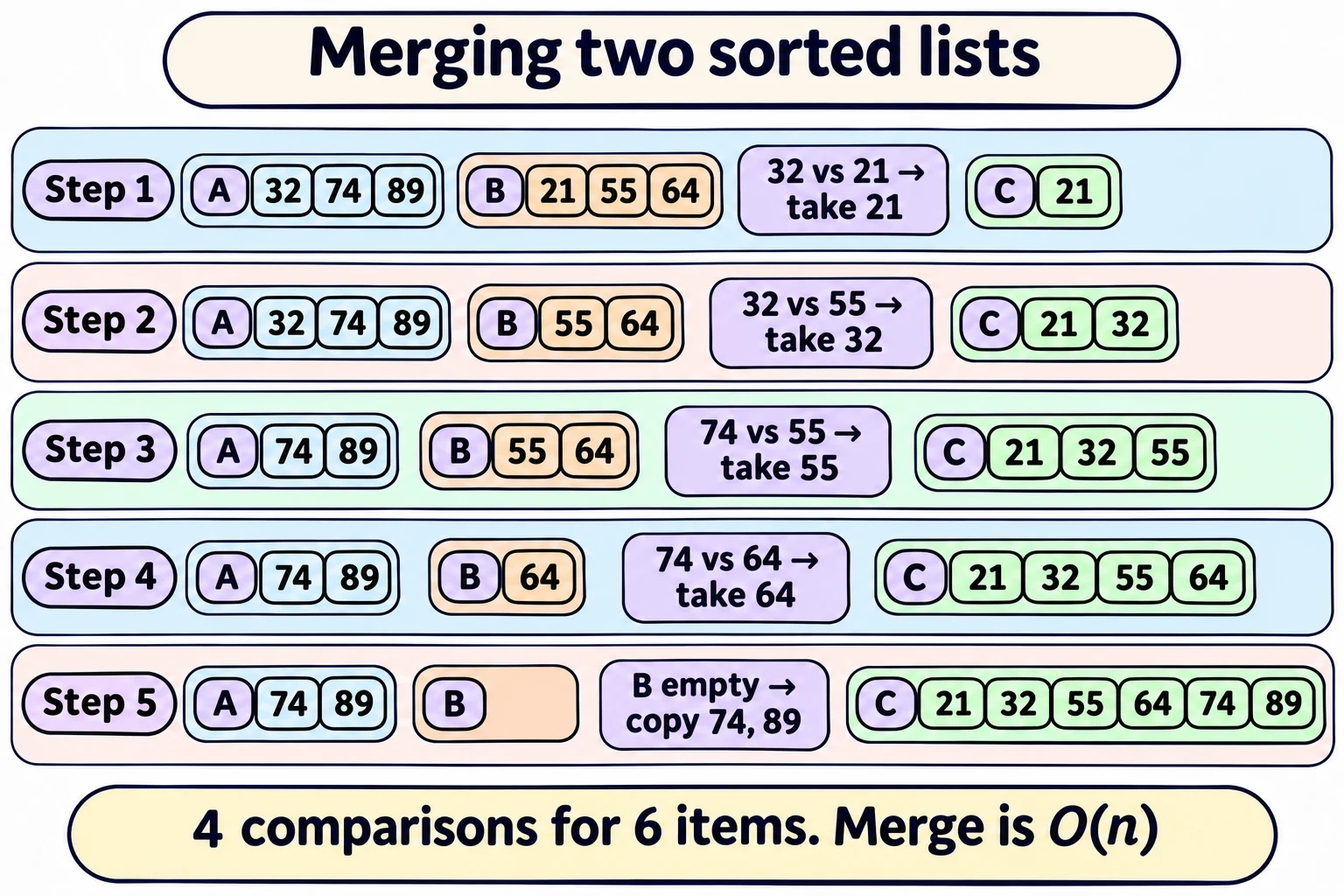
Trace — merge A = [32, 74, 89] and B = [21, 55, 64]
| Step | Front of A | Front of B | Smaller → C | C so far |
|---|---|---|---|---|
| 1 | 32 | 21 | 21 (from B) | [21] |
| 2 | 32 | 55 | 32 (from A) | [21, 32] |
| 3 | 74 | 55 | 55 (from B) | [21, 32, 55] |
| 4 | 74 | 64 | 64 (from B) | [21, 32, 55, 64] |
| 5 | 74 | (B empty) | copy rest of A | [21, 32, 55, 64, 74, 89] |
Only 4 comparisons to merge 6 items. Every comparison puts one item into its final place in C.
The merge code
def merge(A, B):
    (m, n) = (len(A), len(B))
    (C, i, j, k) = ([], 0, 0, 0)
    while k < m + n:
        if i == m:                 # A is used up
            C.extend(B[j:])        # copy the rest of B
            k = k + (n - j)
        elif j == n:               # B is used up
            C.extend(A[i:])        # copy the rest of A
            k = k + (m - i)
        elif A[i] < B[j]:
            C.append(A[i])
            (i, k) = (i + 1, k + 1)
        else:
            C.append(B[j])
            (j, k) = (j + 1, k + 1)
return C| Variable | Meaning |
|---|---|
| i | Position of the next unused item in A |
| j | Position of the next unused item in B |
| k | How many items are already in C |
extend | Adds a whole list to the end of C at once |
Step 2 — Merge sort itself
def mergesort(A):
    n = len(A)
    if n <= 1:
        return A                       # 0 or 1 item: already sorted
    L = mergesort(A[:n//2])            # sort the left half
    R = mergesort(A[n//2:])            # sort the right half
    B = merge(L, R)                    # merge the two sorted halves
    return B
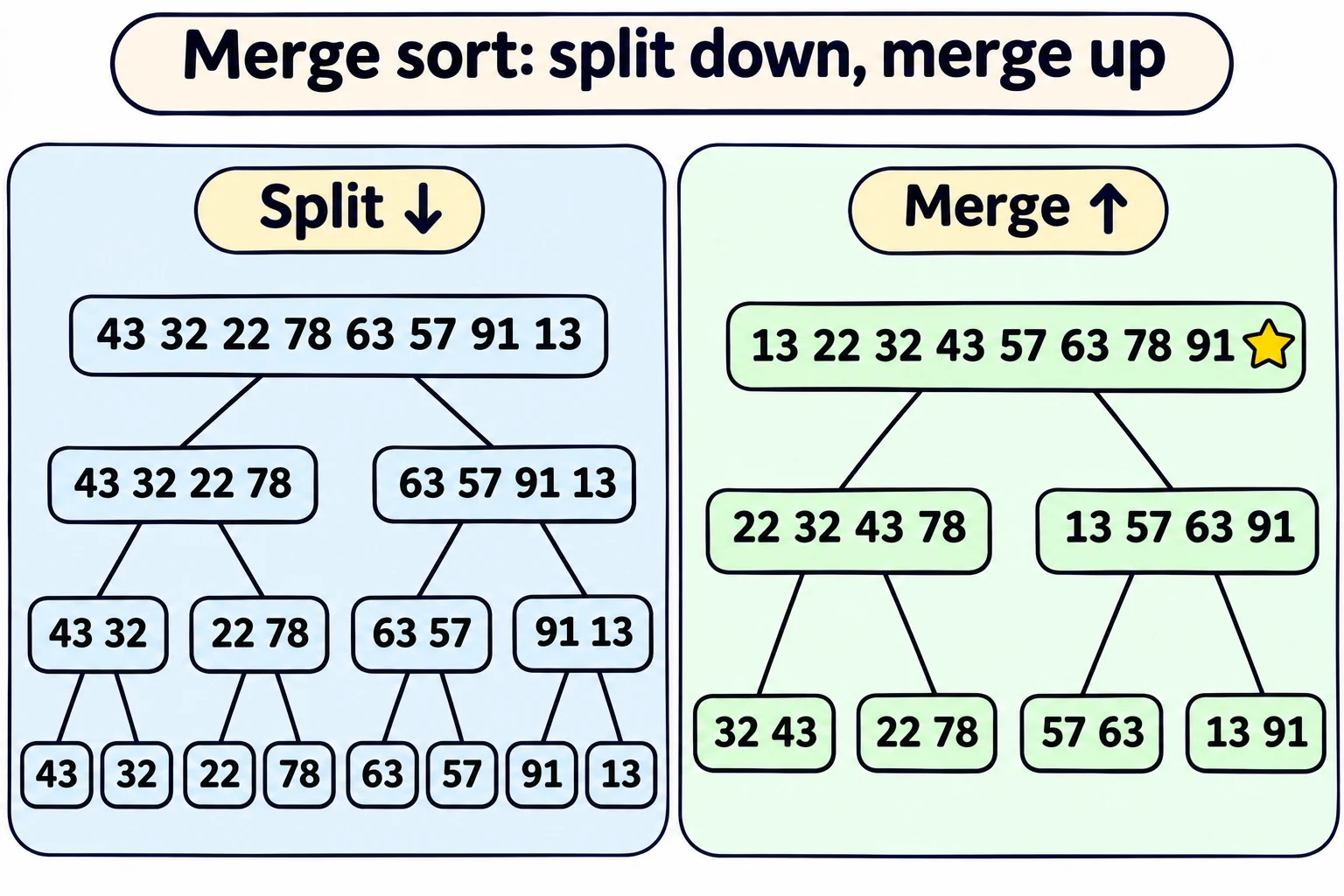
Full example — sort [43, 32, 22, 78, 63, 57, 91, 13]
Going down (divide):
                 [43, 32, 22, 78, 63, 57, 91, 13]
                /                                \
      [43, 32, 22, 78]                    [63, 57, 91, 13]
       /          \                         /          \
   [43, 32]     [22, 78]               [63, 57]     [91, 13]
   /    \        /    \                 /    \        /    \
 [43]  [32]   [22]  [78]             [63]  [57]   [91]  [13]
Coming back up (merge):
| Level | Merges done | Result |
|---|---|---|
| Pairs | [43] + [32] → [32, 43]; [22] + [78] → [22, 78]; [63] + [57] → [57, 63]; [91] + [13] → [13, 91] | [32, 43] [22, 78] [57, 63] [13, 91] |
| Fours | [32, 43] + [22, 78] → [22, 32, 43, 78]; [57, 63] + [13, 91] → [13, 57, 63, 91] | [22, 32, 43, 78] [13, 57, 63, 91] |
| Whole | [22, 32, 43, 78] + [13, 57, 63, 91] | [13, 22, 32, 43, 57, 63, 78, 91] |
Divide and conquer — the general pattern
| Step | In merge sort |
|---|---|
| Break the problem into disjoint (non-overlapping) parts | Left half and right half |
| Solve each part separately | Recursively sort each half |
| Combine the solutions efficiently | Merge the two sorted halves |
You will meet this pattern again (quicksort next week, and many more).
Bonus: variations of merge (from the lecture)
The same "two pointers walking along two sorted lists" idea solves other problems.
Let A = [1, 3, 5, 7] and B = [3, 4, 5, 8].
| Variation | Rule when A[i] == B[j] | Result |
|---|---|---|
| Union (no duplicates) | Move only one copy to C, advance both i and j | [1, 3, 4, 5, 7, 8] |
| Intersection | Move one copy to C; otherwise just skip the smaller item | [3, 5] |
| List difference A − B | Items in A but not in B | [1, 7] |
In one line: Merge sort splits the list in half, sorts each half recursively, and merges the sorted halves by repeatedly taking the smaller front item.
Exam words: merge sort, divide and conquer, merge, two sorted lists, A[:n//2], A[n//2:], base case n ≤ 1, extend, union, intersection, list difference.
Quick check
1. Merge [5, 9, 12] and [3, 10]. Show C after each step.
3 → [3]; 5 → [3, 5]; 9 → [3, 5, 9]; 10 → [3, 5, 9, 10]; B empty, copy 12 → [3, 5, 9, 10, 12].2. What is the base case of mergesort?
A list of length 0 or 1 — it is already sorted, so return it as it is.3. Sort [6, 2, 8, 4] with merge sort. Show the merges.
[6] + [2] → [2, 6]; [8] + [4] → [4, 8]; [2, 6] + [4, 8] → [2, 4, 6, 8].4. At most how many comparisons does merging two lists of total length m + n need?
At most m + n − 1, because every comparison places one item, and the last item needs no comparison.5. Find the intersection of [2, 4, 6, 8] and [1, 2, 3, 6, 9] using the merge idea.
[2, 6].Merge Sort playground
Move one step at a time. The visual state and explanation update together.
38 needs no sorting.
Why? A one-item list is already sorted.