
Insertion Sort
Start here Insertion sort is how most people arrange playing cards in their hand: pick up one card at a time and slide it into the right place among the cards you already hold. It is also O(n²) in the worst case — but unlike selection sort, it becomes very fast when the list is already almost sorted.
The idea — the TA again, Strategy 2
- Move the first paper to a new pile.
- Take the second paper. Lower marks than the first? Put it below. Higher? Put it above.
- Take the third paper and insert it in the correct position among the first two.
- Keep going: insert each new paper into its correct position in the new pile.
The new pile is always sorted; it just keeps getting bigger.
Everyday example: Arranging cards in your hand. You never re-check the whole hand — you just slide each new card left until the card before it is smaller.
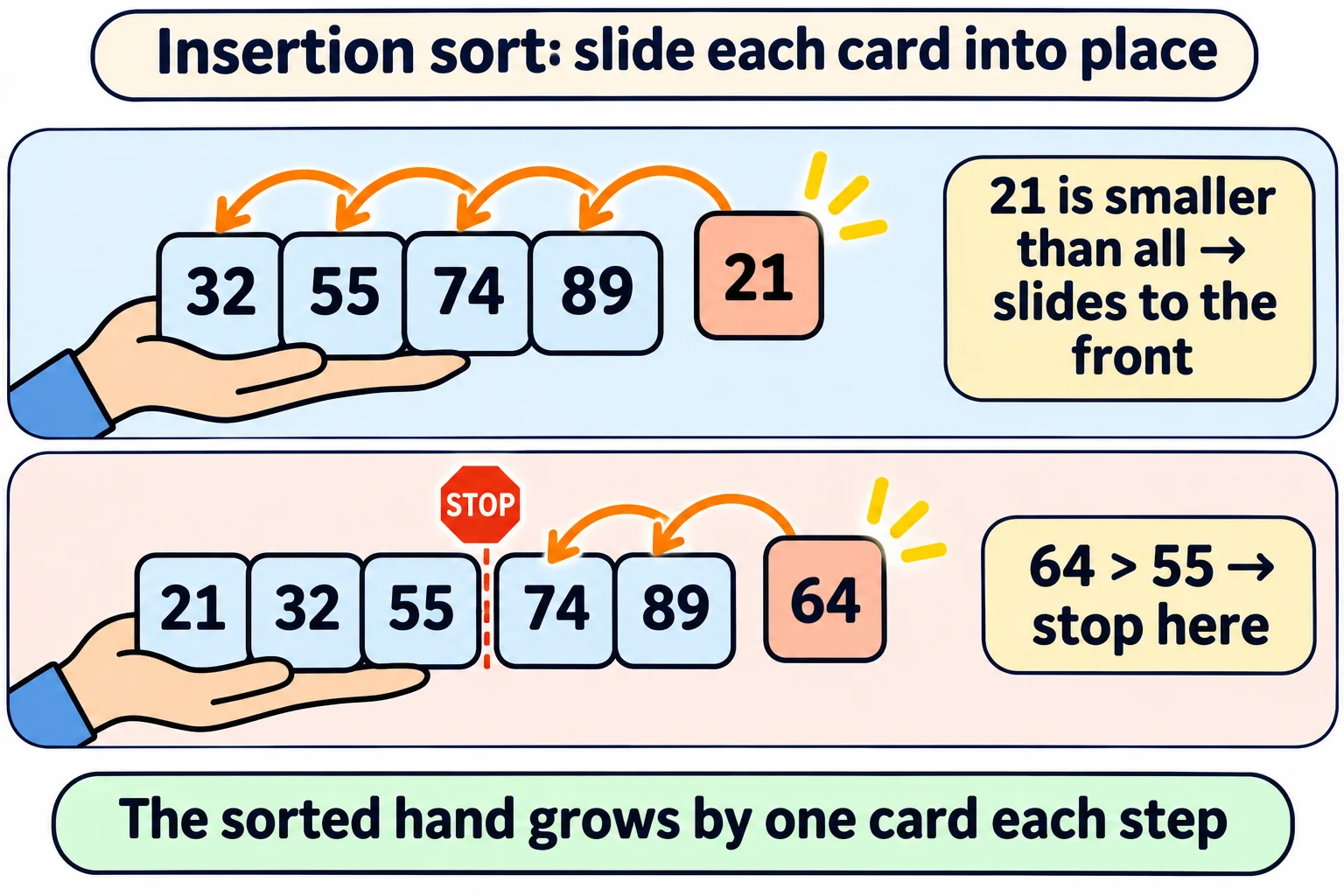
Doing it in the same list
Think of the list as two parts: a sorted part L[:i] on the left and the rest on the right. For each i, take L[i] and swap it leftwards while the item before it is bigger.
Full trace — sort [74, 32, 89, 55, 21, 64]
| i | Item to insert | What happens | List after (sorted part | rest) |
|---|---|---|---|
| 0 | 74 | Nothing before it | 74 | 32, 89, 55, 21, 64 |
| 1 | 32 | 32 < 74 → swap. Reached the front. | 32, 74 | 89, 55, 21, 64 |
| 2 | 89 | 89 > 74 → stop at once (0 swaps) | 32, 74, 89 | 55, 21, 64 |
| 3 | 55 | 55 < 89 swap; 55 < 74 swap; 55 > 32 stop | 32, 55, 74, 89 | 21, 64 |
| 4 | 21 | smaller than 89, 74, 55, 32 → 4 swaps to the front | 21, 32, 55, 74, 89 | 64 |
| 5 | 64 | 64 < 89 swap; 64 < 74 swap; 64 > 55 stop | 21, 32, 55, 64, 74, 89 |
Sorted: 21, 32, 55, 64, 74, 89 ✔
The code (iterative)
def InsertionSort(L):
    n = len(L)
    if n < 1:
        return L
    for i in range(n):
        # Assume L[:i] is sorted
        # Move L[i] to its correct position in L[:i+1]
        j = i
        while j > 0 and L[j] < L[j-1]:
            (L[j], L[j-1]) = (L[j-1], L[j])
            j = j - 1
        # Now L[:i+1] is sorted
    return L
Careful — bug in the lecture slide. The slide writes
while(L[j] < L[j-1]):withoutj > 0. When j reaches 0, Python readsL[j-1]=L[-1]— the last item of the list! The swaps then wrap around the end and keep going, until j becomes so negative that Python stops withIndexError. We ran the slide's code: it crashed on every list we tried, even[1, 2, 3]. Always writewhile j > 0 and L[j] < L[j-1]:. Thej > 0must come first, so Python stops before readingL[j-1].
Why is it correct? — the invariant
At the start of step i, L[:i] is sorted.
Inserting L[i] into its correct place keeps L[:i+1] sorted. When i reaches n, the whole list is sorted.
A recursive version
Another way to think:
- Recursively sort everything except the last item: L[:-1].
- Insert the last item L[-1] into that sorted list.
def Insert(L, v):
    # L is sorted; return a sorted list with v added
    n = len(L)
    if n == 0:
        return [v]
    if v >= L[-1]:
        return L + [v]                       # v belongs at the end
    else:
        return Insert(L[:-1], v) + L[-1:]    # insert v into the rest, then put L[-1] back

def ISort(L):
    n = len(L)
    if n < 1:
        return L
    L = Insert(ISort(L[:-1]), L[-1])
    return L
(One lecture slide shows l[-1:] with a small L and else without a colon — both are typos. It must be L[-1:] and else:.)
Trace of Insert([32, 55, 74], 50):
- 50 ≥ 74? No → Insert([32, 55], 50) + [74]
- 50 ≥ 55? No → Insert([32], 50) + [55]
- 50 ≥ 32? Yes → [32] + [50] = [32, 50]
- Build back up: [32, 50] + [55] = [32, 50, 55]; then + [74] = [32, 50, 55, 74] ✔
How long does it take?
Worst case — the list is in reverse order
Every new item must slide all the way to the front. Step i makes i swaps.
0 + 1 + 2 + ... + (n − 1) = n(n − 1)/2 → O(n²).
For n = 6: 0 + 1 + 2 + 3 + 4 + 5 = 15.
Best case — the list is already sorted
Each new item is compared once with the item before it, sees it is bigger, and stops at once. Only about n comparisons → close to O(n)!
Analysis of the recursive version (from the lecture)
Let T_I(n) = time for Insert on a list of size n, and T_S(n) = time for ISort.
- Insert: T_I(0) = 1, T_I(n) = T_I(n − 1) + 1. Unwinding: T_I(n) = n (it may walk the whole list).
- ISort: T_S(0) = 1, T_S(n) = T_S(n − 1) + T_I(n − 1).
Unwinding: T_S(n) ≈ 1 + 2 + ... + (n − 1) → O(n²).
Selection sort vs insertion sort — real counts
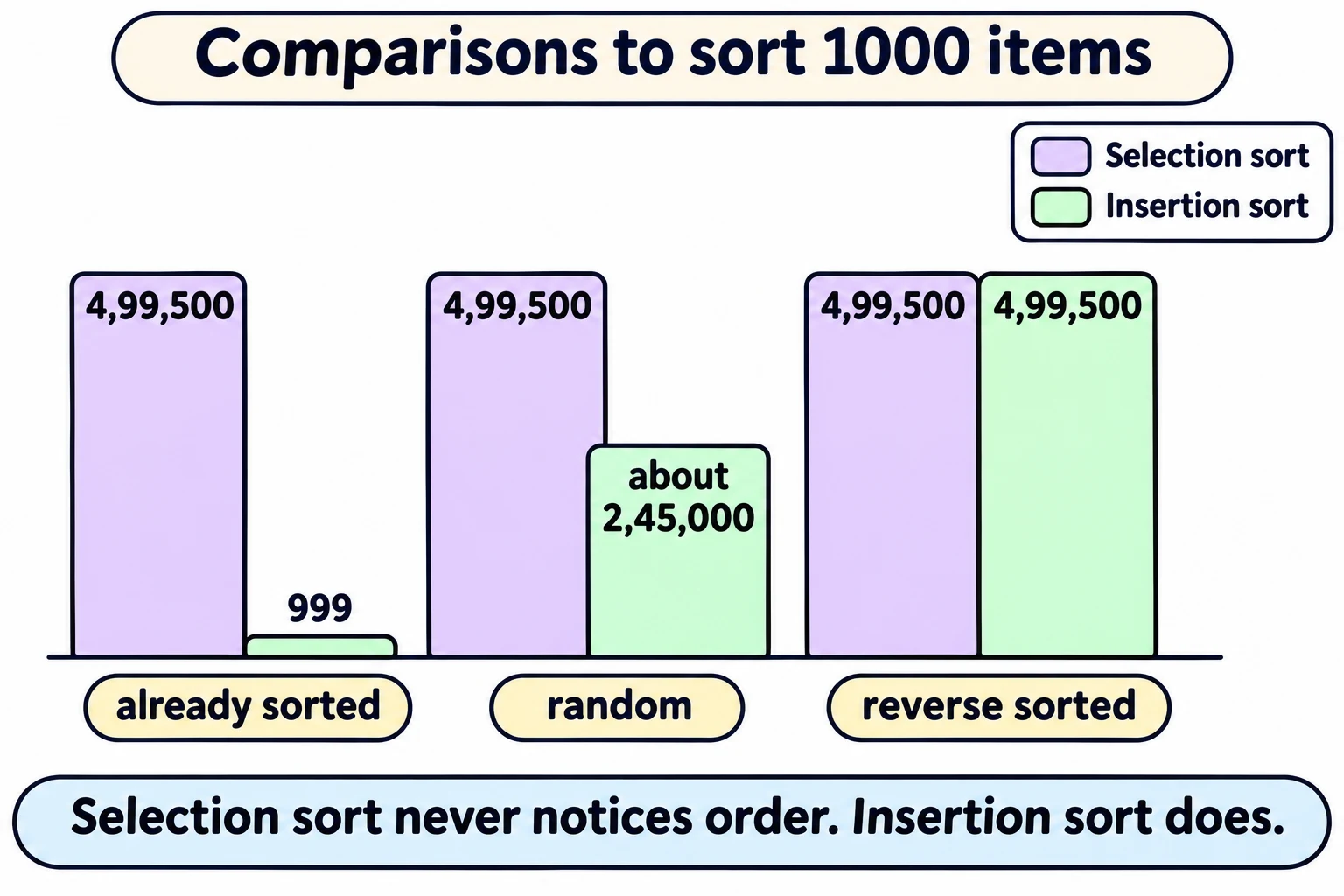
We counted comparisons on lists of 1000 numbers:
| Input (n = 1000) | Selection sort | Insertion sort |
|---|---|---|
| Already sorted | 4,99,500 | 999 |
| Random | 4,99,500 | about 2,45,000 |
| Reverse sorted | 4,99,500 | 4,99,500 |
- Selection sort: same work every time.
- Insertion sort: depends on the input — great for almost-sorted lists, about half the work on random lists, same as selection sort on reverse-sorted lists.
| Selection sort | Insertion sort | |
|---|---|---|
| Idea | Pick the minimum of the rest, swap to the front | Take the next item, slide it into the sorted part |
| Worst case | O(n²) | O(n²) |
| Best case | O(n²) | O(n) (already sorted) |
| Notices existing order? | No | Yes |
In one line: Insertion sort slides each item left into the sorted part; worst case n(n−1)/2 = O(n²), but on an already sorted list only about n steps.
Exam words: insertion sort, sorted prefix L[:i], invariant, j > 0, Insert, ISort, recurrence T_S(n) = T_S(n−1) + T_I(n−1), best case O(n), worst case O(n²).
Quick check
1. Sort [4, 2, 5, 1] with insertion sort. Show the list after each i.
i=0: [4, 2, 5, 1]. i=1: 2 slides past 4 → [2, 4, 5, 1]. i=2: 5 stays → [2, 4, 5, 1]. i=3: 1 slides to the front → [1, 2, 4, 5].2. How many swaps does insertion sort make on [5, 4, 3, 2, 1]?
0 + 1 + 2 + 3 + 4 = 10 (reverse order = worst case).3. How many comparisons on the already sorted list [1, 2, 3, 4, 5]?
For i = 1 to 4, one comparison each: 4 (n − 1). No swaps.4. Why must j > 0 come before L[j] < L[j-1]?
So the loop stops at the front. Without it, at j = 0 Python compares L[0] with L[-1] (the last item) and keeps swapping around the list until it crashes.5. Which sort would you pick for a list that is already nearly sorted? Why?
Insertion sort — each item moves only a little, so it runs close to O(n). Selection sort would still take n(n−1)/2 comparisons.Insertion Sort playground
Move one step at a time. The visual state and explanation update together.
Take 2 from the unsorted side.
Why? The values to its left are already sorted.