
Analysis of Merge Sort — Why It Is O(n log n)
Start here We built merge sort. Now we prove it is really faster than O(n²). We do it in two steps: first find the cost of one merge, then write a recurrence for merge sort and unwind it. The answer is O(n log n) — which is as good as any comparison-based sort can ever be.
Step 1 — Cost of merge
Merging A (length m) and B (length n) into C:
- C ends up with m + n items.
- Every round of the loop puts at least one item into C.
- So there are at most m + n rounds → merge takes O(m + n).
Since m + n ≤ 2 · max(m, n), when the two halves are about the same size (m ≈ n), merge is just O(n) — linear.
Step 2 — The recurrence for merge sort
Let T(n) = time for mergesort on n items. To keep the maths clean, assume n = 2ᵏ (a power of 2), so it always splits evenly.
- Base case: T(0) = T(1) = 1.
- Recurrence: T(n) = 2T(n/2) + n
Where does each part come from?
| Part | Meaning |
|---|---|
| 2T(n/2) | Two recursive calls, each sorting n/2 items |
| + n | Merging the two halves: n/2 + n/2 = n items |
Step 3 — Unwind the recurrence
T(n) = 2T(n/2) + n
     = 2[2T(n/4) + n/2] + n          = 2²T(n/2²) + 2n
     = 2²[2T(n/2³) + n/2²] + 2n      = 2³T(n/2³) + 3n
     ...
     = 2ᵏ T(n/2ᵏ) + k·n
Each unwinding step adds one more n. Stop when n/2ᵏ = 1, i.e. k = log n:
T(n) = 2^(log n) · T(1) + (log n) · n
     = n · 1 + n log n
     = n + n log n
(Here 2^(log n) = n, because log n is exactly the power you raise 2 to, to get n.)
So T(n) is O(n log n). ✔
Check with real numbers
Using T(1) = 1 and T(n) = 2T(n/2) + n:
| n | T(n) worked out | n + n log n |
|---|---|---|
| 2 | 2·T(1) + 2 = 2 + 2 = 4 | 2 + 2×1 = 4 ✔ |
| 4 | 2·T(2) + 4 = 8 + 4 = 12 | 4 + 4×2 = 12 ✔ |
| 8 | 2·T(4) + 8 = 24 + 8 = 32 | 8 + 8×3 = 32 ✔ |
| 16 | 2·T(8) + 16 = 64 + 16 = 80 | 16 + 16×4 = 80 ✔ |
The picture — n work per level, log n levels
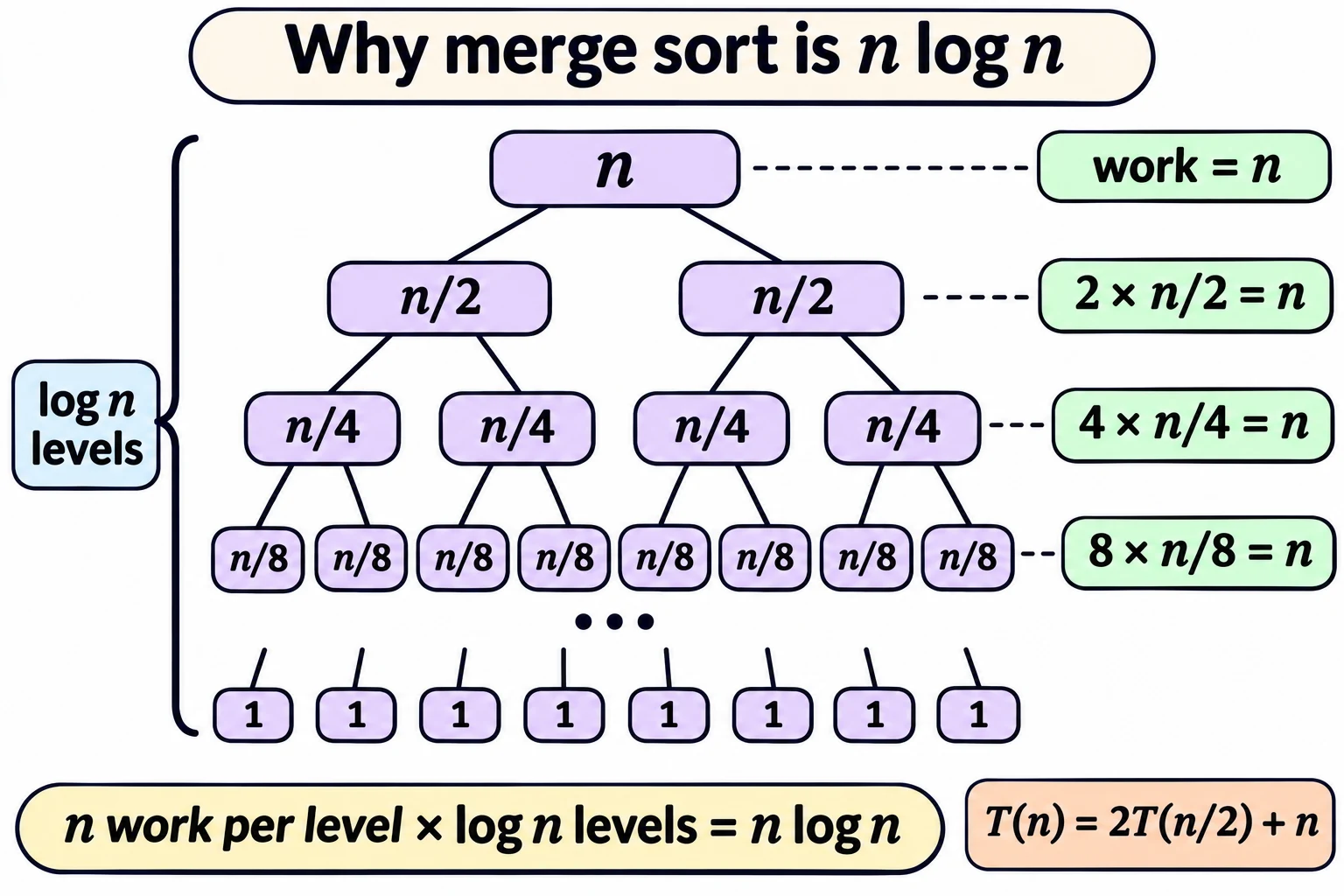
Draw the recursive calls as a tree:
| Level | Number of pieces | Size of each piece | Merge work at this level |
|---|---|---|---|
| 0 | 1 | n | n |
| 1 | 2 | n/2 | 2 × n/2 = n |
| 2 | 4 | n/4 | 4 × n/4 = n |
| ... | ... | ... | n |
| log n | n | 1 | (single items, nothing to merge) |
Every level does about n work in total, and there are log n levels. Total ≈ n × log n.
How much faster is it really?
| n | n² (selection / insertion, worst) | n log n (merge sort) | Merge sort is about ... times faster |
|---|---|---|---|
| 1,000 | 10⁶ | 10⁴ | 100× |
| 10⁶ | 10¹² (about 28 hours) | 2 × 10⁷ (about 2 seconds) | 50,000× |
Tried it ourselves (n = 1000, counting comparisons): selection sort 4,99,500; insertion sort about 2,45,000 on random input; merge sort under 9,000. In time: on 4000 random numbers, selection sort took about 0.41 s and merge sort about 0.008 s. Doubling n made merge sort only about 2 times slower, not 4.
The catches (from the lecture)
Merge sort is fast, but not perfect:
- Needs extra memory. Merge builds a new list C. There is no easy way to merge two halves "in place" efficiently. For huge data, this extra storage can be costly.
- Inherently recursive. Recursive calls and returns take extra time and memory compared to a simple loop.
(Next week's quicksort tries to fix the extra-memory problem.)
Merge sort is optimal (for comparison sorting)
Recall from the Big O page: any algorithm that sorts by comparing and swapping needs Ω(n log n) comparisons in the worst case. Merge sort takes O(n log n). Upper bound = lower bound → merge sort is asymptotically optimal among comparison-based sorts.
All Week 2 algorithms at a glance
| Algorithm | Best case | Worst case | Extra memory |
|---|---|---|---|
| Linear search | O(1) | O(n) | none |
| Binary search (sorted list) | O(1) | O(log n) | none (lo/hi version) |
| Selection sort | O(n²) | O(n²) | none (in place) |
| Insertion sort | O(n) | O(n²) | none (in place) |
| Merge sort | O(n log n) | O(n log n) | O(n) — new list for merging |
In one line: Merge costs O(n); merge sort satisfies T(n) = 2T(n/2) + n, which unwinds to n + n log n = O(n log n), at the price of extra memory.
Exam words: merge is O(m + n), recurrence T(n) = 2T(n/2) + n, unwinding, k = log n, 2^(log n) = n, recursion tree, n log n, extra storage, not in place, optimal.