
Calculating Complexity — Worked Examples
Start here Now we apply Big O to real code. There are only two kinds of programs to handle: - Iterative programs (loops): count how many times the loops run. - Recursive programs (a function calling itself): write a recurrence and solve it by unwinding.
>
We go through five examples from the lecture, plus a few extra ones for practice.
The quick rules for loops
| Code shape | Steps | Big O |
|---|---|---|
| One loop over n items | n | O(n) |
| Two loops one after the other (each n) | n + n = 2n | O(n) |
| One loop inside another (each n) | n × n | O(n²) |
| Inner loop starts at i + 1 (all pairs) | (n−1) + (n−2) + ... + 1 = n(n−1)/2 | O(n²) |
| Three nested loops | n × n × n | O(n³) |
| Loop that halves n each time | log n | O(log n) |
Example 1 — Find the maximum in a list
def maxElement(L):
    maxval = L[0]
    for i in range(len(L)):
        if L[i] > maxval:
            maxval = L[i]
return maxval- Input size: n = length of L.
- One loop, runs exactly n times for every input (there's no early exit).
- Time: O(n). (Here best case = worst case = n.)
Example 2 — Does a list have duplicates?
def noDuplicates(L):
    for i in range(len(L)):
        for j in range(i+1, len(L)):
            if L[i] == L[j]:
                return False
return True- The nested loops check every pair (i, j) with i < j.
- Best case: L[0] == L[1] → found in the very first check, return at once.
- Worst case: no duplicates → both loops run fully.
Count the worst case for n = 5 (positions 0 to 4):
| i | j goes over | Checks |
|---|---|---|
| 0 | 1, 2, 3, 4 | 4 |
| 1 | 2, 3, 4 | 3 |
| 2 | 3, 4 | 2 |
| 3 | 4 | 1 |
| 4 | (none) | 0 |
| Total | 4 + 3 + 2 + 1 = 10 |
In general: (n − 1) + (n − 2) + ... + 1 = n(n − 1)/2. Check: 5 × 4 / 2 = 10 ✔
Time: O(n²).
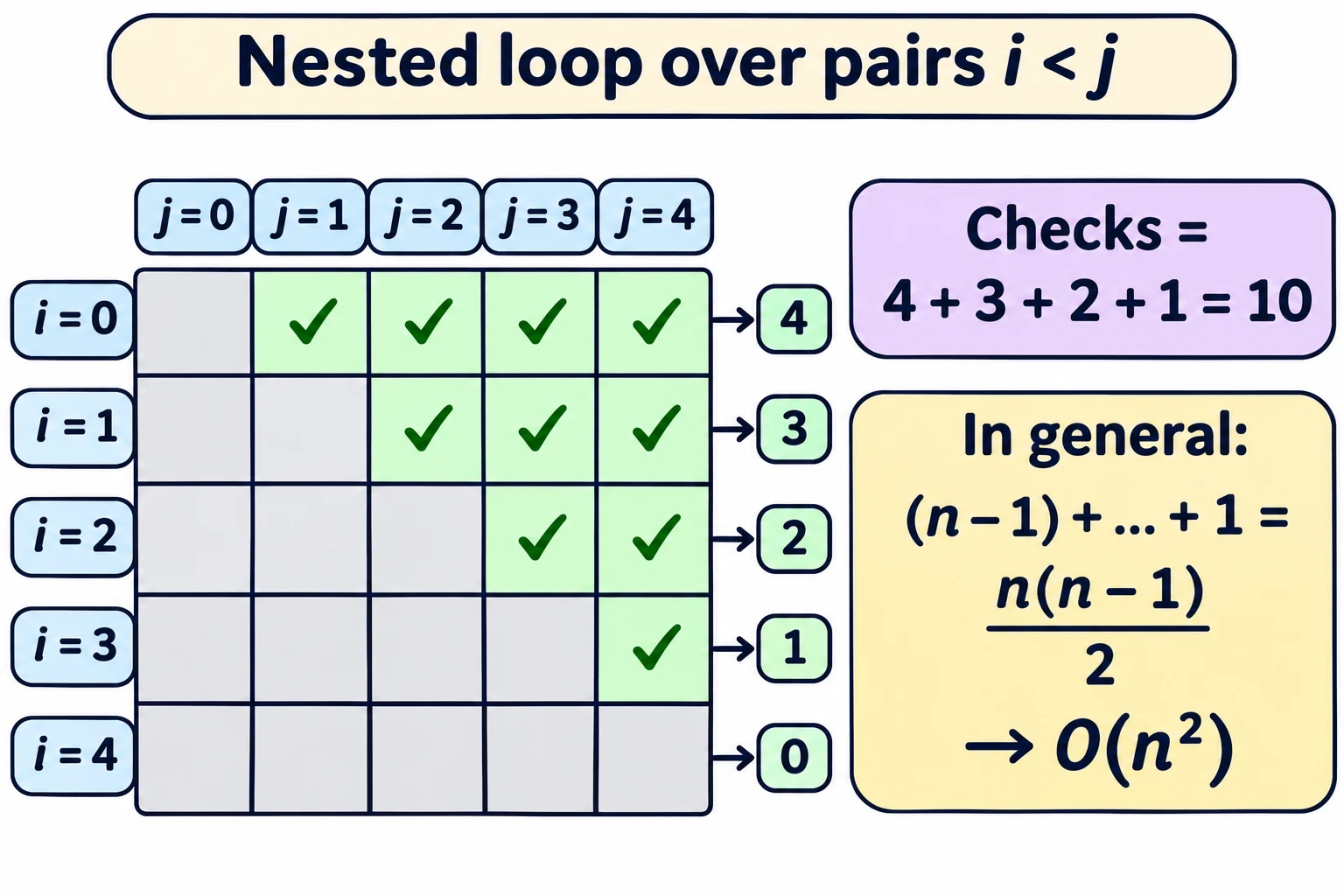
Why is 1 + 2 + ... + (n−1) = n(n−1)/2? Write the sum forwards and backwards and add:
  1   +   2   + ... + (n-1)
(n-1) + (n-2) + ... +   1
-----------------------------
  n   +   n   + ... +   n      ← (n-1) times
Twice the sum = n(n − 1), so the sum = n(n − 1)/2.
Example 3 — Matrix multiplication
A matrix is stored as a list of lists. The matrix
| 1 | 2 | 3 |
|---|---|---|
| 4 | 5 | 6 |
is stored as [[1, 2, 3], [4, 5, 6]] (2 rows, 3 columns).
def matrixMultiply(A, B):
    (m, n, p) = (len(A), len(B), len(B[0]))
    C = [[0 for i in range(p)] for j in range(m)]
    for i in range(m):
        for j in range(p):
            for k in range(n):
                C[i][j] = C[i][j] + A[i][k] * B[k][j]
return C- A is m × n, B is n × p, answer C is m × p.
- Each entry C[i][j] needs n multiplications (the k loop).
- There are m × p entries.
- Time: O(m · n · p). If both are n × n square matrices: O(n³).
Small check: A = 2 × 3 and B = 3 × 2 → 2 × 3 × 2 = 12 multiplications.
Example 4 — Number of bits of n
def numberOfBits(n):
    count = 1
    while n > 1:
        count = count + 1
        n = n // 2
    return count
Trace for n = 13 (13 in binary is 1101, which has 4 bits):
| n before | n > 1? | count after | n after (n // 2) |
|---|---|---|---|
| 13 | yes | 2 | 6 |
| 6 | yes | 3 | 3 |
| 3 | yes | 4 | 1 |
| 1 | no — stop | 4 |
- The loop halves n each time → runs about log n times.
- But careful: for number problems, input size = number of digits d ≈ log n.
- So this algorithm takes about d steps → linear in the input size.
Example 5 — Towers of Hanoi (a recursive program)
The puzzle:
- Three pegs: A, B, C. There are n disks on peg A, biggest at the bottom.
- Goal: move all n disks from A to B, using C as a helper ("transit") peg.
- Rules: move one disk at a time, and never put a bigger disk on a smaller one.
The recursive solution:
- Move the top n − 1 disks from A to C (using B as helper).
- Move the biggest disk from A to B.
- Move the n − 1 disks from C to B (using A as helper).
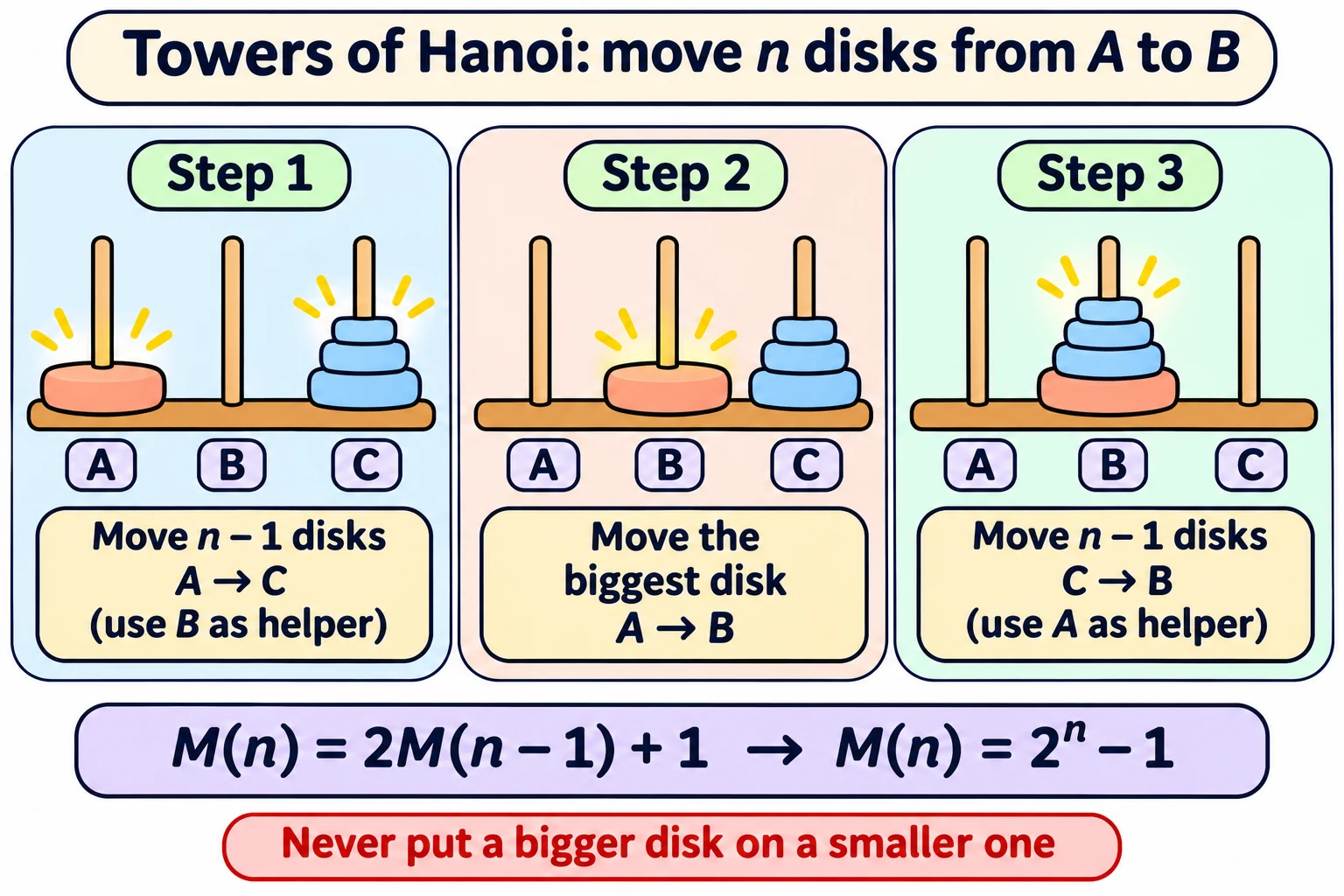
All 7 moves for n = 3 (A → B, helper C):
| Move | Disk moved from → to |
|---|---|
| 1 | A → B |
| 2 | A → C |
| 3 | B → C |
| 4 | A → B (the biggest disk) |
| 5 | C → A |
| 6 | C → B |
| 7 | A → B |
Counting moves with a recurrence
Let M(n) = number of moves for n disks.
- Base case: M(1) = 1 (just move the disk).
- Recurrence: M(n) = M(n − 1) + 1 + M(n − 1) = 2M(n − 1) + 1.
Solve by unwinding (keep substituting the formula into itself):
M(n) = 2M(n−1) + 1
     = 2[2M(n−2) + 1] + 1          = 2²M(n−2) + (2 + 1)
     = 2²[2M(n−3) + 1] + (2 + 1)   = 2³M(n−3) + (4 + 2 + 1)
     ...
     = 2ᵏ M(n−k) + (2ᵏ − 1)
Stop when n − k = 1, i.e. k = n − 1:
M(n) = 2ⁿ⁻¹ M(1) + (2ⁿ⁻¹ − 1)
     = 2ⁿ⁻¹ + 2ⁿ⁻¹ − 1
     = 2ⁿ − 1
Check with small n: M(1) = 2 − 1 = 1 ✔. M(2) = 4 − 1 = 3 ✔. M(3) = 8 − 1 = 7 ✔ (the table above has 7 moves).
Time: O(2ⁿ) — exponential! For 64 disks: 2⁶⁴ − 1 ≈ 1.8 × 10¹⁹ moves. At one move per second, that is about 58,000 crore (580 billion) years.
Extra practice — find the Big O
A.
for i in range(n):
    print(i)
for j in range(n):
    print(j)
Two separate loops: n + n = 2n → O(n).
B.
for i in range(n):
    for j in range(n):
        print(i, j)
n × n → O(n²).
C.
i = 1
while i < n:
    i = i * 2
i goes 1, 2, 4, 8, ... until ≥ n → about log n rounds → O(log n).
D.
for i in range(n):
    j = 1
    while j < n:
        j = j * 2
Outer n times, inner log n times → O(n log n).
E. A recursive function with T(n) = T(n − 1) + 1, T(0) = 1. Unwind: T(n) = T(n−1) + 1 = T(n−2) + 2 = ... = T(0) + n = n + 1 → O(n).
In one line: For loops, count iterations (nested → multiply, in a row → add, halving → log n); for recursion, write a recurrence and unwind it.
Exam words: iterative, recursive, recurrence, base case, unwinding, n(n−1)/2, O(mnp), Towers of Hanoi, 2ⁿ − 1.