
Analysis of Algorithms
Start here In Week 1, one method took 3200 years and another took 50 minutes for the same job. This week we learn how to measure an algorithm's speed properly — without a stopwatch, and without caring which computer we use. This is the language you will use for the rest of the course.
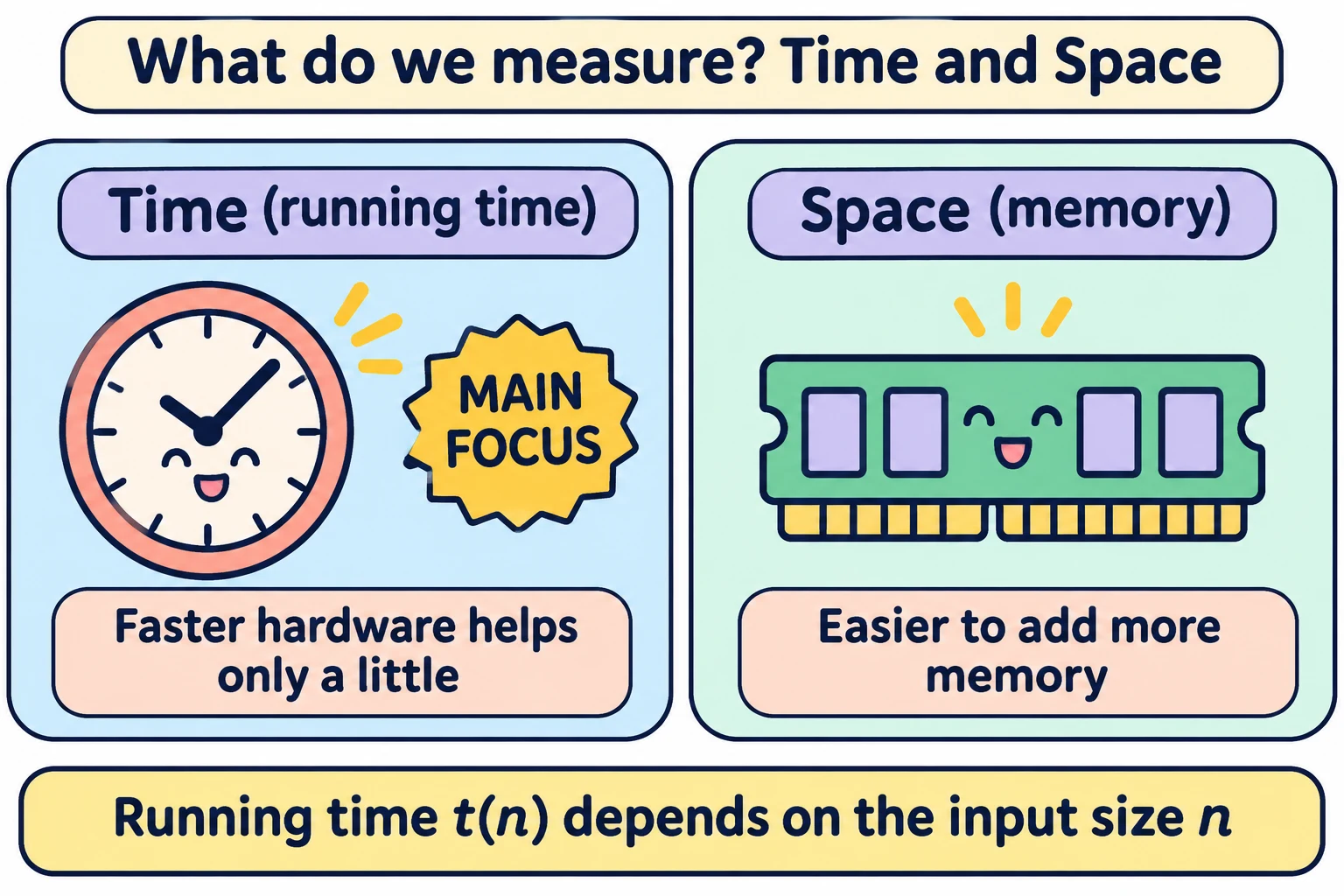
What do we measure?
Two things decide how "good" an algorithm is:
| Resource | Question | Can we fix it by buying better hardware? |
|---|---|---|
| Time (running time) | How long does it take? | Only a little. A computer twice as fast saves half the time — but 3200 years becomes 1600 years. Still useless. |
| Space (memory) | How much memory does it need? | Easier. Memory is cheaper and easier to add. |
So in this course we mainly focus on time.
Running time depends on input size
Sorting 10 numbers is quick. Sorting 10 crore numbers is not. So we always describe running time as a function of the input size n:
t(n) = time taken by the algorithm on an input of size n.
Example 1 — SIM cards and Aadhaar (from Week 1)
n ≈ 10⁹ cards.
| Algorithm | t(n) | Steps for n = 10⁹ | Time at 10⁷ steps/second |
|---|---|---|---|
| Naive (check every pair) | n² | 10¹⁸ | ≈ 3200 years |
| Clever (sort + halve) | n log n | 10⁹ × 30 = 3 × 10¹⁰ | ≈ 50 minutes |
What is log n?
log₂ n = how many times you divide n by 2 to reach 1.
- log₂ 8 = 3, because 8 → 4 → 2 → 1 (3 halvings).
- log₂ 1024 = 10, because 2¹⁰ = 1024.
- In general: log₂ n = k means n = 2ᵏ.
In this course, log n always means log₂ n unless said otherwise.
| n | log₂ n (about) |
|---|---|
| 1,000 | 10 |
| 1,00,000 (10⁵) | 17 |
| 10,00,000 (10⁶) | 20 |
| 10⁹ | 30 |
So log n grows very slowly. Even for 100 crore items, it is only 30.
Example 2 — a video game
A game screen has many objects. Every frame, the game must find the two objects closest to each other.
- Naive way: check the distance between every pair → about n² steps.
- Suppose n = 1,00,000 = 10⁵ objects.
- n² = 10¹⁰ steps → 10¹⁰ ÷ 10⁷ = 1000 seconds ≈ 16.7 minutes in Python. For ONE frame! A game needs many frames per second. Unacceptable.
- A clever algorithm takes n log n: log₂ 10⁵ ≈ 17, so 10⁵ × 17 ≈ 1.7 × 10⁶ steps → a fraction of a second.
(For scale: a high-resolution screen of 4000 × 2000 pixels has 8 × 10⁶ = 80 lakh points.)
Orders of magnitude — ignore the small stuff
When comparing two running times, we care about how fast they grow, not exact numbers. So we ignore constant factors.
Lecture example — n³ vs 5000n² f(n) = n³ and g(n) = 5000n². For small n, f is smaller: at n = 10, f = 1000 but g = 5,00,000. At n = 5000 they are equal: 5000³ = 5000 × 5000² = 1.25 × 10¹¹. After n = 5000, n³ is always bigger, and the gap keeps growing. So n³ is the "slower" algorithm in the long run, even though it starts out faster.
This "what happens when n becomes very large" view is called asymptotic complexity.
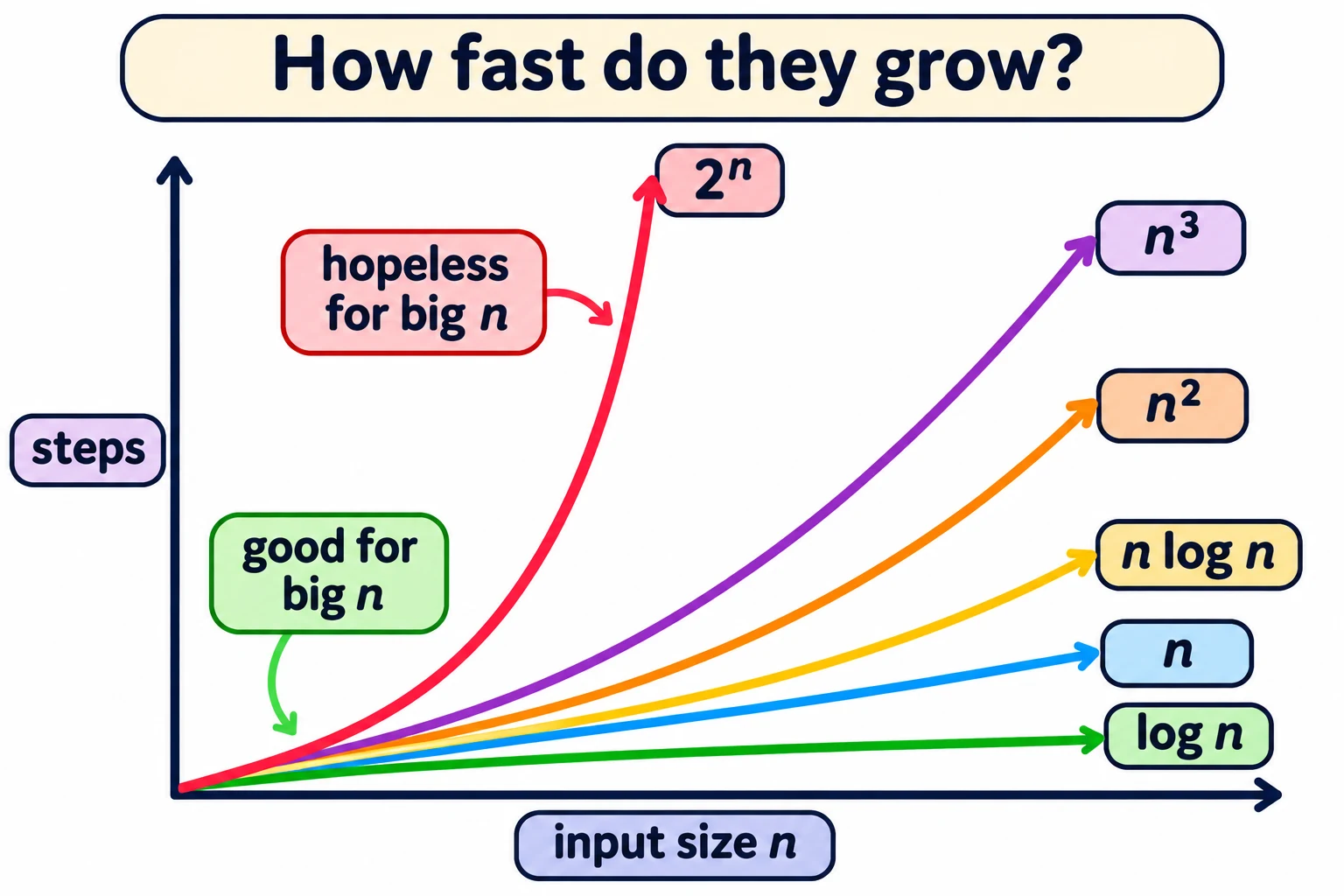
Typical growth functions (from slow-growing to fast-growing)
| Name | Function | Example |
|---|---|---|
| Constant | 1 | Read the first item of a list |
| Logarithmic | log n | Binary search |
| Linear | n | Find the maximum of a list |
| "n log n" | n log n | Merge sort |
| Quadratic | n² | Selection sort, insertion sort |
| Cubic | n³ | Matrix multiplication |
| Exponential | 2ⁿ | Towers of Hanoi |
| Factorial | n! | Trying every arrangement of n items |
Polynomial = n, n², n³, ... (manageable). Exponential and factorial = hopeless for big n.
The table that explains everything
Values of t(n) for different input sizes (rounded; "—" means astronomically large):
| n | log n | n | n log n | n² | n³ | 2ⁿ | n! |
|---|---|---|---|---|---|---|---|
| 10 | 3.3 | 10 | 33 | 100 | 1000 | 1000 | 10⁶ |
| 100 | 6.6 | 100 | 664 | 10⁴ | 10⁶ | 10³⁰ | 10¹⁵⁷ |
| 1000 | 10 | 1000 | 10⁴ | 10⁶ | 10⁹ | — | — |
| 10⁴ | 13 | 10⁴ | 10⁵ | 10⁸ | 10¹² | — | — |
| 10⁵ | 17 | 10⁵ | 10⁶ | 10¹⁰ | — | — | — |
| 10⁶ | 20 | 10⁶ | 10⁷ | 10¹² | — | — | — |
| 10⁹ | 30 | 10⁹ | 10¹⁰ | — | — | — | — |
(Small rounding: 2¹⁰ = 1024 ≈ 1000, and 10! = 36,28,800 ≈ 10⁶. The lecture slide writes 66 for n log n at n = 100; the correct value is 100 × 6.64 ≈ 664.)
How to use this table: Python does about 10⁷ steps per second. If you have one second, look for the biggest n where t(n) is around 10⁷:
| Algorithm type | Biggest n you can handle in about 1 second |
|---|---|
| n log n | about 10⁶ (10 lakh) |
| n² | about 3000 (because 3000² ≈ 10⁷) |
| n³ | about 200 (because 200³ ≈ 10⁷) |
| 2ⁿ | about 23 (because 2²³ ≈ 10⁷) |
Count steps, not seconds
Seconds depend on the computer. So we count basic operations instead:
- Comparing two values (
x < y) - Assigning a value to a variable (
x = 5) - ...
Do we have to be very exact? No. Look at swapping two values:
(x, y) = (y, x) # 1 line — call it 1 operation?t = x # or 3 assignments?
x = y
y = tIs a swap 1 operation or 3? It doesn't matter. They differ by a constant factor (3), and we ignore constant factors anyway.
What exactly is "input size"?
Usually it is obvious:
| Problem | Input size n |
|---|---|
| Search or sort a list | Length of the list |
| Rearrange objects | Number of objects |
| A graph (later weeks) | Number of vertices AND number of edges (two separate numbers) |
Careful with number problems. For "Is n prime?", the input size is not n itself. It is the number of digits of n.
Why? We do arithmetic digit by digit — addition with carry, subtraction with borrow, long multiplication, long division. A 10-digit number is "size 10", not "size 10 crore".
- Number of digits of n in base 10 ≈ log₁₀ n.
- Number of bits of n in binary ≈ log₂ n.
Example. Checking primes by trying all divisors up to n takes about n steps. If n has d digits, n ≈ 10ᵈ. So the time is about 10ᵈ — exponential in the input size d. That's why "try every divisor" is slow for big numbers, even though "n steps" sounds small.
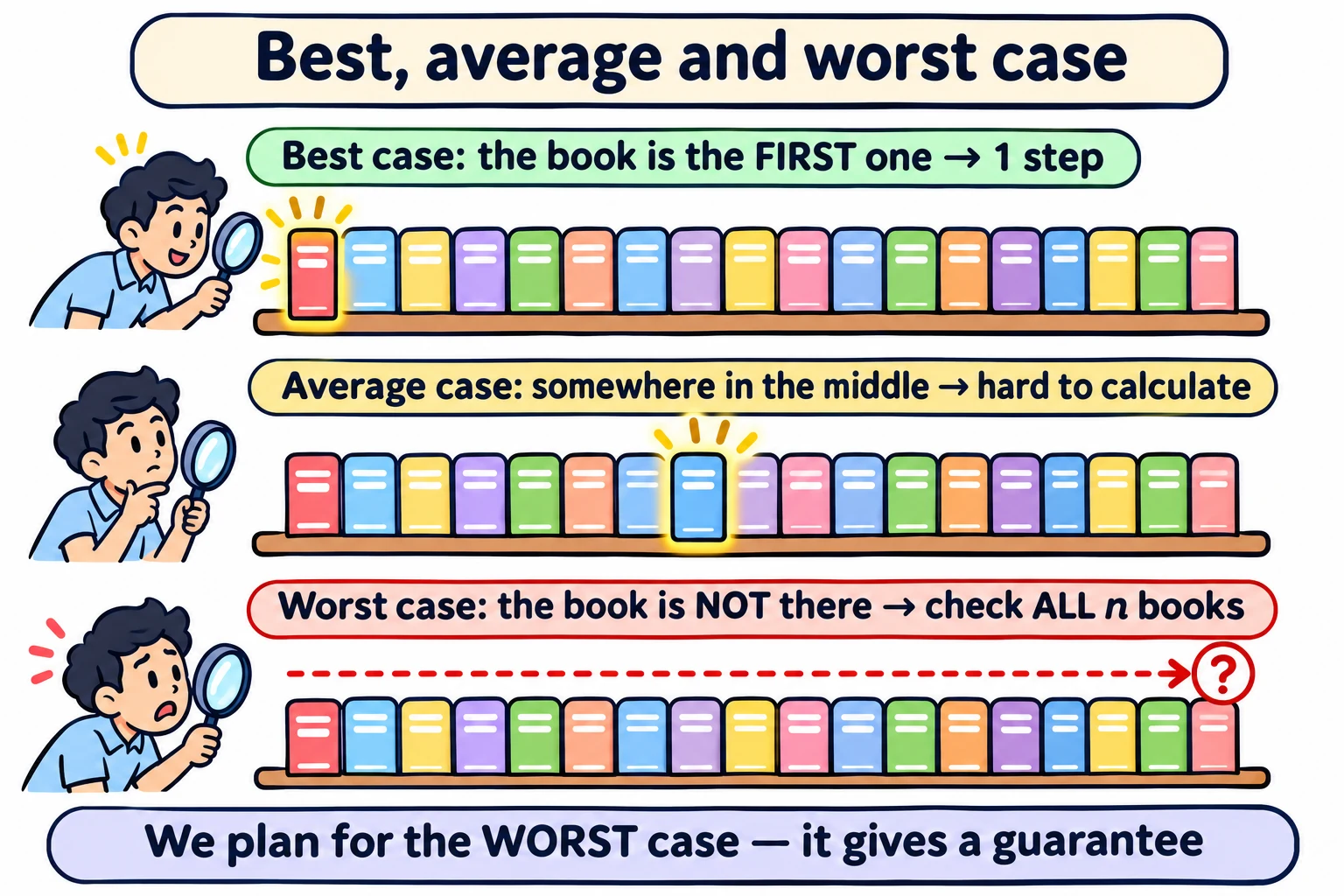
Which input do we measure? Worst case!
Different inputs of the same size can take different times.
Example: search for a value in an unsorted list of 1000 items.
- Best case: it's the very first item → 1 step. (Lucky!)
- Worst case: it's not in the list at all → must check all 1000 items.
- Average case: would need to know how likely each input is — hard to calculate.
| Case | Meaning | Used? |
|---|---|---|
| Best case | The luckiest input | Rarely — it promises nothing |
| Average case | Typical behaviour | Ideal, but needs probabilities; hard to compute |
| Worst case | The input that makes the algorithm work the longest | Yes — this is what we use |
Worst case is pessimistic (the worst input may be rare), but it is easier to calculate and gives a guarantee: "it will never be slower than this".
Everyday example: When you leave for an exam, you plan for the worst traffic, not the best. If you arrive early, good. But you are never late.
In one line: Measure time as a function t(n) of input size, ignore constants, look at large n, and plan for the worst case.
Exam words: running time, space, input size, t(n), log₂ n, orders of magnitude, asymptotic complexity, basic operation, worst case, best case, average case.