
Ready to begin
No records have been processed. Start with Next step.
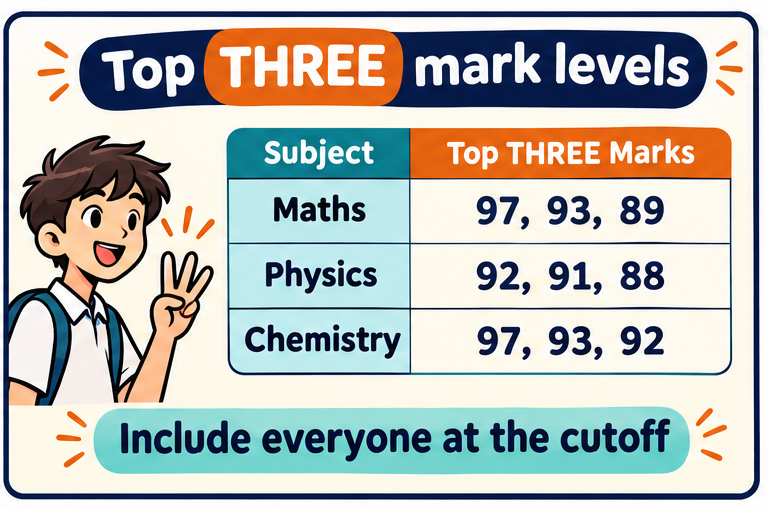
The earlier TopThreeMarks procedure finds distinct score levels. Maths has levels 97, 93 and 89; Physics 92, 91 and 88; Chemistry 97, 93 and 92. Include every student whose mark is at least the third level. Ties mean a subject’s list can contain more than three people.
Follow one occurrence at a time. Choose another input to test empty lists, repeated IDs and different parameters.
Ready
No records have been processed. Start with Next step.
Predict the next change, then step through the list. The original course records remain unchanged.
MathsIDs = []; PhysicsIDs = []; ChemistryIDs = []
foreach X in ScoreRecords:
    if X.Mathematics >= 89:
        MathsIDs = MathsIDs ++ [X.CardNo]
    if X.Physics >= 88:
        PhysicsIDs = PhysicsIDs ++ [X.CardNo]
    if X.Chemistry >= 92:
ChemistryIDs = ChemistryIDs ++ [X.CardNo]| Subject | IDs | Number of students |
|---|---|---|
| Maths | [11,14,20,23] | 4 |
| Physics | [5,7,9,11,18,23] | 6 |
| Chemistry | [11,14,18,25] | 4 |
Learn the cutoffs first, then construct membership lists with fixed cutoffs. Three independent IF statements let Rahul enter all three lists. Using strict > would wrongly discard students exactly at the boundary. Computing the cutoffs by separate consuming table scans also requires restoring the table between calls.
The lecture’s zero-initialized top-three procedure relies on non-negative marks and this dataset having enough positive distinct scores. A general implementation should use empty slots or an explicit unavailable result when fewer than three distinct values exist. Equality must not shift a repeated top mark into a new distinct level.
Why are there four Maths IDs rather than three?
97 is shared by Rahul and Deepika. The top three distinct levels include everyone scoring 97, 93 or 89.
Does Chemistry 92 qualify when the cutoff is 92?
Yes. Use ≥, including the boundary.
What must happen before reusing a consuming TopThreeMarks table procedure?
Restore the input records according to its contract so every subject call sees the full dataset.