
Ready to begin
No records have been processed. Start with Next step.
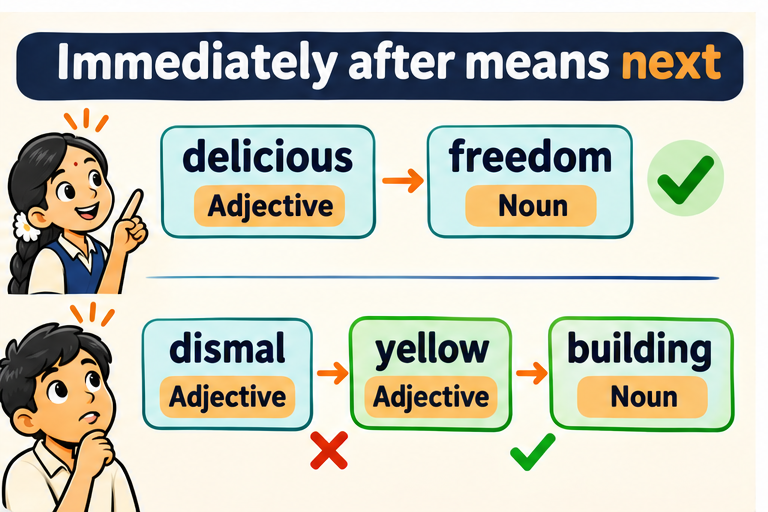
Follow one occurrence at a time. Choose another input to test empty lists, repeated IDs and different parameters.
Ready
No records have been processed. Start with Next step.
Predict the next change, then step through the list. The original course records remain unchanged.
Keep the word-card order. Let X = first(L) and Y = first(rest(L)). Select this neighbour pair only if X.PartOfSpeech is Adjective AND Y.PartOfSpeech is Noun. Append positions or a structured pair so you remember which occurrences matched.
Pairs = []
L = WordRecords
while length(L) >= 2:
    X = first(L)
    Y = first(rest(L))
    if X.PartOfSpeech == "Adjective" AND Y.PartOfSpeech == "Noun":
        Pairs = Pairs ++ [[X.SerialNumber,Y.SerialNumber]]
L = rest(L)| Positions | Adjacent words |
|---|---|
| [21,22] | delicious freedom |
| [50,51] | yellow building; |
| [53,54] | fire-eyed Vedanayagam, |
| [63,64] | long cane... |
The tags are given on the cards; this procedure does not solve English grammar in general. “Reluctant to” has an adjective followed by a preposition, so fails this specific test. “Dismal yellow building” has two adjectives before a noun, but dismal is not IMMEDIATELY before building. The lecture discusses that wider phrase pattern without changing the adjacent-pair rule.
Should “thin” and “cane” be counted as an immediate pair in “thin long cane”?
No. Long lies between them. Long–cane is the immediate adjective–noun pair.
How many adjacent word pairs are tested in the 65-card paragraph?
64 when all neighbours are inspected once.
Why preserve SerialNumber rather than only the word spelling?
The same word can occur more than once. Positions identify the actual occurrences and preserve the text sequence.