
Ready to begin
No records have been processed. Start with Next step.
Procedure rest(L):
    Found = false
    Result = []
    foreach x in L:
        if Found:
            Result = Result ++ [x]
        else:
            Found = true
    return Result

Procedure init(L):
    Found = false
    Result = []
    foreach x in L:
        if Found:
            Result = Result ++ [Prev]
        else:
            Found = true
        Prev = x
    return Result
rest uses Found to skip exactly the first occurrence. init uses a one-element delay: when the second element arrives, append the remembered first; when the third arrives, append the remembered second. Update Prev AFTER appending it. The final current element is never appended, so the final position is excluded.
Both functions return [] on [] and on a singleton under the tutorial’s definitions. “L minus first(L)” is an informal description of dropping one endpoint, not a set subtraction that deletes every equal value. The functions build new result lists; the caller chooses whether to assign the result back to its working variable.
Follow one occurrence at a time. Choose another input to test empty lists, repeated IDs and different parameters.
Ready
No records have been processed. Start with Next step.
Predict the next change, then step through the list. The original course records remain unchanged.
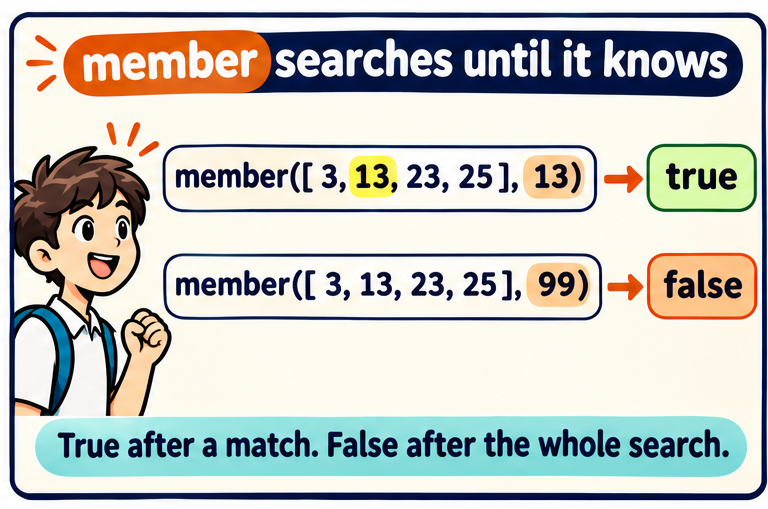
Procedure member(L, e):
    foreach x in L:
        if e == x:
            return true
    return false
A true result can return early; a false result comes after the loop. The empty list returns false with zero equality tests. Repeated values do not require repeated true results: membership asks only whether at least one occurrence exists. Parameter order is member(list,element), matching the tutorial.
The tutorial’s length and last scan the list; rest and init copy result elements. Repeatedly calling these scanning or copying helpers inside another loop can add work. A short pseudocode expression is not an automatic constant-time guarantee. At this stage, first understand the interface and result; later analyze the chosen implementation’s cost.
In init, what goes wrong if Prev = x happens before appending Prev?
You append the current element rather than the previous one, shifting the result and potentially retaining the final element.
Why is return false inside member’s loop after the first unequal value wrong?
A later occurrence can still match. False requires finishing the search; true needs only one match.
For rest([3,3,25]) and init([3,3,25]), what are the results?
rest gives [3,25]; init gives [3,3]. They remove positions at opposite ends, not values everywhere.