
Ready to begin
No records have been processed. Start with Next step.
Follow one occurrence at a time. Choose another input to test empty lists, repeated IDs and different parameters.
Ready
No records have been processed. Start with Next step.
Predict the next change, then step through the list. The original course records remain unchanged.
L = explode(Word)
Count = 0
while length(L) >= 2:
    if isVowel(first(L)) AND isVowel(first(rest(L))):
        Count = Count + 1
    L = rest(L)
return Count
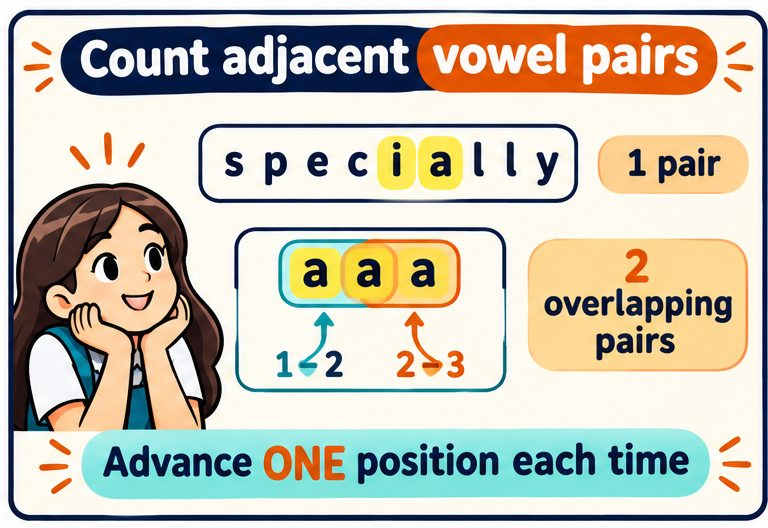
Use the five-vowel convention a, e, i, o, u, ignoring case for this test. In specially, i is immediately followed by a, giving one match. The task counts PAIRS, not vowels: specially has other vowels but only one adjacent vowel pair.
Move one position after each test, so pairs may overlap. aaa has matches at positions 1–2 and 2–3: two pairs. If you instead want to count word cards that contain at least one matching pair, stop the inner word scan after its first match and increment a separate word counter once. An outer word loop and inner character loop process different levels.
Dots and hyphens are not vowels and interrupt adjacency in this raw character representation. Empty and one-character lists yield zero adjacent pairs. The algorithm does not infer pronunciation or vowel sounds.
How many adjacent vowel pairs are in aaa?
Two. The middle a participates in both neighbouring pairs.
What differs between “count matching pairs” and “count words with a match”?
One word can contain several matching pairs. A word-level count increments at most once per qualifying word.
What loop guard prevents reading past the end?
Require length(L) ≥ 2 before examining first(L) and first(rest(L)).