
Ready to begin
No records have been processed. Start with Next step.
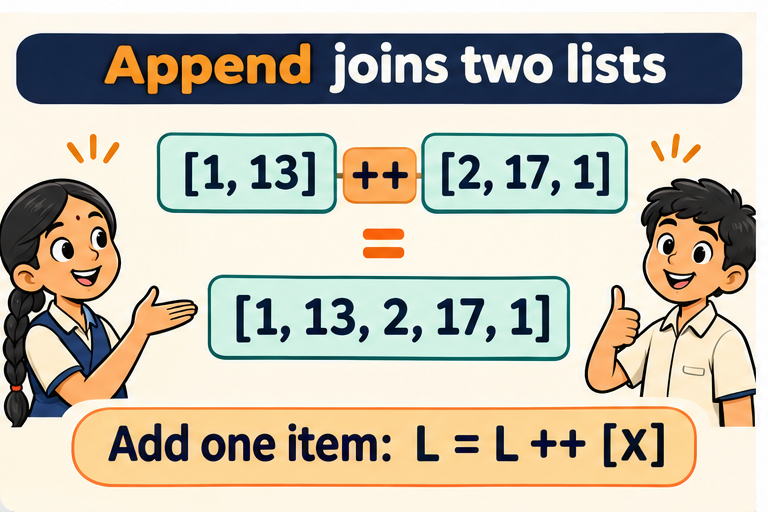
In this course, ++ means list concatenation. If A = [1,13] and B = [2,17,1], A ++ B is [1,13,2,17,1]. No sorting or deduplication happens. A ++ B generally differs from B ++ A.
Follow one occurrence at a time. Choose another input to test empty lists, repeated IDs and different parameters.
Ready
No records have been processed. Start with Next step.
Predict the next change, then step through the list. The original course records remain unchanged.
L = []
L = L ++ [3]       # [3]
L = L ++ [13]      # [3,13]
L = [25] ++ L      # [25,3,13]
L = L ++ [3]       # [25,3,13,3]
The brackets matter because ++ expects two lists. L ++ x is not valid when x is a single number. L ++ [x] adds x at the end; [x] ++ L adds it at the front. To keep a pair [ID,mark] together as one new element, use L ++ [[ID,mark]]. L ++ [ID,mark] adds two separate outer elements.
An expression computes a result; assignment stores it. Writing L ++ [3] without assigning the result does not by itself promise to update L. [] ++ L and L ++ [] give the same sequence as L.
What is [3,13] ++ [13,25]?
[3,13,13,25]. The repeated 13 stays in the list.
How do you prepend 25 to [3,13]?
[25] ++ [3,13], giving [25,3,13].
How do you add the pair [3,53] as ONE outer element?
Use L = L ++ [[3,53]]. The extra outer brackets wrap the pair into a singleton list.