
Ready to begin
No records have been processed. Start with Next step.
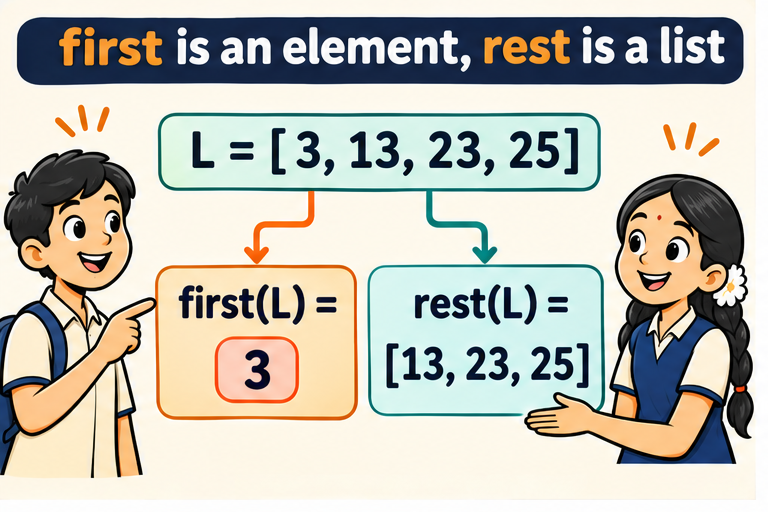
Follow one occurrence at a time. Choose another input to test empty lists, repeated IDs and different parameters.
Ready
No records have been processed. Start with Next step.
Predict the next change, then step through the list. The original course records remain unchanged.
first(L) returns one element. rest(L) returns a list containing all occurrences after the first position. Neither operation means “remove every occurrence equal to the first value”. For [3,3,25], rest is [3,25]. The second 3 remains.
L = [3,13,23,25]
x = first(L)        # x is 3; L is still the original list
R = rest(L)         # R is [13,23,25]
L = rest(L)         # NOW L refers to the shorter list
Keep the difference between evaluating an operation and assigning its result. A local working variable can become shorter while the source data remains available. This lesson’s demonstrations construct result lists rather than mutating the original course dataset.
first([]) has no defined element result. Guard it with a non-empty check. The tutorial defines rest([]) as [] and rest([x]) as []. For a comparison with first(rest(L)), you need at least TWO elements in L, because the rest must also be non-empty.
What are first([3]) and rest([3])?
The element 3 and the empty list [], respectively. [3] is not the same value as 3.
What is rest([3,3,25])?
[3,25]. Drop one position, not all matching values.
How many elements are needed before calling first(rest(L))?
At least two in the original list. A one-element list has an empty rest.