
When the nearest-name rule gets meaning wrong
| Position | Pronoun context | Nearest explicit person name | Meaning in this passage |
|---|---|---|---|
| 9 | his eyes | Swaminathan | Swaminathan |
| 11 | He considered | Swaminathan | Swaminathan |
| 40 | He shuddered | Swaminathan | Swaminathan |
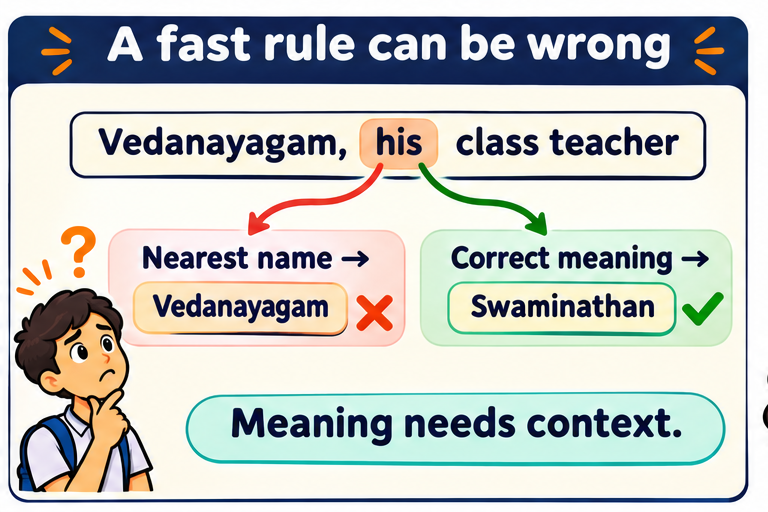
| 55 | Vedanayagam, his class teacher | Vedanayagam | Swaminathan |
| 61 | headmaster with his thin long cane | Vedanayagam | headmaster |
At position 55, the teacher is Vedanayagam, but “his class teacher” means Swaminathan’s class teacher. At position 61, the cane belongs to the headmaster. Headmaster is a person described by a role, not one of our two explicit names. Both examples show that syntax and context matter.
Backward search and forward LastName memory can implement the same inadequate nearest-name rule. Making that rule faster does not make it a correct general language algorithm. Test counterexamples, state the rule’s limits and flag unresolved meaning rather than confidently returning a wrong person.
A richer resolver could remember multiple candidate people and roles, read sentence structure, and return uncertainty when the evidence is insufficient. That is a direction for improvement, not a complete natural-language solution taught by this small exercise. A strict procedure contract should promise only the rule it can actually perform.
Try it yourself
If a procedure correctly finds the nearest name at position 55, has it correctly understood “his”?
Show explained answer
No. It correctly performed a search rule, but the rule returns Vedanayagam while the meaning here is Swaminathan.
Try it yourself
Why does the word headmaster matter although it is not a personal name?
Show explained answer
A role can refer to a person. Meaning cannot always be reduced to searching a fixed list of names.
Try it yourself
What is the right response to a counterexample?
Show explained answer
Keep it in the tests, explain why the current rule fails, and refine or limit the rule. Do not hide it by choosing only easy examples.