
Ready to begin
Choose Next step to follow the actual course records.
For this task, “same birthday” means the same day number AND the same month. The year does not matter. Two different students born on 15 March match; 15 March and 15 April do not.
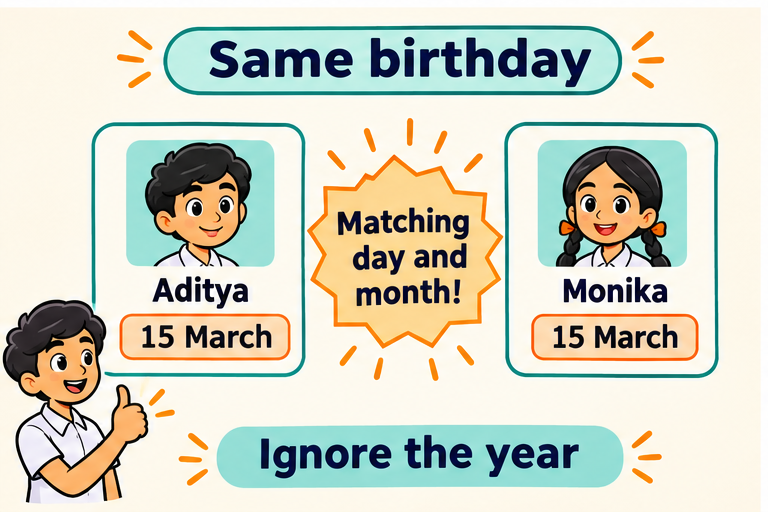
Trace the records, compare the methods and watch what changes. Back and Reset let you try again.
Ready
Choose Next step to follow the actual course records.
Start with Next step. Predict what changes before reading the explanation.
“Is there any matching pair?” needs a true/false answer. Stop once a real pair is found. “How many pairs match?” needs the whole scan. Finding the first pair is not a general way to count all the pairs. Changing the card order can change the first pair found and the work before early stopping, but not the complete set of matching pairs.
A student must never be matched with their own card. Remove X from the search or use a separate identity such as CardNo to exclude it. Names can repeat in a larger dataset, so an identifier is safer than a name for deciding whether two records represent the same student.
In a simplified model with 365 equally likely birthdays and independent people, 23 people already give a little over a 50% chance of at least one shared birthday. It is a probability, not a guarantee. The chance that somebody shares YOUR birthday is a different question. You do not need the probability formula to trace the search.
Three different students share one birthday. How many matching unordered pairs are there?
Three: A–B, A–C and B–C. There is one shared date, three students on that date, and three pairs. These are different counts.
May 15 and March 15: match or no match?
No match. Both day AND month must agree.
Can a class of 30 students have no shared birthday?
Yes. A likely event is not a certain event. The search must be able to return false after checking all eligible pairs.