
Heuristics: useful choices, limits and better bins
On this page 1 headings
A heuristic is a practical rule that tries to find a good answer with less search. It is not automatically an exact method or a proof of the best answer. The study-partner activity has many reasonable solutions because “good” depends on the goal.
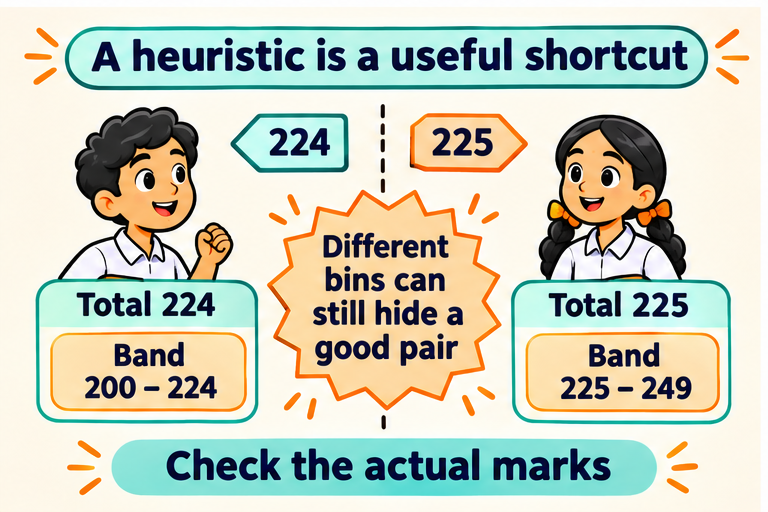
For exact birthday matching, different months cannot match, so excluding cross-month pairs is safe. For study partners, 224 and 225 are close totals but lie in different bands. Excluding that cross-band pair may lose a useful match. This is a major difference between safe pruning and heuristic pruning.
You can change band widths, compare neighbouring bands, try a Maths-plus-Physics subtotal, consider Chemistry, or reconsider earlier pairs. To create exclusive teams, remove or mark a student after assigning them and define a tie or choice policy. A greedy early choice can prevent another student from finding a partner. An optimal pairing requires a precise objective and may require a more involved search.
Equal width versus equal size
Marks may cluster in the middle, but do not assume every class follows a bell-shaped curve. Inspect this dataset. Narrower middle bands and wider edge bands can balance bin counts. Another option is to split a crowded bin as data arrives. Each extra preparation pass costs work but can reduce later candidate comparisons. Report the actual sizes and do not claim a guaranteed speedup.
Try it yourself
What makes a birthday month bin exact but a study-partner total bin heuristic?
Show explained answer
Different months mathematically rule out equal birthdays. Different total bands do not rule out a good study pair.
Try it yourself
Does a candidate list prove that everybody can be put into a distinct pair?
Show explained answer
No. Candidates can share students. Exclusive pairing is a separate assignment task, and some students may remain unpaired.
Try it yourself
How could you improve a very crowded central band?
Show explained answer
Split it into narrower ranges, then consider whether neighbouring-bin comparisons are needed for the goal. Measure the resulting group sizes and work.