
Ready to begin
Choose Next step to follow the actual course records.
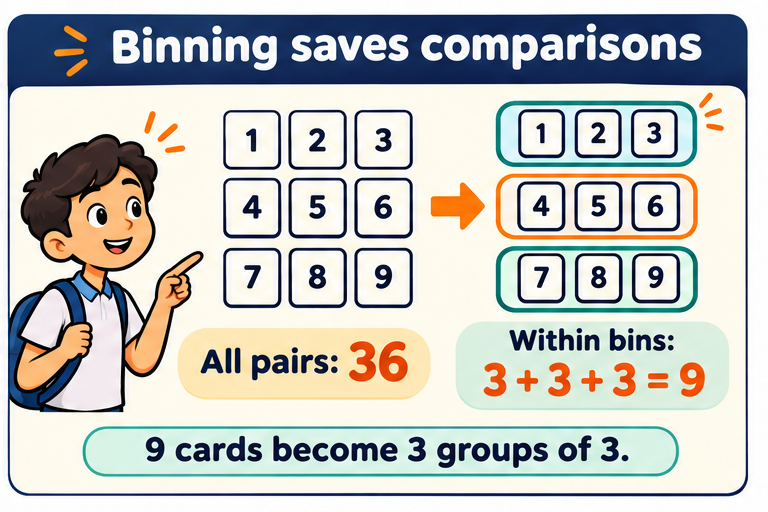
For a bin containing nᵢ items, the pair count is nᵢ(nᵢ−1)/2. Add that number over all bins. This works even when the bins are not the same size.
If k bins have exactly equal sizes n/k, the sum simplifies to n(n/k−1)/2. Compared with n(n−1)/2, the exact reduction factor is (n−1)/(n/k−1), provided the denominator is nonzero. This is about k for large bins. Equal-size formulas require equal counts, not merely equal-width ranges.
Trace the records, compare the methods and watch what changes. Back and Reset let you try again.
Ready
Choose Next step to follow the actual course records.
Start with Next step. Predict what changes before reading the explanation.
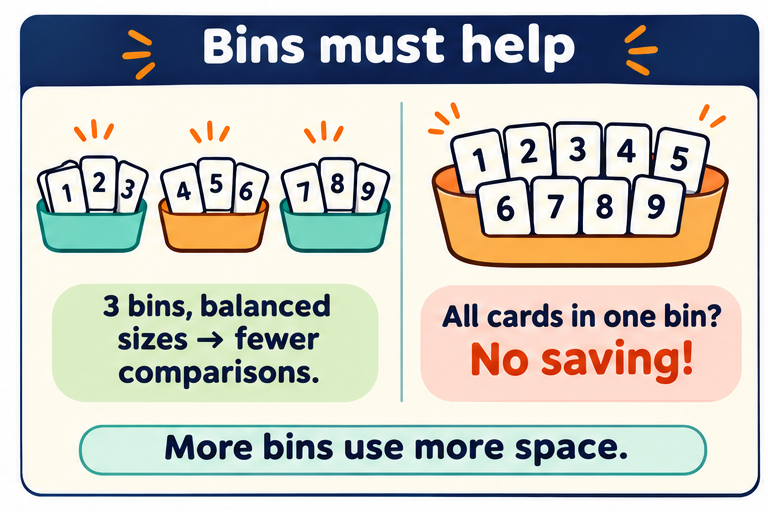
First, prove that excluded cross-bin pairs cannot matter for an exact search. Second, inspect the actual bin sizes: uneven distribution changes the saving. Third, include the cost of grouping and storage. Physical bins take desk space; computer bins take memory. Memory is large but not unlimited.
If every bin has at most one card, there are zero within-bin pair checks. Do not divide by zero to call the speedup a finite factor. You still had to read and place the cards. Creating thousands of empty bins may also waste space; using only bins that occur can be helpful.
Nine cards split into bins of 7, 1 and 1. How many pair checks remain?
7 × 6 ÷ 2 + 0 + 0 = 21. This is more than the 9 checks for three balanced bins of 3.
Does doubling the number of bins always halve the whole running time?
No. Some bins may be empty or crowded. Grouping, lookup and storage cost work too. The equal-size pair formula describes only a particular comparison pattern.
What does the time–space trade-off mean here?
Using more labelled groups can avoid repeated comparisons, but the groups require more storage or desk space.