
Ready to begin
Choose Next step to follow the actual course records.
Trace the records, compare the methods and watch what changes. Back and Reset let you try again.
Ready
Choose Next step to follow the actual course records.
Start with Next step. Predict what changes before reading the explanation.
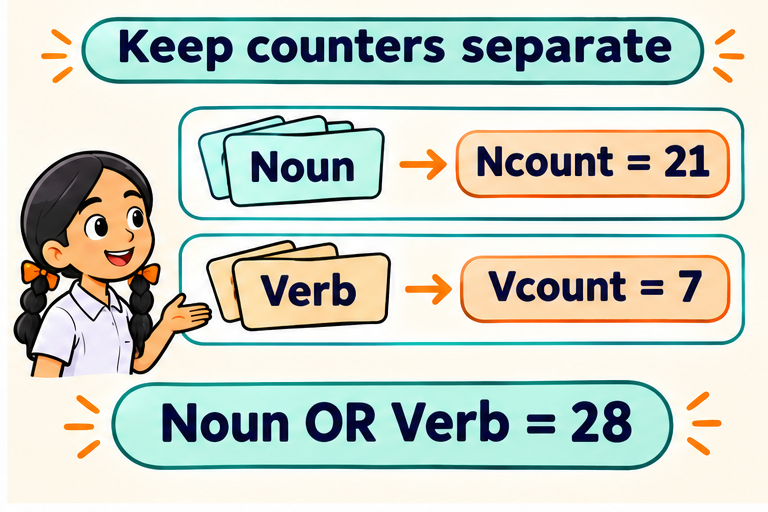
In these tagged word cards, an occurrence has one PartOfSpeech value, so Noun and Verb are mutually exclusive labels. Counting Noun OR Verb gives 28. Two separate IF statements that both increase the SAME Count also give 28 here because a card cannot pass both tests.
Ncount = 0
Vcount = 0
for each word card X:
    if X.PartOfSpeech == "Noun":
        Ncount = Ncount + 1
    if X.PartOfSpeech == "Verb":
        Vcount = Vcount + 1
# Ncount = 21, Vcount = 7
Now consider the wrong rewrite: IF Noun OR Verb, increase Ncount AND increase Vcount. Every noun then increases the verb counter, and every verb increases the noun counter. Both counters become 28. Keeping two counters means the updates must remain connected to the correct conditions.
These counts are word-card occurrences, not distinct spellings. A word may appear several times in the paragraph. In general English a spelling can have different grammatical roles in different sentences; our exclusivity claim is about the single label stored on each particular card.
Can Ncount = 28 and Vcount = 28 be the correct separate counts for these cards?
No. Those are the results of the incorrect combined-update block. Correct separate counts are 21 and 7.
Does “Noun OR Verb” require a card to be both?
No. Either label is enough. Requiring both would be AND, which no single label in this dataset satisfies.
Why does the separate-IF rewrite work for one combined count here but fail for Maths > 90 OR Physics > 90?
The noun/verb labels are mutually exclusive on a card. A student can pass both subject thresholds, creating overlap.