
Ready to begin
Choose Next step to follow the actual course records.
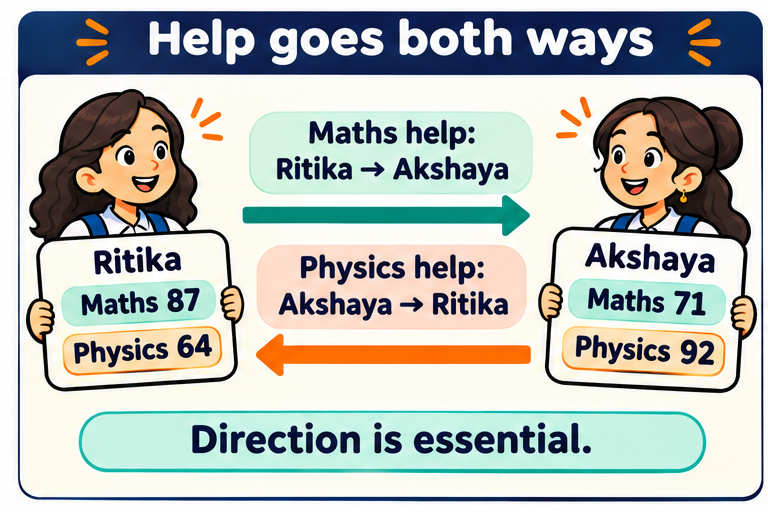
A useful study pair can help in both directions: one student has stronger Maths marks, while the other has stronger Physics marks. This is different from pairing the highest scorer with the lowest scorer so that help goes mostly one way. Define the goal before choosing the method.
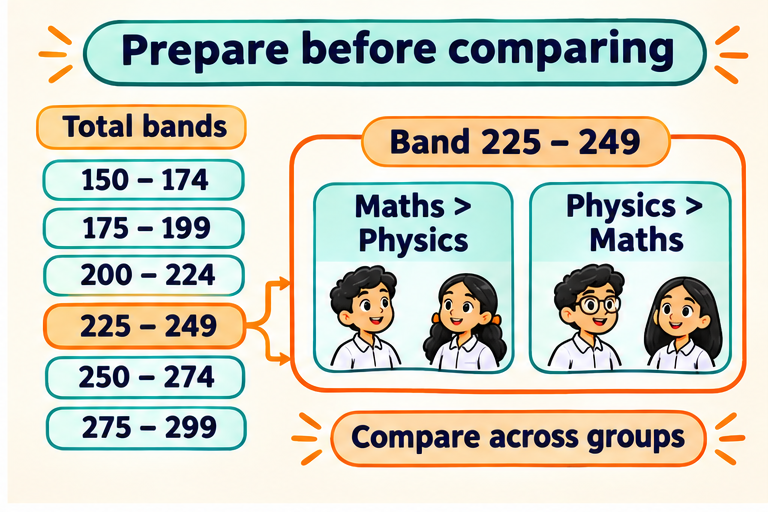
To reduce the search, first group students into total bands. We use 150–174, 175–199, 200–224, 225–249, 250–274 and 275–299. The endpoints do not overlap: 250 belongs to 250–274. The counts in these six bands are 2, 6, 9, 6, 5 and 2. Equal widths do not create equal numbers of students.
Trace the records, compare the methods and watch what changes. Back and Reset let you try again.
Ready
Choose Next step to follow the actual course records.
Start with Next step. Predict what changes before reading the explanation.
for each total band B:
    M = students in B with Mathematics > Physics
    P = students in B with Physics > Mathematics
    for each student X in M:
        for each student Y in P:
            if X.Mathematics > Y.Mathematics AND Y.Physics > X.Physics:
                report a candidate study pair
The two personal-strength groups are a shortcut to candidate generation. We still check X’s Maths against Y’s Maths and Y’s Physics against X’s Physics. A student with equal marks in both subjects goes into neither strict group. This does not mean they cannot have any useful partner.
With groups of a and b students, there are a × b cross-group candidate checks, not (a+b) squared. An 8-student group split into 4 and 4 needs 16 cross-group checks; all distinct unordered pairs among 8 would be 28. The complete walkthrough lists candidate pairs, so one student may appear more than once. It does not allocate exclusive teams.
Why can similar three-subject totals fail to imply complementary Maths and Physics?
Chemistry contributes to Total. Two students can reach a similar Total through very different Chemistry marks. Check the actual subject marks or use a Maths-plus-Physics subtotal for that goal.
Is a student with Maths 80 and Physics 75 automatically a good partner for one with Maths 70 and Physics 65?
No. The first student is higher in both subjects. That fails the goal of each student helping the other in a different subject.
Does the lecture’s choice to set aside the highest band mean high scorers never need help?
No. That was one choice in the classroom activity. High scorers may still benefit from peers. Our candidate explorer includes every band.