
Lists vs Arrays
Start here Binary search assumed we can jump straight to the middle item in one step. Is that always true? It depends on how the sequence is stored in memory. There are two basic ways — linked lists and arrays — and each is fast at different things. Algorithm analysis must take this into account.
Two ways to store a sequence
| (Linked) list | Array | |
|---|---|---|
| Size | Flexible — grows and shrinks easily | Fixed — decided in advance |
| Memory | Values scattered anywhere in memory, joined by links | One contiguous (continuous) block of memory |
| Jump to the i-th item | Slow: follow links one by one | Fast: compute its address directly |
| Insert / delete in the middle | Easy: change a couple of links | Expensive: shift many items |
Linked lists
A linked list is a chain of nodes. Each node holds:
- a value, and
- a link (pointer) to the next node.
The first node is the head; the last node is the tail, whose link is None (the end).
 head                                      tail
 [ v0 | •]→[ v1 | •]→[ v2 | •]→ ... →[ vn−1 | None ]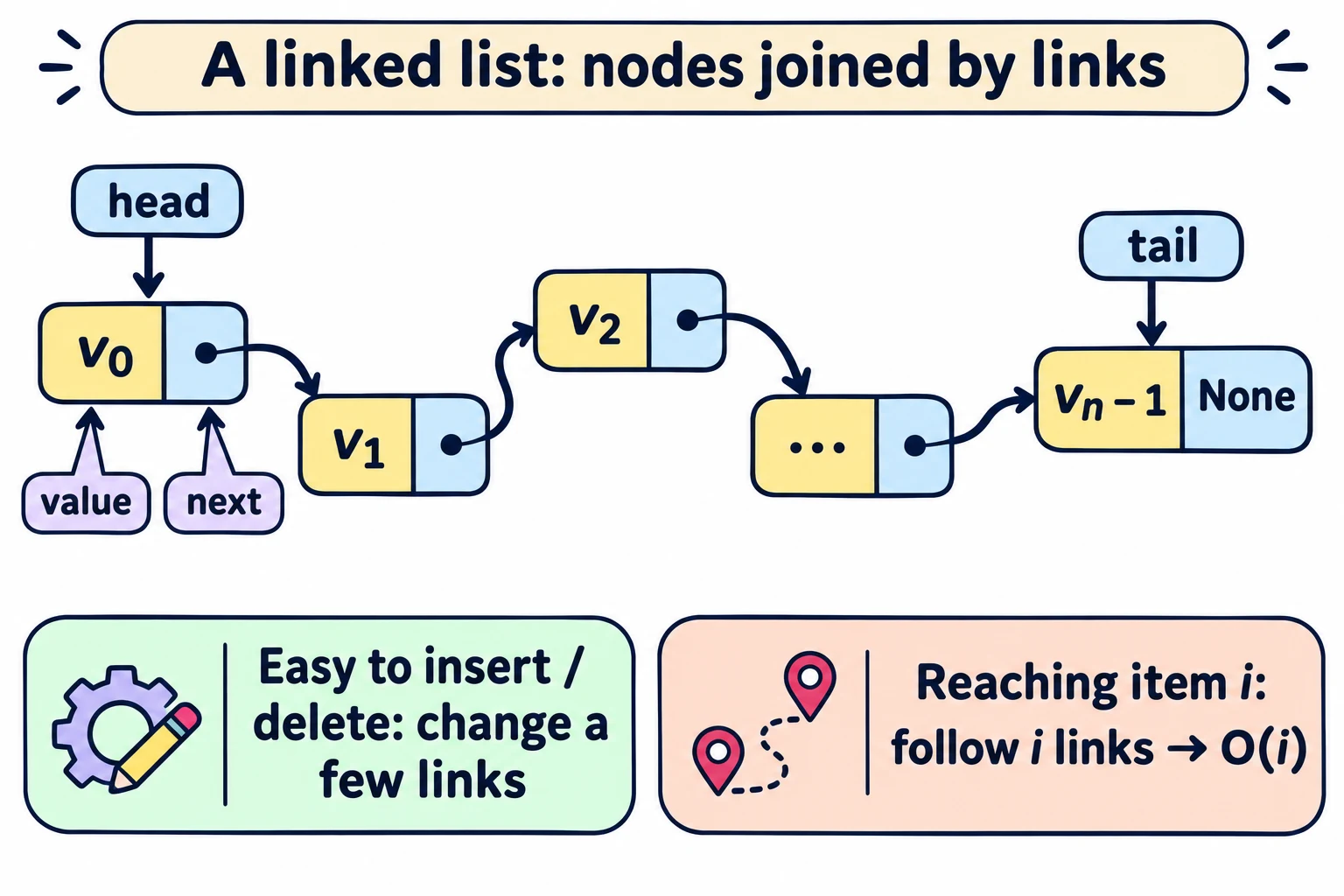
Everyday example: A treasure hunt. Each clue tells you where the next clue is. To reach clue number 7, you must visit clues 1 to 6 first.
Good:
- Flexible size.
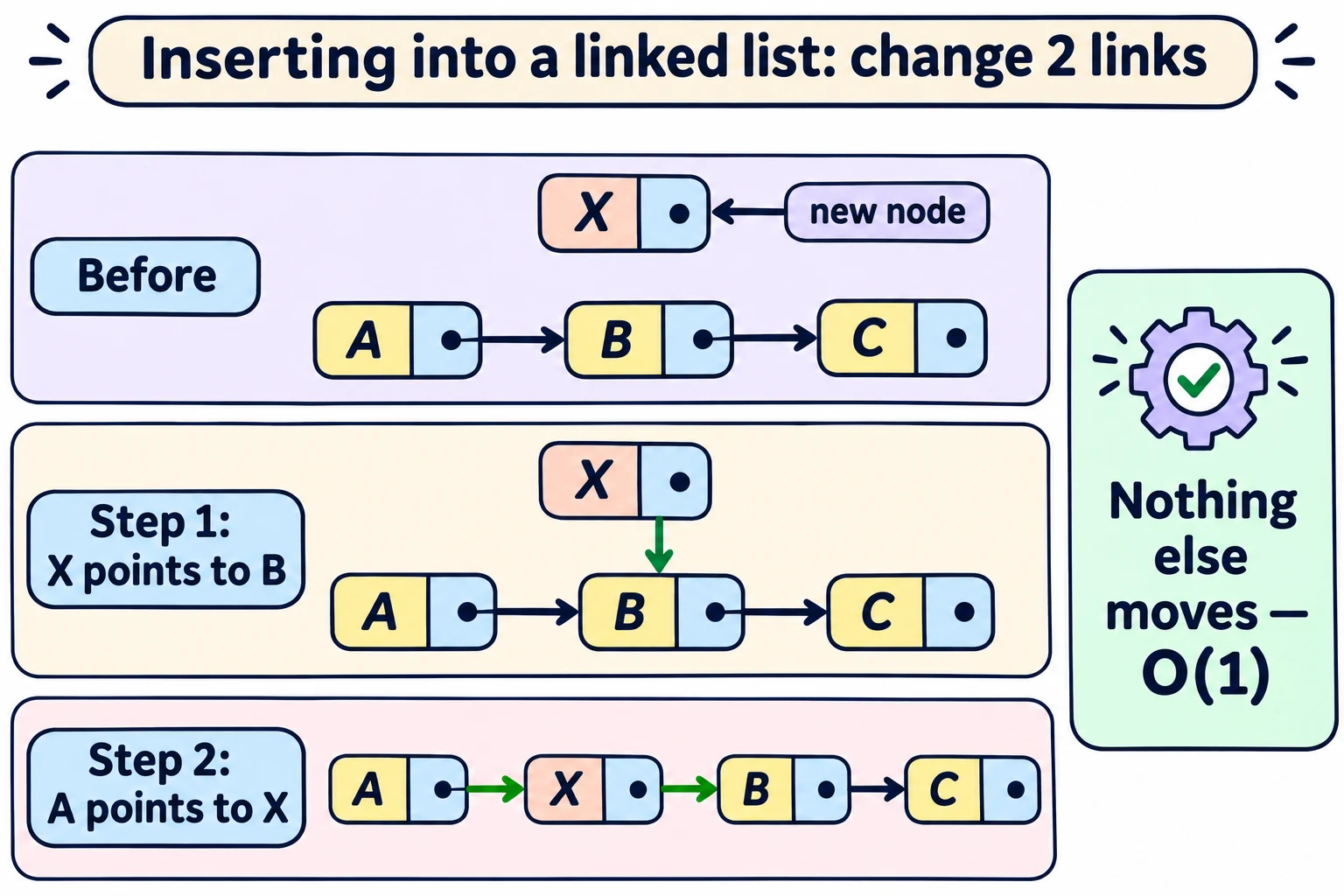
- Inserting and deleting are easy — just "re-plumb" the links locally. To insert X between A and B: make X point to B, then make A point to X.
Bad:
- To get A[i], you must follow i links from the head. That takes O(i) time.
Arrays
An array is one continuous block of memory with n equal-sized slots, declared in advance.
| Index | Value |
|---|---|
| A[0] | v₀ |
| A[1] | v₁ |
| ... | ... |
| A[i] | vᵢ |
| ... | ... |
| A[n−1] | vₙ₋₁ |
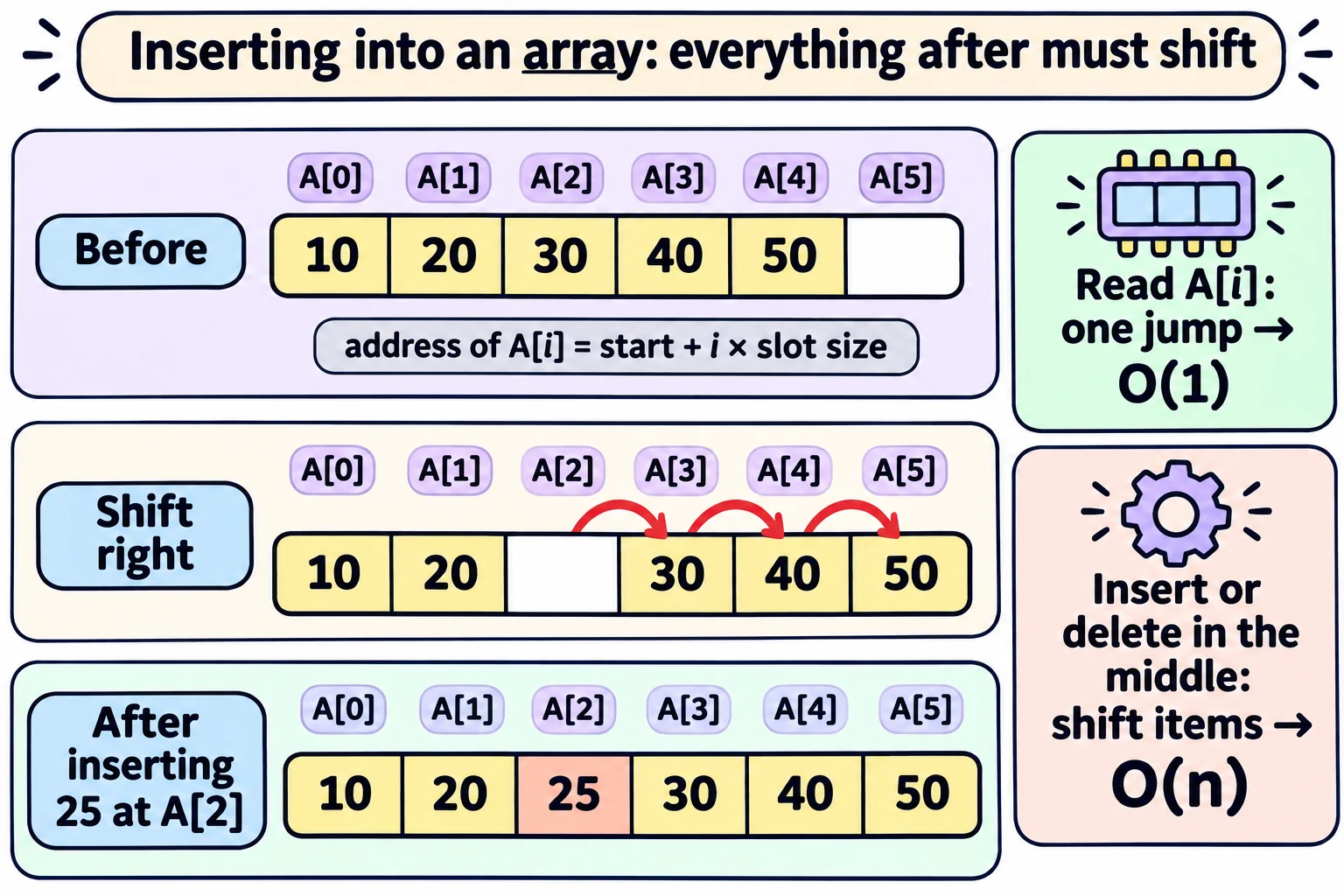
Random access: to find A[i], the computer calculates its address directly:
address of A[i] = address of A[0] + i × (size of one slot)
Example: A[0] is at memory address 1000 and each slot is 8 bytes. Then A[5] is at 1000 + 5 × 8 = 1040. One calculation — no need to visit A[0] to A[4].
So accessing A[i] takes constant time, O(1), no matter how big i is. ("Random" access means any position is equally fast.)
Everyday example: Houses on a street numbered in order with equal plot sizes. To reach house 57, you don't knock on houses 1 to 56 — you calculate where it is and walk straight there.
Bad:
- Fixed size. Growing beyond the block means getting a new, bigger block and copying everything.
- Inserting or deleting in the middle means shifting all the items after it — O(n) in the worst case.
Comparing the operations
| Operation | Array | Linked list |
|---|---|---|
| Read A[i] | O(1) | O(i) — follow i links |
| Exchange A[i] and A[j] | O(1) | O(n) — must first walk to both |
| Insert v after A[i] (already at A[i]) | O(n) — shift items | O(1) — change two links |
| Delete A[i] (already there) | O(n) — shift items back | O(1) — bypass one node |
| Grow / shrink | Expensive (copy to a new block) | Easy |
Why this matters — binary search insert
Can we use binary search to insert a value into a sorted sequence quickly?
| Stored as | Finding the position | Inserting there | Total |
|---|---|---|---|
| Array | Binary search: O(log n) ✔ | Shift items: O(n) ✘ | O(n) |
| Linked list | Can't jump to the middle: O(n) ✘ | Change links: O(1) ✔ | O(n) |
Either the search is slow or the insertion is slow — still O(n) either way.
Lesson: when analysing an algorithm, keep the implementation of the data structure in mind. "Binary search is O(log n)" is only true if you can reach the middle in O(1).
Coming up
- How does Python store its built-in
list? Is it really a linked list? (Spoiler: no — it's an array underneath.) - The NumPy library provides arrays — are they faster than lists?
In one line: Arrays give O(1) access by index but costly insert/delete; linked lists give cheap insert/delete but O(i) access — choose based on which operations you need most.
Exam words: sequence, linked list, node, value, next pointer, head, tail, array, contiguous memory, random access, offset, O(1) access, O(n) insert/delete, local plumbing.
Quick check
1. An array starts at address 2000 and each slot is 4 bytes. Where is A[10]?
2000 + 10 × 4 = 2040.2. How long does it take to read the 500th item of a linked list?
You must follow about 500 links from the head: O(i) → here about 500 steps.3. You need to insert and delete items in the middle very often, and rarely read by position. Array or linked list?
Linked list — insert/delete is O(1) once you are at the spot.4. You need to read items by position very often (like binary search). Array or linked list?
Array — O(1) access to any position.5. Why is swapping A[i] and A[j] O(n) for a linked list?
You first have to walk from the head to positions i and j, which can take up to n steps.Array Insertion playground
Move one step at a time. The visual state and explanation update together.
Make room at position 3.
Why? Arrays need contiguous positions, so later values must shift right.