
How Dictionaries Work — Hash Tables
Start here A list lets you find an item by its position (0, 1, 2, ...). A dictionary lets you find a value by any key — a name, a roll number, a word — and it is just as fast for every key. How? A dictionary is secretly an array, plus a clever function that turns any key into an array position. This is called a hash table.
Lists vs dictionaries
| List / array | Dictionary | |
|---|---|---|
| Access by | Position: l[3] | Key: d["Asha"] |
| Keys are | 0, 1, ..., n − 1 | Almost anything immutable: strings, numbers, tuples |
| Speed | O(1) | O(1) on average — the same for all keys ("random access") |
A dictionary is a collection of key–value pairs, like {"Asha": 85, "Ravi": 72}.
The idea: turn keys into positions
The storage underneath is an array. Given a position i, we can reach A[i] in constant time. So we only need a way to convert any key into a position in 0, 1, ..., n − 1.
That converter is a hash function.
Hash function h : S → X maps a big set of possible keys S to a small range of integers X = {0, 1, ..., n − 1}.
A toy hash function — worked example
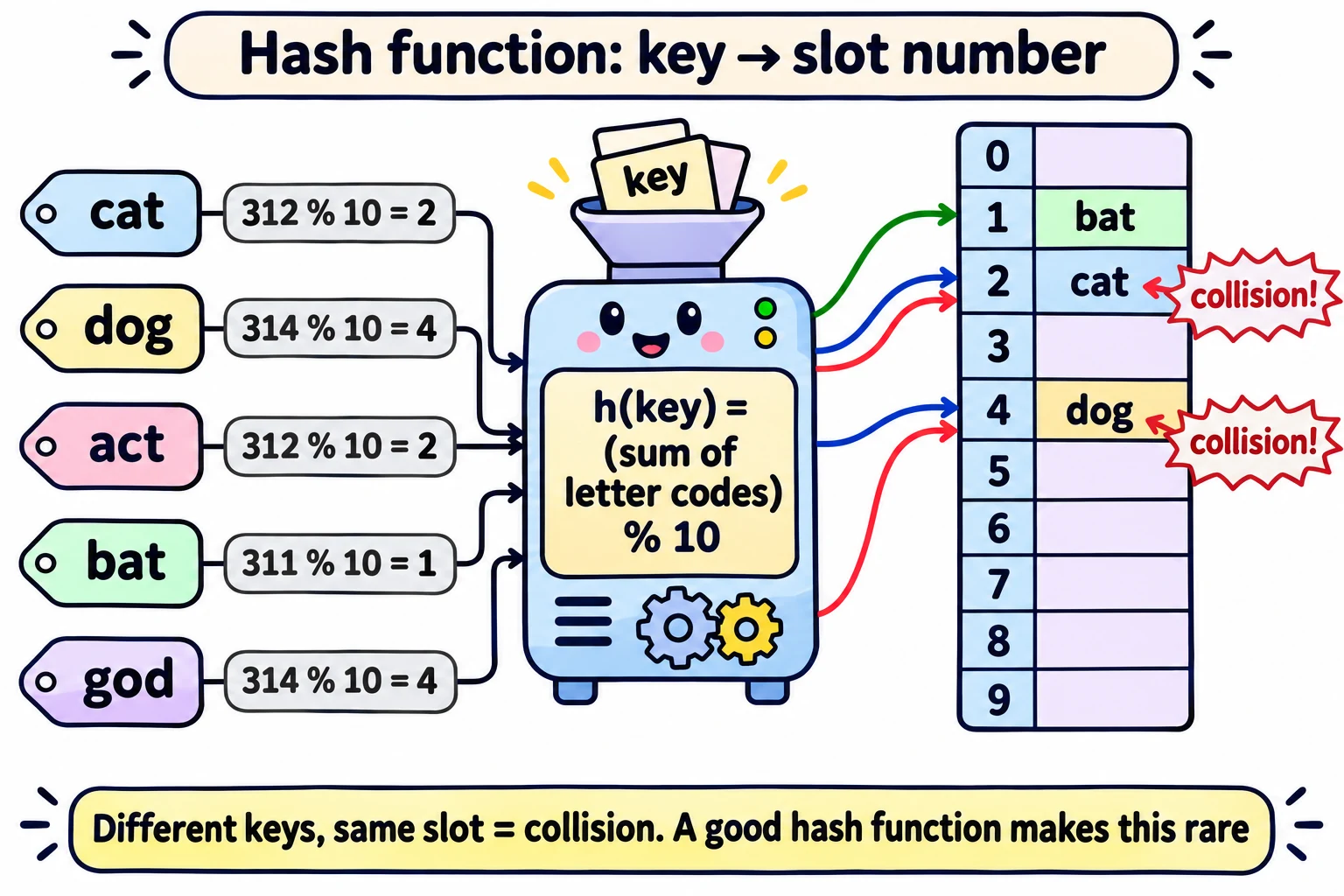
Let's use a table of size n = 10 and this hash function: add up the character codes of the key, then take the remainder when divided by 10.
(Each character has a number code: 'a' = 97, 'b' = 98, 'c' = 99, 'd' = 100, 'g' = 103, 'o' = 111, 't' = 116.)
| Key | Character codes | Sum | Sum % 10 = h(key) |
|---|---|---|---|
| "cat" | 99 + 97 + 116 | 312 | 2 |
| "dog" | 100 + 111 + 103 | 314 | 4 |
| "act" | 97 + 99 + 116 | 312 | 2 ← same as "cat"! |
| "bat" | 98 + 97 + 116 | 311 | 1 |
| "god" | 103 + 111 + 100 | 314 | 4 ← same as "dog"! |
So "cat" goes to slot 2, "dog" to slot 4, "bat" to slot 1. But "act" also wants slot 2, and "god" also wants slot 4.
Collisions
There are far more possible keys than slots (|X| is much smaller than |S|), so two different keys will sometimes get the same position:
Collision: h(s) = h(s′) even though s ≠ s′.
A good hash function spreads keys out evenly to make collisions rare. (Our toy function is bad: any two words with the same letters, like "cat" and "act", always collide.) Collisions can't be avoided completely, so we need a plan to handle them.
Two ways to handle collisions
1. Open addressing (also called closed hashing)
Everything stays inside the same array. If the slot is taken, probe (try) other slots in a fixed sequence until a free one is found. The simplest sequence is "try the next slot": h, h+1, h+2, ... (wrapping around at the end). This is called linear probing.
Inserting cat, dog, act, bat, god in that order:
| Key | h(key) | Slots tried | Stored at |
|---|---|---|---|
| cat | 2 | 2 | 2 |
| dog | 4 | 4 | 4 |
| act | 2 | 2 (taken), 3 | 3 |
| bat | 1 | 1 | 1 |
| god | 4 | 4 (taken), 5 | 5 |
Final array (slots 0–9): [ —, bat, cat, act, dog, god, —, —, —, — ]
2. Open hashing (also called chaining)
Each slot of the array points to a list of key–value pairs. On a collision, just add to that slot's list.
| Slot | List stored there |
|---|---|
| 1 | bat |
| 2 | cat → act |
| 4 | dog → god |
| others | (empty) |
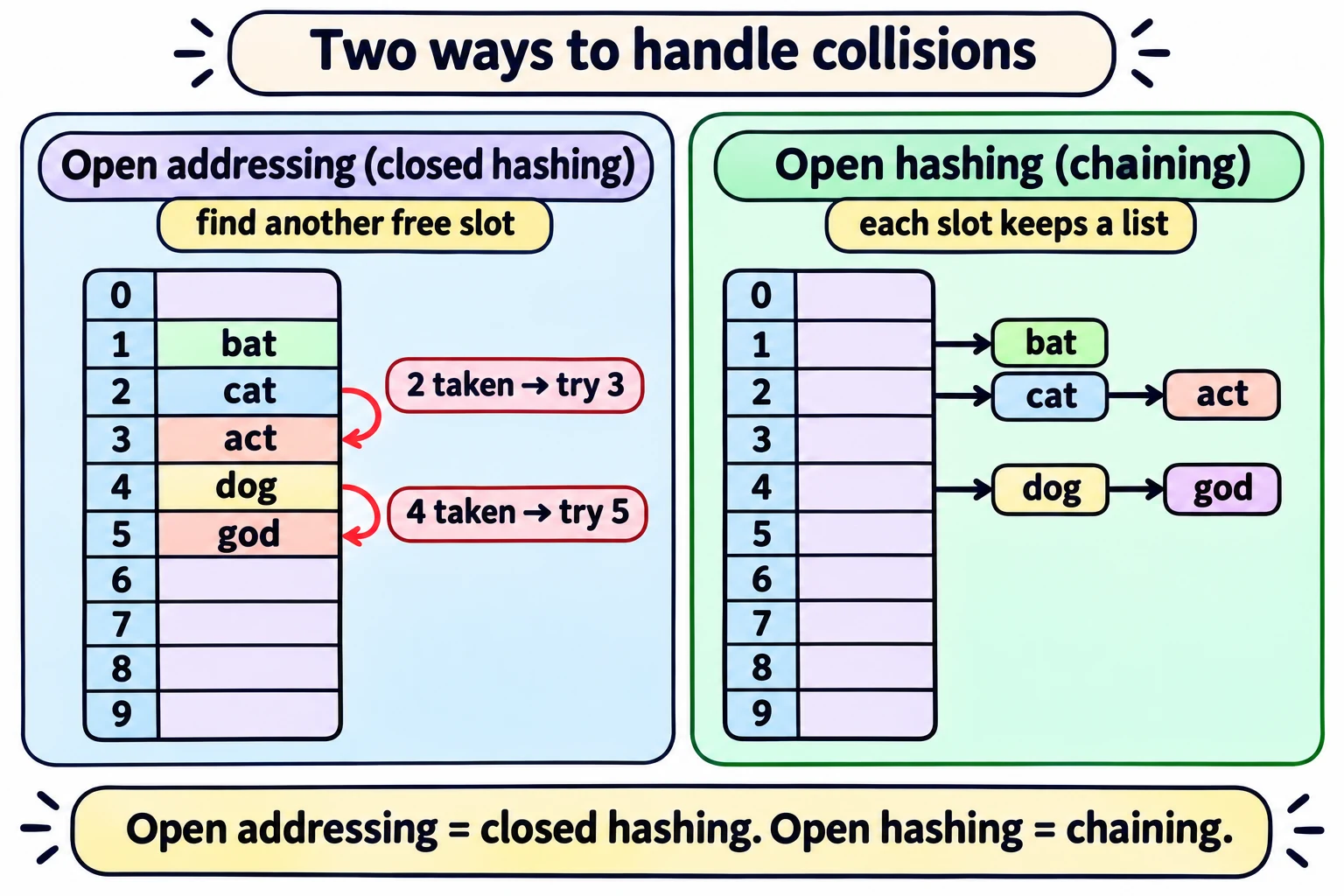
(Yes, the names are confusing: open addressing = closed hashing; open hashing = chaining. Learn them as pairs.)
| Open addressing (closed hashing) | Open hashing (chaining) | |
|---|---|---|
| Where collided keys go | Another free slot in the same array | Into a list hanging off the same slot |
| Extra memory | None beyond the array | Lists at each slot |
| When the table gets full | Probing gets long; must grow the table | Lists get long; must grow the table |
Why dictionary keys must be immutable
The position of a key is computed from the key itself. If a key could change after it was stored, its hash would change too — and the dictionary would look in the wrong slot and never find it.
So Python only allows immutable keys: numbers, strings, tuples. Lists can't be keys:
d = {[1, 2]: 3}
# TypeError: unhashable type: 'list'

d = {(1, 2): 3}      # a tuple is fine
Hashing in the real world — SHA-256
SHA-256 is an industry-standard hash function. Its output is 256 bits long (usually written as 64 hexadecimal characters). Even a tiny change in the input gives a completely different hash.
Use: cloud storage services hash large files to avoid storing duplicates. If the hash of your file matches a file already stored, there is no need to upload it again.
In one line: A dictionary is a hash table — an array plus a hash function that turns keys into positions; collisions are handled by probing for another slot (open addressing) or by keeping a list at each slot (chaining).
Exam words: dictionary, key–value pair, hash function, hash table, collision, open addressing (closed hashing), probing, linear probing, open hashing (chaining), immutable keys, unhashable, SHA-256.
Quick check
1. Using the toy hash (sum of codes % 10), where does "tab" go? Does it collide with anything above?
t + a + b = 116 + 97 + 98 = 311 → slot 1. It collides with "bat" (same letters).2. With linear probing, the table has slots 3, 4 and 5 full. A new key hashes to 3. Where does it go?
Try 3 (full), 4 (full), 5 (full), 6 → stored at slot 6.3. Which name means "each slot holds a list of key–value pairs"?
Open hashing (chaining).4. Why can't a list be a dictionary key, but a tuple can?
A list can change (mutable), which would change its hash and lose the entry. A tuple can't change (immutable), so its hash is stable.5. What makes a hash function "good"?
It spreads keys evenly over the slots, so collisions are rare (and it's fast to compute).Hash Table Insertion playground
Move one step at a time. The visual state and explanation update together.
Turn each letter in “cat” into a number.
Why? A hash function converts a key into a repeatable number.