
Ready to begin
No records have been processed. Start with Next step.
Practise the same ideas with the original word cards and shopping bills. These are new questions on familiar data, so you can focus on the procedure rather than learning a new dataset.
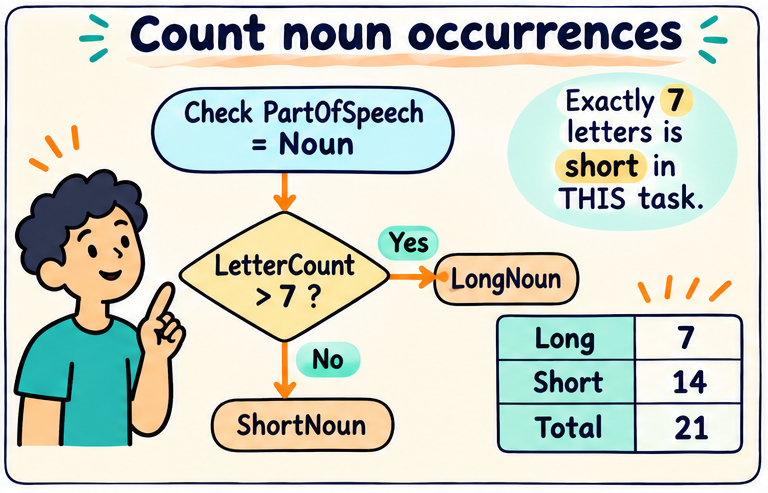
LongNoun = 0; ShortNoun = 0
for each row X in Words {
    if (X.PartOfSpeech == "Noun") {
        if (X.LetterCount > 7) { LongNoun = LongNoun + 1 }
        else { ShortNoun = ShortNoun + 1 }
    }
}Read the current record, check the explanation, and watch the variables. Use Back to revisit any step.
Ready
No records have been processed. Start with Next step.
Start at the first step. Watch the current row and the values we remember.
The result is 7 long noun occurrences and 14 short noun occurrences:21 nouns in total. Non-nouns increase neither counter. Notice that “short” here means 7 or fewer; this task uses a different definition from the hypothesis lesson’s 5-or-fewer rule.
Read the current record, check the explanation, and watch the variables. Use Back to revisit any step.
Ready
No records have been processed. Start with Next step.
Start at the first step. Watch the current row and the values we remember.
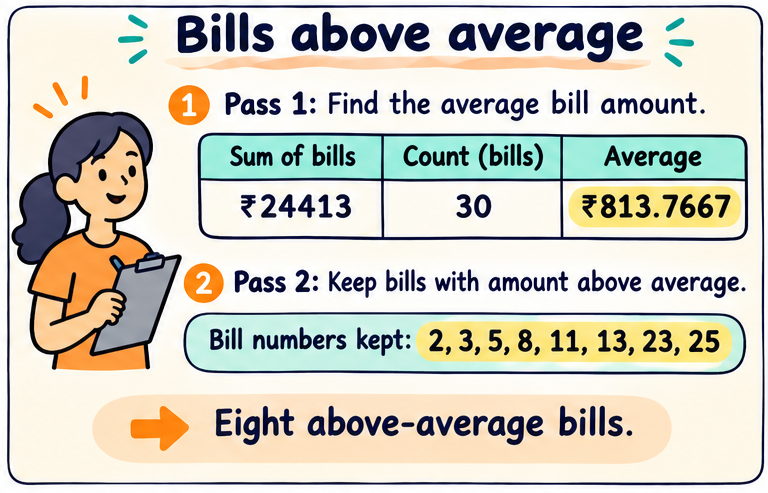
All 30 amounts total₹24,413. Average=24413/30≈₹813.7667. The 8 above-average BillNo values are 2,3,5,8,11,13,23,25. Use the unrounded average for comparisons.
Read the current record, check the explanation, and watch the variables. Use Back to revisit any step.
Ready
No records have been processed. Start with Next step.
Start at the first step. Watch the current row and the values we remember.
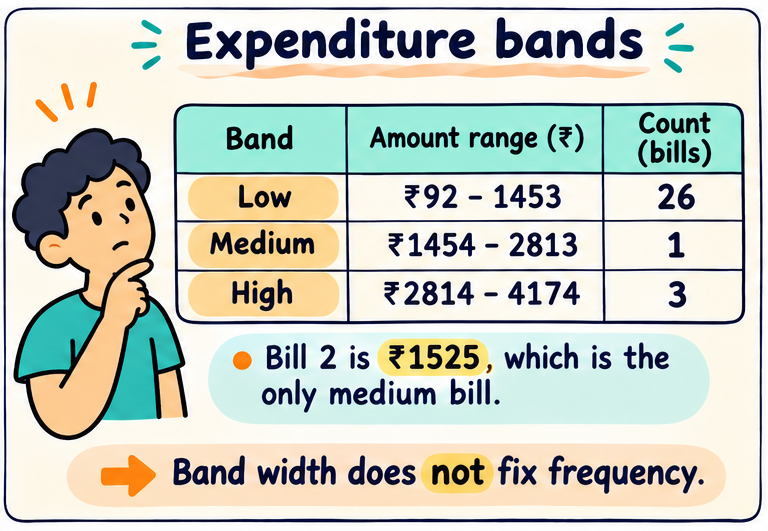
| Tutorial band | Inclusive rupee bounds | Count |
|---|---|---|
| Low | 92–1453 | 26 |
| Medium | 1454–2813 | 1 |
| High | 2814–4174 | 3 |
The numerical width is(4174−92)/3≈1360.6667. The tutorial rounds cut points to define the integer bands above. Specify those bounds explicitly; they are the convention used here. Real bills can include paise, so a general solution would use continuous bounds or integer paise rather than leaving fractional amounts between integer bands.
A guessed huge initial Minimum is only safe with a guaranteed bound. Initializing Minimum and Maximum from the first actual bill avoids assuming that no larger bill can ever occur. Handle an empty dataset separately.
Does a noun with 7 letters count as long here?
No. The condition is strictly greater than 7, so it is short in this tutorial.
What is LongNoun+ShortNoun?
7+14=21 noun occurrences.
How many bills exceed the final average?
8 bills.
Which BillNo is the only medium-expenditure bill?
Bill 2, for₹1,525.
Do three expenditure bands contain ten bills each?
No. They have 26 low,1 medium and 3 high bills.