
Ready to begin
No records have been processed. Start with Next step.
A procedure may return the right sum and still change the data arrangement. That extra change is called a side effect. To use the procedure safely, the caller must know what happens to its input.
SumMarks(Gender,Field) assumes a particular deck already exists. To reuse it for another class, also pass the dataset: SumMarks(Deck,Gender,Field). State whether the procedure may consume, reorder or edit that deck.
Read the current record, check the explanation, and watch the variables. Use Back to revisit any step.
Ready
No records have been processed. Start with Next step.
Start at the first step. Watch the current row and the values we remember.
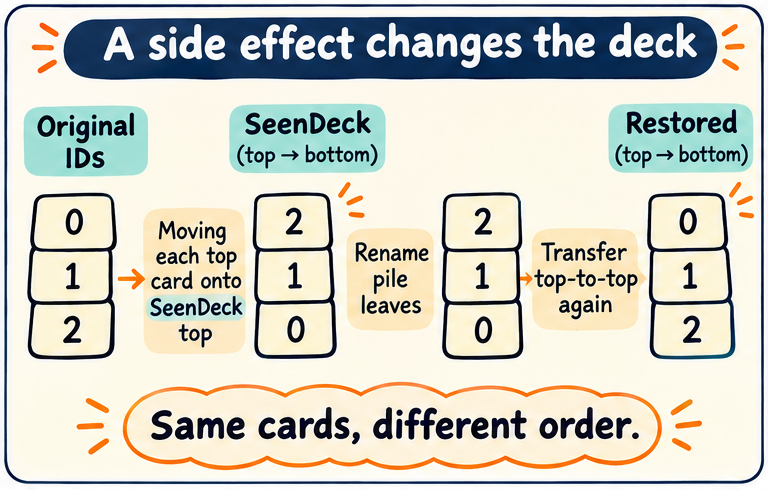
Start with top-to-bottom IDs 0,1,2. Move each top card onto the top of SeenDeck: the new top-to-bottom order is 2,1,0. Renaming SeenDeck as Deck gives every card back, but in reverse order. A second top-to-top transfer reverses it again and restores 0,1,2.
For a sum, order does not change the answer: 68+62 equals 62+68. However, leaving the original deck empty breaks a later call unless the interface explicitly says it consumes the deck. In the lab, compare “Move cards back one at a time” with “Rename the seen pile”. Both retain the marks sum 2,171, but only the former restores sequence.
UpdateMarks(CardNo,Field,NewValue) may be called as a statement because its purpose is to change a record. If a mark changes, keep the stored Total consistent too. Sorting also intentionally changes order; for such a procedure the change is its goal, not an unwanted surprise.
Can a correct sum hide an unwanted side effect?
Yes. The sum can be correct while the input deck is emptied or reordered.
What order results from moving 0,1,2 top-to-top into a new pile?
2,1,0, read top-to-bottom.
Does renaming a reversed pile restore sequence?
No. It returns the cards but preserves the reversed sequence.
Why pass Deck as an argument?
So the same procedure can work on different datasets rather than one hidden fixed pile.
Is reordering always a bug?
No. Sorting intentionally reorders data. Whether a change is acceptable depends on the contract.